
Writer of detailed lesson plans
You write and revise a lot of text and want to know whether the feel of the keys, the layout and the editing keys suit you.


If you mainly write and edit lengthy lesson plans, start with a familiar layout and keys that feel comfortable to type on. Choose a more compact keyboard if you want to keep space for your mouse and papers. Give quiet typing or switching between devices extra weight only if you’ll actually use those features, and check the layout, connection and available space for the exact model. A different keyboard won’t replace a well-arranged workstation or regular breaks from screen-based work.
You write and revise a lot of text and want to know whether the feel of the keys, the layout and the editing keys suit you.
You switch between typing, using your mouse and working with printed lesson materials, and want enough room to keep everything close at hand.
For example, you type on both a computer and a tablet, and want to weigh up whether switching between devices is more useful than a fixed connection.
When planning lessons at home, your choice often comes down to the keyboard layout, desk space, noise and connection. Decide which of these matters most for the way you work every day.
| What to consider | What to look for | Who should give this more weight? |
|---|---|---|
| Keyboard layout and text editing | Compare the physical layout and position of the editing keys; consider whether you need a numeric keypad. | I write a lot of lesson plans and want familiar letters, punctuation and editing keys. Around 36% of consumers put text entry and editing first. |
| Desk space and hand position | Measure the space available for your keyboard, mouse and papers; consider whether you can manage without a numeric keypad. | I want to keep my mouse and lesson materials within reach without the keyboard taking up too much of my work surface. Around 29% of consumers put space and hand position first. |
| Quiet typing | Look for information about the noise made by the exact model and consider how the keys feel; don’t assume a keyboard is quiet based on its appearance alone. | I sometimes type while other people are working nearby and want to take the sound of my keys into account. Around 21% of consumers prioritise a quiet home-working space. |
| Connection and switching between devices | Check the operating system, the USB port or wireless connection required, and the physical layout of the model. | I use several devices and want to know whether I can switch between them without losing sight of how the keyboard connects. Around 14% of consumers put switching between devices first. |
A full-size layout includes a numeric keypad, but takes up more width. A narrower keyboard can free up space and let you position your mouse closer to you; RTINGS describes this as a potential benefit of more compact models.
Measure the space for your keyboard, mouse and lesson materials first, then weigh it against your need for a numeric keypad.
The position of letters and symbols can vary between national layouts. The version you choose may therefore feel different from what you expect, especially when it comes to punctuation you use often.
Check the images and the variant code for the exact model before ordering.
Your screen, mouse and work surface set-up, as well as varying your tasks, also matter when working at a screen.
Consider the keyboard as part of your whole workstation and take regular breaks from screen-based work.
The MX Keys S is worth considering if you’re looking for a full-size wireless keyboard with backlighting and the option to switch between devices.
The KC 6000 SLIM is a full-size scissor-switch keyboard for a workstation with a USB-A port.
The compact Lyra is worth considering if you want to save space for your mouse and genuinely switch between devices.
The B1 Pro ISO collection offers a compact keyboard with several connection options and customisable keys.
This selection includes keyboards for planning lessons at home, with both full-size and compact layouts and a range of connection options.
 No image available
Suited to lesson plans with lots of text and number entry if you’re looking for a full-size layout with a numeric keypad.
Wired and plug-and-play, with a QWERTY layout, full-size design and black finish.
 No image available
Could suit a fixed workstation if you’re looking for a mechanical keyboard with a 94-key layout.
Metal casing, phone stand and wrist rest.
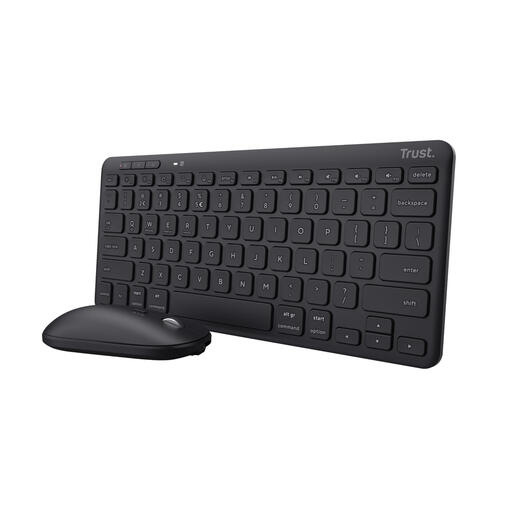 No image available
Suited to a smaller desk if you’re looking for a compact keyboard and mouse set.
Multi-device and rechargeable, with a US QWERTY layout. Check whether you can work without a separate numeric keypad.
 No image available
Suited to lesson plans with lots of text and number entry if you want a full-size keyboard with a numeric keypad.
Scissor keys and a US QWERTY layout. Check whether this physical layout suits your preference.
 No image available
Could be suitable if you’re looking for a Dutch QWERTY model for writing and editing lesson plans.
The product name lists USB + Bluetooth and a black finish. Check which connection is compatible with your device.
For employees who work at a screen for more than two hours a day, Arboportaal describes a requirement for the screen and keyboard not to be attached to each other. When using a laptop, it must therefore be possible to use a separate screen or keyboard. This is a conditional workstation requirement, not a requirement for every private buyer. Make sure the rest of your workstation is set up appropriately too, and take regular breaks from screen-based work.
First check the ports and operating system on your computer. CHERRY lists Windows and USB-A for the KC 6000 SLIM, while Trust lists a USB receiver and Bluetooth for the Lyra. Then choose the physical keyboard layout you want to use.
No. Consider your screen, mouse, posture and the variety of tasks you do as well. Arboportaal recommends a relaxed posture and changing position regularly; the shape of a keyboard alone can’t guarantee that you won’t experience discomfort.
When you buy as a consumer, you’re entitled to a product that conforms to the contract. According to the Dutch government, there’s no fixed statutory guarantee period in the Netherlands that applies to all products. For online purchases from a business, a 14-day cooling-off period applies in many cases. A manufacturer’s guarantee is separate from your statutory rights; if a product is faulty, contact the seller.