If you want to learn a melody on your own, choose a keyboard with learning features, touch-sensitive keys and enough range for your arrangement. For practising in a shared studio, a headphone socket may be more important, while automatic accompaniment is useful if you also want to play rhythms and chords. Check the connections, power supply and accessories included with the version you’re considering, too.
Who is this keyboard suitable for?
Beginner learning a melody
Want to learn the tune note by note and practise your timing and touch? Compare the learning features and check that the keyboard’s range suits your arrangement. Yamaha and Roland describe learning features for their models.
Practising in a shared studio
Want to avoid using the built-in speakers when other people are using the room? Check whether the keyboard has a headphone socket and whether your headphone plug will fit.
Player who wants to practise with accompaniment
Want to combine a melody with chords or rhythm? Look at the accompaniment styles and controls, rather than comparing only the number of sounds. Yamaha, Roland and Korg describe automatic accompaniment features on the models mentioned here.
What should you look for when choosing?
First decide whether you mainly want to learn the melody, practise quietly, play with accompaniment or move the keyboard frequently. This will help you compare the features that really matter for your practice space.
| What to consider |
What to look for |
Who is it important for? |
| Learning melody and timing |
Compare the learning features and keyboard range with your sheet music. Yamaha lists 61 touch-sensitive keys and Keys to Success for the PSR-E383; Roland describes lessons for built-in songs and a metronome for the E-X10. |
If you want to practise note by note and build your timing, prioritise learning features and a suitable keyboard range; around 39% of consumers prioritise learning a melody. |
| Practising with headphones |
Check the connections on the exact model and make sure your headphone plug fits. Korg lists a 3.5 mm headphone socket for the EK-50. |
If you practise in a shared studio, you’ll want to be able to avoid using the speakers; around 23% of consumers prioritise practising quietly. |
| Rhythm and chords |
Check that the accompaniment style and chord controls suit your tune. Yamaha lists 260 accompaniment styles for the PSR-E383, Roland describes left-hand control for the E-X10, and Korg lists Styles for the EK-50. |
If you want to add rhythm or chords to the melody, focus on finding a suitable style and controls; around 23% of consumers give accompaniment top priority. |
| Space and transport |
Measure the available space and check which power supply and accessories are included with the version you choose. Casio lists dimensions of 930 × 256 × 73 mm and a weight of 3.3 kg for the CT-S300; Korg lists dimensions of 994 × 392 × 132 mm and a weight of 7.5 kg for the EK-50, excluding the music rest and batteries. |
If you have limited space or want to move the instrument, its dimensions and weight are key; around 15% of consumers prioritise space and portability. |
Common buying mistakes
-
Assuming a built-in lesson covers your tune
Yamaha and Roland’s learning features are linked to built-in songs. That doesn’t mean every festive tune you choose will be available.
Check the song list and practice method before making learning features a major factor in your decision. If the song isn’t included in the material, you may need sheet music or another way to learn it.
-
Comparing only the number of sounds or styles
An accompaniment style is only useful if its rhythm and chord controls suit your arrangement.
Check how to control the accompaniment and whether a suitable style is available for the tune you want to practise.
-
Not measuring your complete studio set-up
The instrument’s dimensions alone don’t tell you how much space the music rest, cables and playing area will take up together.
Measure the available space and check the connections and what’s included with the version you choose. You may also need a stand or suitable headphones.
Brands to compare
Yamaha
The PSR-E383 is worth considering if you want to practise melodies with learning features and automatic accompaniment. Yamaha describes the PSR-EW320 as an alternative with 76 touch-sensitive keys.
- Yamaha lists 61 touch-sensitive keys, Keys to Success and 260 accompaniment styles for the PSR-E383.
- The specifications don’t confirm that your tune is included in the learning material, so check separately.
Casio
The CT-S300 is worth a look if portability and touch response are important to you.
- Casio lists dimensions of 930 × 256 × 73 mm, a weight of 3.3 kg and touch response for this model.
- Dance Music mode doesn’t confirm that a style will suit your tune, so check that the model has the learning features you need.
Roland
The E-X10 is an option to compare if you want to combine built-in lessons with automatic accompaniment.
- Roland describes lessons for built-in songs, a metronome and accompaniment controlled with the left hand.
- These features don’t confirm that your specific song is built in.
Korg
The EK-50 is an accompaniment-focused model to compare if styles and audio connections matter to you.
- Korg lists more than 280 styles, a headphone socket and separate L/mono and R outputs.
- The listed weight is 7.5 kg, excluding the music rest and batteries. Check that it suits how you plan to move the keyboard.
Keyboard picks at Joybuy
These keyboards are suited to practising with a learning mode, rhythms or a headphone socket. Check that the features and accessories included with each version suit your practice plan.
 No image available
MLS-931 digital piano, 61 keys, black
The listed rhythms and headphone socket make it suitable for practising with accompaniment or in a shared space.
The product name lists 61 keys, 300 sounds, 300 rhythms, weighted keys, an LCD screen, USB-MIDI, speakers and a headphone socket.
View at Joybuy
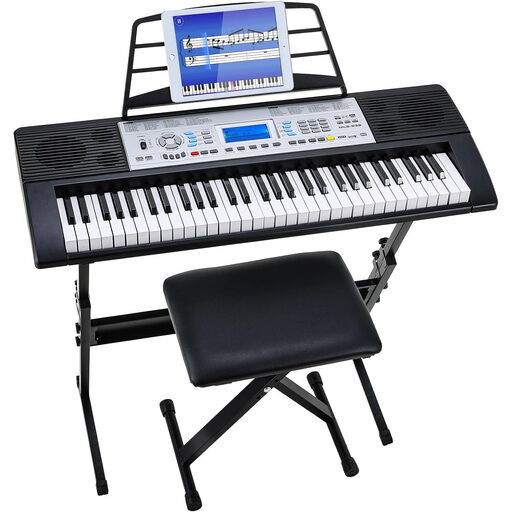 No image available
Digital keyboard, 61 keys, with stand and stool
The listed learning mode may be suitable if you want to practise a melody on your own; check what kind of practice support it offers.
The product name lists 61 keys, 500 sounds, a 3-level learning mode, dual speakers, an LCD screen, a stand and a stool.
View at Joybuy
Frequently asked questions
Can I learn any festive tune with the built-in learning feature?
Not necessarily. Yamaha lists built-in songs and learning features for the PSR-E383; Roland describes lessons for built-in songs on the E-X10. Check whether your song is available, or practise using your own sheet music.
What should you check before connecting the keyboard in the practice studio?
Check the connections and power supply for the exact model. Korg lists a 3.5 mm headphone socket and separate audio outputs for the EK-50. Yamaha specifies that you should use the supplied or specified adapter for the PSR-E383.
How should you use and clean the instrument according to the safety instructions?
Follow your model’s manual. Yamaha warns against listening at a high or uncomfortable volume for long periods and says to unplug the instrument before cleaning it.
What are your rights when buying online or if a product is faulty?
For online purchases from a business, you generally have 14 days to change your mind; check whether an exception applies. The Government of the Netherlands states that there is no fixed statutory warranty period in the Netherlands. If a product is faulty, the seller must provide a solution.
Is CE marking an additional quality mark?
No. According to the European Union, CE marking is only required for products covered by EU rules that specifically require it; it is not an independent quality assessment. Check the marking and product information for the specific model being offered.


