What should you look for when choosing?
When programming and debugging a knitting counter, your choice mainly depends on key access, available desk space, hand position and the connection you need.
| What to consider |
What should you check? |
Who is this important for? |
| Key access |
Check the physical function-key row, Fn setting and position of programming symbols. In Visual Studio Code, F5 and F9 start the debugger and set a breakpoint by default, respectively (Microsoft, Visual Studio Code). |
If I want quick access to F keys and programming symbols while debugging, how easy they are to reach matters most. Around 31% of consumers give key access top priority. |
| Desk space |
Measure the available width and decide whether you need an integrated numeric keypad for your knitting counter. |
If I want to leave room for my mouse and enter few numbers, a compact model may suit my workspace better. Around 25% of consumers prioritise desk space. |
| Hand position |
Check whether there is room for both keyboard halves and your mouse, and allow time to get used to a split layout. |
If I want to position my hands independently during longer typing sessions, a split design is worth comparing. Around 25% of consumers give hand position top priority. |
| Connection and devices |
Check which connection is required, whether wireless options are available and whether settings require software. |
If I work on several computers or want a fixed wired connection, the connection needs to suit my devices. Around 19% of consumers prioritise the connection or switching between devices. |
Joybuy products
This selection includes keyboards with a numeric keypad and compact 75% models with function keys, to compare for number entry, debugger shortcuts and desk space.
 Image unavailable
Wired keyboard with numeric keypad, QWERTY
Suitable if you want to keep a numeric keypad and function-key row when building and debugging.
Full-size, QWERTY layout, black and plug-and-play according to the product name.
View at Joybuy
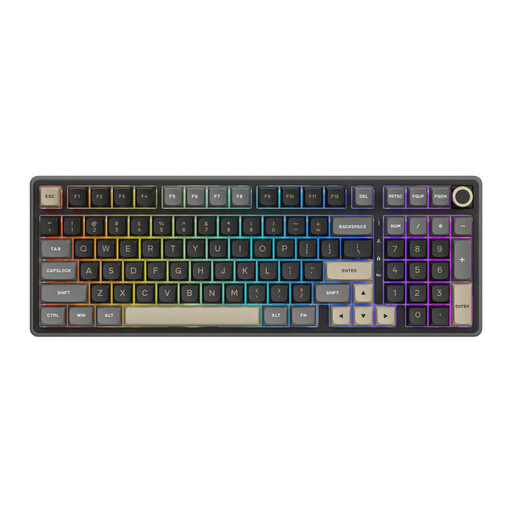 Image unavailable
RK ROYAL KLUDGE R98 Pro wired mechanical keyboard
An option to compare if you want a wired connection and a numeric keypad.
The product name lists a volume knob, hot-swappable keys and Beige Switch switches. The description mentions a driver for customising keys and macros.
View at Joybuy
 Image unavailable
AULA F75 75% mechanical keyboard, US QWERTY
Suitable if you want a compact layout with function keys to free up desk space.
The product name lists a US QWERTY layout. The description mentions Bluetooth, 2.4 GHz and USB-C.
View at Joybuy
 Image unavailable
AJAZZ AK820 MAX 75% mechanical keyboard, US QWERTY
A compact option to compare if you want to keep function keys and customise your keys.
The product name lists tri-mode connectivity, Flying Fish switches and an 8000 mAh battery. The description mentions a function-key row and key and macro customisation via a webdriver.
View at Joybuy
 Image unavailable
AJAZZ AK820 Pro 75% tri-mode keyboard, US QWERTY
Suitable if you want a compact layout with function keys and the option to customise settings.
The product name lists a US QWERTY layout and Flying Fish Switch Purple switches. The description mentions wired, Bluetooth and 2.4 GHz connections, a TFT screen and compatibility with Windows and macOS.
View at Joybuy
Frequently asked questions
Do you definitely need a full-size keyboard for debugging?
No. In Visual Studio Code, F5 and F9 are debugger functions by default. With a compact keyboard, check whether you can access these keys directly or via Fn, and whether your own layout or custom shortcuts change anything.
Do you need to set up keys or macros before you can get started?
Not necessarily; check your editor’s default shortcuts first. Visual Studio Code has a keyboard shortcuts editor, and Keychron lists key and macro customisation via Keychron Launcher for the V1.
What are your rights if a keyboard bought online is unsuitable or breaks too soon?
For an online consumer purchase, ACM ConsuWijzer says you generally have a statutory cooling-off period of up to 14 days after delivery, with some exceptions. Separately, a product must meet what you could reasonably expect under normal use; if there is a fault, the seller must offer an appropriate solution.
Does Dutch law require a separate keyboard for a workplace?
Not for every hobby user. Arboportaal states that for employees who spend more than 2 hours a day working with a display screen, the screen and keyboard must not be attached to each other. In that case, laptop users must be able to use a separate screen or keyboard; this does not mean they have to buy a particular type of keyboard.
Is CE an independent quality mark for your keyboard?
No. According to the European Commission, the manufacturer uses CE to indicate that a product complies with the applicable EU product rules; the Commission does not routinely issue a certificate itself. Which rules apply also depends on the exact model, for example whether it has wireless connections.


