Who is this buying guide for?

Learning a tune

You want to learn the notes and tempo of a single hymn tune in a spare room. Check first that the keyboard covers the tune’s range, and that its touch response and practice features suit you. Yamaha and Casio describe these features for specific models.

Practising quietly at home

You practise when other people are at home or your neighbours are around, so you’re looking for a suitable headphone socket and an instrument that fits your space. Korg specifies a headphone socket for the Liano; the Dutch government advises talking to your neighbours and agreeing on arrangements if noise is an issue.

Planning to accompany yourself

After learning the tune, you’d like to play chords or a more extensive two-handed part. Compare the range, any accompaniment features and pedal connections on the exact model you’re considering; Yamaha and Korg provide model-specific information on these.

What should you look for when buying?

Compact 61-key keyboard

A good fit if: the notes in your hymn tune fall within the keyboard’s range and you don’t use the spare room as a permanent music room.

Trade-off: a 61-key keyboard has a more limited range than the 76- or 88-key models mentioned here. Built-in songs don’t guarantee that your hymn is included.

76-key keyboard

A good fit if: your piece needs a wider range than a 61-key keyboard offers, and you’d also like to compare keyboard accompaniment features. Yamaha specifies 76 keys for the PSR-EW320.

Trade-off: the Yamaha PSR-EW320 is 1.148 mm wide, so measure your practice space beforehand to make sure it will fit.

Slim 88-key digital piano

A good fit if: you want a full piano range as well as being able to play the hymn tune. Korg specifies that the Liano has 88 touch-sensitive keys and a headphone socket.

Trade-off: the Liano is 1.282 mm wide and, according to Korg, has eight sounds. Compare this option with a digital piano that has a keyboard if automatic accompaniment is important to you.

What to consider What to look for when buying Who should pay particular attention?
Being able to play the tune Compare the lowest and highest notes in your sheet music with the keyboard’s range. Then check whether the touch response and any lesson features will be useful for the way you practise. I want to be able to play the tune from my sheet music, so I’m checking its lowest and highest notes. Around 36% of consumers say learning the tune is their top buying priority.
Practising in a shared home Check whether the exact model has a headphone socket and whether your headphone plug will fit. If necessary, agree on times for practising. When I practise at home while others are around, I want to be considerate of the people I live with and listen through compatible headphones. Around 29% of consumers prioritise quiet practice at home.
Space and storage Measure the available width and leave enough room to play and set out your sheet music. Compare the space with the dimensions of the model you’re considering. I want to be able to put the instrument away after use without it taking up space in my spare room permanently. Around 21% of consumers make available space and storage their top priority.
Room to progress Decide whether you want to play chords or a left-hand part yourself, or whether you’re looking for automatic accompaniment. Also check the pedal connection and what’s included with the exact model. If I want to play more than just the tune later on, I’ll look at the range and accompaniment options. Around 14% of consumers prioritise progressing to chords or accompaniment.

Common pitfalls

  • Assuming a built-in lesson will teach you your hymn

    Yamaha lists songs and lesson features for the PSR-E383, but that doesn’t mean your tune is included in its repertoire.

    Use your sheet music as your starting point, and treat built-in lessons as an extra practice aid.

  • Choosing a larger keyboard without measuring the room

    The listed widths of the Casio CT-S300, Yamaha PSR-EW320 and Korg Liano range from 930 to 1.282 mm.

    Measure the space available and choose extra keys only if your sheet music or future playing plans call for a wider range.

  • Confusing touch sensitivity with weighted hammer-action keys

    Casio describes the CT-S300 as having piano-style keys and touch response; Korg specifies a touch-sensitive LS keyboard for the Liano. Neither specification means the keys have weighted hammer action.

    If the feel of the keys matters more to you than simply having enough range for the hymn tune, check the specified key action separately.

  • Assuming all accessories are included

    Korg lists a pedal switch as included with the Liano, while the stand is described as a separate accessory. What’s in the box can vary by model and offer.

    Check the contents of the specific box against what you need for your practice space.

Brands to compare

Yamaha

The PSR-E383 is a 61-key keyboard with touch response and lesson features. The PSR-EW320 has 76 keys for players who need a wider range.

  • Yamaha specifies touch-sensitive keys and lesson features for the PSR-E383, and 76 keys for the PSR-EW320.
  • Built-in songs don’t guarantee that your hymn is included. The PSR-EW320 is 1.148 mm wide.

Casio

The CT-S300 is a compact Casiotone with touch response, designed for people who also need to think about storage.

  • Casio specifies dimensions of 930 × 256 × 73 mm, a weight of 3,3 kg and touch response for the CT-S300.
  • The listed specifications don’t confirm that a particular hymn is included as a practice song. Check the connections and box contents for the version you choose.

Korg

The Liano is an 88-key digital piano with a straightforward selection of sounds, for anyone who wants a full piano range.

  • Korg specifies a headphone socket, eight sounds and an included pedal switch for the Liano.
  • The Liano is 1.282 mm wide. Its specified LS keyboard should not be described as having weighted hammer action.

Joybuy products

This Joybuy selection focuses on a compact 61-key keyboard for practising a tune.
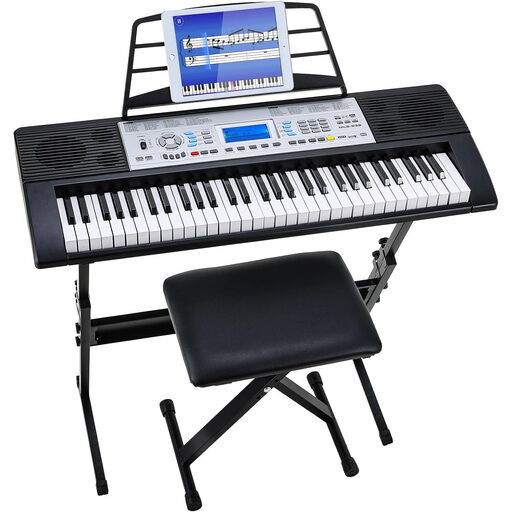
61-key digital keyboard set with stand and stool

61-key digital keyboard set with stand and stool

The title lists 61 keys, while the product description mentions a three-level learning mode, which may suit anyone looking to learn a tune.

The product description lists 500 sounds, dual speakers and an LCD screen.

View product

Frequently asked questions

Is a 61-key keyboard enough for your hymn?

It depends on the lowest and highest notes in your version, and whether you’ll also be playing a left-hand part. Compare these with the model’s range first. A 76- or 88-key instrument is an alternative if the piece goes beyond the range of a 61-key keyboard.

Can you get started without a computer?

According to Yamaha, the PSR-E383 has built-in sounds and songs; according to Korg, the Liano has its own sounds and speakers. Before buying, check the power requirements and what’s included with the version you want to order.

What should you check when setting up and maintaining your keyboard?

Measure the space where you plan to set it up and make sure you can reach the connections and controls. Follow the manual for the exact model for power, cleaning and safe use. Don’t use a power supply from another instrument without checking that it’s compatible.

Which accessories and consumer rights matter when buying online?

Check whether headphones, a stand and the pedal you want are included with the specific offer. For a qualifying online consumer purchase in the Netherlands, you generally have a statutory 14-day cooling-off period from delivery, according to ACM ConsuWijzer. The seller also remains responsible for the statutory guarantee if the product doesn’t meet what you could reasonably expect under normal use.

Are there national decibel limits for practising keyboard in your spare room?

The Dutch government advises people to discuss noise problems with their neighbours and agree on arrangements first. Its guidance doesn’t give a general decibel limit or time for this particular situation. If the disturbance continues, you could involve your landlord, owners’ association or local council, among others. Check which arrangements apply to your home.
