What should you look for when choosing?
First, compare the range of your arrangement with the keyboard. Then consider practice volume, key action and the features that suit the way you learn.
61-key keyboard
A good fit if: the melody and any accompaniment fit within its range.
Bear in mind: it offers less playing range than models with 76 or 88 keys; touch-sensitive keys are not automatically the same as weighted piano keys.
76-key keyboard
A good fit if: your part needs a wider range than a 61-key model offers, but you don’t need an 88-key piano.
Bear in mind: Yamaha lists the PSR-EW320 as 1,148 mm wide, so measure the space you have available.
88-key digital piano
A good fit if: your arrangement needs a wider range or you also want to practise on weighted piano keys.
Bear in mind: this set-up takes up more space. According to Korg, the stand with three-pedal unit is included with the B2+SP set, not the standalone B2+.
| What to consider |
What should you check? |
Which shoppers should consider this? |
| Key range |
Compare the lowest and highest notes in the melody and any left-hand part with the keyboard. Yamaha lists 61 keys for the PSR-E383 and 76 for the PSR-EW320; Roland and Korg describe pianos with 88 keys. |
I want to know whether I can play every note in my arrangement before choosing an instrument. Around 33% of shoppers prioritise having the right key range. |
| Practice volume |
Check whether the exact model has a headphone socket and which plug it takes. Yamaha lists a socket for the PSR-EW320 and Roland for the FP-10. The Dutch government recommends agreeing with neighbours on how to manage noise. |
If I practise in a shared building, I want to listen to the instrument through suitable headphones and be considerate of others. Around 27% of shoppers prioritise being able to practise quietly. |
| Key action |
Check whether you need weighted keys for lessons or piano practice. Yamaha describes the PSR-E383 as having touch-sensitive keys; Roland and Korg each specify an 88-key keyboard for the FP-10 and B2+. |
I also want to practise piano technique, so I’m looking beyond the number of keys alone. Around 20% of shoppers prioritise the piano key action they want. |
| Learning features and accompaniment |
Decide whether you’ll use built-in lessons, a metronome or automatic accompaniment. Yamaha lists lesson and accompaniment features for the PSR-E383, and lesson features and a metronome for the PSR-EW320. |
I’d like built-in support while learning a piece; features I don’t need matter less to me. Around 20% of shoppers prioritise learning or accompaniment features. |
Joybuy products
This selection includes digital keyboards with 61 keys. Compare their range with the notes in your arrangement and check which learning features and accessories are included with each version.
 No image available
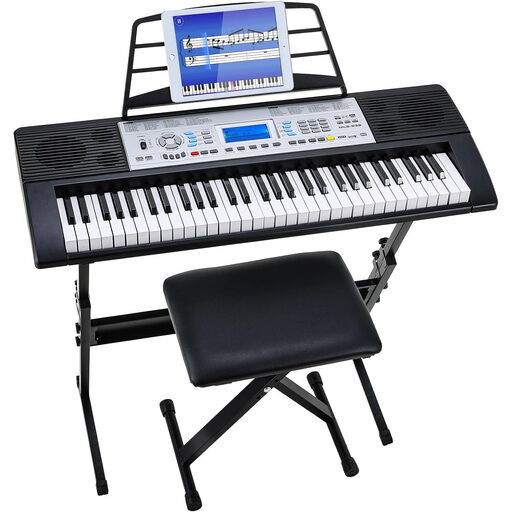
61-key digital keyboard with stand and bench
The three-level learning mode is worth considering if you’d like built-in practice support. Check that all the notes in your arrangement fit within the 61 keys.
The product name lists a stand, bench and music stand, 300 tones, 300 rhythms, an LCD screen and USB-MIDI.
View at Joybuy
 No image available
61-key digital keyboard with stand and stool
The stated three-level learning mode may be useful if you’re looking for step-by-step practice support; compare the key range with your arrangement.
The product information lists 500 sounds and rhythms, two built-in speakers, an LCD screen, a stand and an adjustable stool.
View at Joybuy
 No image available
61-key electronic keyboard with metronome
This model may suit you if you want to use a metronome and learning mode; check that the keyboard covers all the notes in your arrangement.
The product information lists a three-step learning system, recording function, MIDI controller, speakers and a headphone socket. The product name also mentions a music stand.
View at Joybuy
 No image available
MLS-931 digital piano with 61 keys
The product name mentions a weighted keyboard; check whether this type of key action suits what you need for lessons or piano practice.
The product information lists 300 sounds, 300 rhythms, an LCD screen, USB-MIDI, speakers, a headphone socket and a music stand.
View at Joybuy
Frequently asked questions
Are 61 keys enough for your musical number?
It depends on your arrangement. Compare the lowest and highest notes in both the melody and any left-hand part with the keyboard. The models covered here have 61, 76 or 88 keys, but without seeing your arrangement, there’s no set minimum number of keys for this piece.
Can you practise with headphones without worrying about your neighbours?
Headphones let you hear the electronic sound of the instrument, but they don’t guarantee that singing or the physical sound of the keys will be inaudible. The Dutch government recommends talking to your neighbours first and agreeing on how to manage noise, such as music.
What should you check before setting up the instrument?
Measure the space available, check the power supply and make sure you have the right headphone plug. Also check what’s included with the version you’ve chosen. Yamaha lists the PSR-EW320 as 1,148 mm wide and with a standard stereo headphone socket. Korg distinguishes between the standalone B2+ and the B2+SP set with a stand and pedal unit.
What are your rights on returns and guarantees when buying online in the Netherlands?
For online purchases from a business, you’ll often have a 14-day cooling-off period; the terms and exceptions depend on the specific purchase. You’re also entitled to a product that works properly, but there’s no fixed statutory guarantee period in the Netherlands. If a product is faulty, contact the seller.


