
Beginner with limited space
You’re looking for an instrument that doesn’t have to stay set up permanently once you’ve finished practising. First, work out how many keys you need and measure the whole playing area.


Start by checking the note range of your song intro. A shorter keyboard with 61 keys may be enough if the part fits within that range and you’re happy with a light touch. If you also want to practise piano technique or parts with a wider range, compare digital pianos with 88 keys. For either option, measure the entire playing area, including the stand, seat and pedal.
You’re looking for an instrument that doesn’t have to stay set up permanently once you’ve finished practising. First, work out how many keys you need and measure the whole playing area.
As well as the intro, you practise two-handed parts or piano technique, so you’re comparing models with 88 keys and different key actions.
You share your space with others and want to practise with headphones. Check that the version you’re considering has a headphone socket.
First, compare the intro’s range with the number of keys, then measure the entire set-up. The percentages show how many consumers in this practice scenario consider each need their top priority.
| What to consider | What to look for | Who should prioritise this? |
|---|---|---|
| Space for the set-up | Measure the width and depth, including the stand, stool and pedal; compare dimensions on a like-for-like basis. | If space is tight, you’ll want to know whether the instrument will fit and whether you can sit comfortably at it. Around 36% of consumers prioritise space for the complete set-up. |
| Key range and action | Check the lowest and highest notes in the intro, then compare 61-key and 88-key models and the stated key action. | If you also want to practise parts with a wider range or piano technique, look beyond the intro alone. Around 29% of consumers make key range and action their top priority. |
| Practising with headphones | Check the headphone socket and plug size on the exact version; keyboards can also produce sound without speakers. | If you share your space at home and want to practise without sound coming from speakers, check how to connect your headphones. Around 21% of consumers prioritise practising privately. |
| Stand, pedal and storage | Check what’s included, which parts are optional and how the instrument will fit into your set-up. | If you want to put the piano away after practising, check both the parts you’ll need and the full set-up. Around 14% of consumers prioritise a complete practice space that can be packed away. |
The stated dimensions may not include a music rest or stand. You’ll also need space for your stool and pedal.
Measure the whole playing set-up and compare dimensions with the same accessories included.
A stand and seat take up extra space; also check whether the stand you want is available separately.
A shorter keyboard may suit an intro that fits within 61 keys, but it doesn’t have the same range as an 88-key model.
Check the range of the intro and the learning materials you’d like to practise later.
You may need a second instrument later if you want a wider range or a different key action.
A supplied pedal doesn’t automatically mean that a stand or a more extensive pedal unit is also included in the box.
Check what’s included with the exact version and make sure any extra parts will fit it.
A compatible stand or a more extensive pedal unit may be available separately.
According to Casio, the CDP-S110 is an 88-key digital piano with a depth of 232 mm.
Yamaha offers two different options here: the portable P-145BT with 88 GHC keys and the shorter NP-15 with 61 light-touch keys.
According to Korg, the B2N has 88 keys with a light NT key action.
The FP-40 is a portable digital piano with 88 keys and a PHA-4 keyboard.
These product picks are aimed at song intros that fit within a 61-key keyboard, with options for headphone practice and, on some versions, a stand or stool.
 No image available
An option if the notes in your intro fit within 61 keys; check the part’s range before choosing.
The product name lists MIDI, a recording function, speakers, a metronome and a music rest. The description also mentions a headphone socket.
 No image available
Could suit an intro that fits within 61 keys; check that its range matches the other material you plan to practise.
The product name lists weighted keys, 300 sounds, 300 rhythms, USB-MIDI, a headphone socket and a music rest.
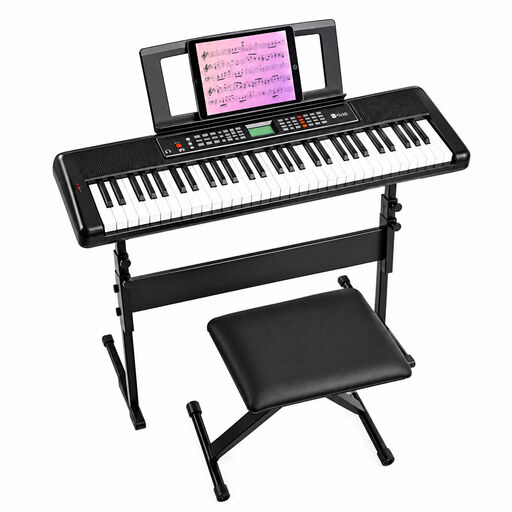 No image available
An option for an intro that fits within 61 keys; also measure the space taken up by the stand and stool.
The product name lists a stand, stool, music rest, 300 sounds, 300 rhythms, an LCD screen and USB-MIDI. The description mentions a recording function and headphone socket.
Compare the lowest and highest notes in the part you want to practise with the instrument’s range. Yamaha presents the NP-15 as a keyboard with 61 light-touch keys. Don’t choose based on width alone if you want to practise parts with a wider range later.
Measure the space for the instrument, seat, pedal and any stand. Also check the conditions under which the stated dimensions apply: the Korg B2N’s dimensions exclude the music rest, while Roland also gives dimensions for the FP-40 set up with a stand and pedal unit.
No, a digital piano doesn’t need acoustic tuning. Follow the manufacturer’s instructions for using and maintaining the exact model.
For eligible distance sales, you generally have a 14-day cooling-off period, according to the Dutch Government. You’re also entitled to a product that meets the required standards; there’s no fixed statutory guarantee period in the Netherlands. If a product is faulty, the retailer is your point of contact.
According to the Dutch Ondernemersplein, electrical and electronic equipment sold on the market must comply with the relevant European rules. CE marking is only mandatory for product groups that are subject to this requirement; a mention on a shop page does not, by itself, prove that a specific version meets all the applicable requirements.