
Two-handed hymn player
You practise the melody and bass or chord part at the same time. Compare the lowest and highest notes in your sheet music with the keyboard’s range. Yamaha Nederland and Korg describe models with different numbers of keys.


A 61-key keyboard is a space-saving choice if the melody and left-hand part of your hymns fit within its range. Choose 76 or 88 keys if your sheet music calls for a wider range. A headphone socket can help you avoid using the speakers, but also check the dimensions and whether the organ sounds or accompaniment suit the way you practise.
You practise the melody and bass or chord part at the same time. Compare the lowest and highest notes in your sheet music with the keyboard’s range. Yamaha Nederland and Korg describe models with different numbers of keys.
You want to play independently in a spare room and avoid using the speakers by connecting suitable headphones. Yamaha Nederland and Roland Nederland list a headphone socket on certain models.
You want to be able to choose between piano and organ sounds, for example, or try out accompaniment while you practise. Yamaha Nederland, Roland Nederland and Casio describe these features on specific models; check that the controls suit the way you practise.
First check that your hymns fit on the keyboard, then weigh up practice volume, the sounds you want and the space available.
Suitable if: your parts fit within 61 keys and you want to use sounds or accompaniment without a computer.
Bear in mind: its range is smaller than that of the 76- or 88-key models reviewed; an accompaniment style does not mean your hymn is built in.
Suitable if: your parts need a wider range, but you want an arranger keyboard with sounds and accompaniment.
Bear in mind: Yamaha lists the PSR-EW320 as 1.148 mm wide, so measure the space available.
Suitable if: the full piano range matters more to you than extensive automatic accompaniment.
Bear in mind: Korg lists the Liano as 1.282 mm wide; the LS keyboard does not necessarily have weighted hammer action.
| Factor to consider | What to check before buying | Who is this important to? |
|---|---|---|
| Key range | Compare the lowest and highest notes in a few hymns with the range of the exact model. | If I play the melody and left-hand part at the same time, I don’t want to keep having to move notes. Around 33% of consumers prioritise a key range that suits their parts. |
| Quiet practice | Check the headphone socket and the plug you need; arrange practice times if necessary. | In a shared home, I want to avoid using the speakers and be considerate of others. Around 27% of consumers give quiet practice their highest priority. |
| Sounds and accompaniment | Compare the piano and organ sounds and check how any accompaniment is controlled. | If I want to use a different sound or backing accompaniment while practising, these are the features I focus on. Around 20% of consumers prioritise sounds or accompaniment. |
| Space in the spare room | Measure the space available for the instrument, music stand, chair and cables; compare it with the stated dimensions. | If the room has other uses too, I want to know in advance how much space the setup will take up. Around 20% of consumers give the available space the greatest weight. |
The instruments reviewed range from 61 to 88 keys; a part may include notes that fall outside the range of a smaller keyboard.
First check the notes in your own repertoire and compare them with the range of the exact model.
A listed collection of sounds or styles does not confirm that a particular hymn is included as a ready-made arrangement.
If you’re looking for a specific built-in piece, check the song or style list for the exact model.
Your practice space will also need room for things such as a chair, music stand and cables.
Measure the whole setup and check which accessories are included with the product.
A stand, chair or headphones may need to be purchased separately; check what’s included with each offer.
According to Yamaha Nederland, the PSR-E383 has 61 keys and the PSR-EW320 has 76.
The E-X10 is a 61-key keyboard to consider if you’re interested in organ sounds or automatic accompaniment.
Casio describes the CT-S1RD as a 61-key model with piano and organ sounds, among others; the CT-S1-76BK is a separate variant.
The Liano is an 88-key digital piano for those who value a full keyboard range more than extensive arranger features.
The Joybuy instruments shown have 61 keys and are designed for independent practice. Compare the sounds, connections and any included accessories for each model before choosing your setup.
 No image available
A 61-key instrument to consider if your hymns fit within its range and you want to practise privately.
The product description lists 300 sounds, 300 rhythms, built-in speakers, a headphone socket and a metronome.
Also listed: USB-MIDI and recording and playback functions.
 No image available
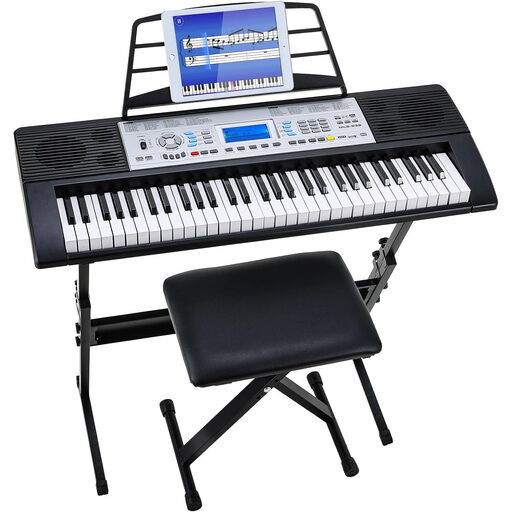
An option if you’re looking for a 61-key instrument with a dedicated practice setup.
The product description lists built-in speakers, 500 sounds and rhythms, an LCD screen and a three-level lesson function.
According to the description, a stand and adjustable stool are included.
 No image available
A 61-key option to consider if touch-sensitive keys and accompaniment suit the way you practise.
The product description lists touch-sensitive keys, built-in speakers, a headphone socket and a metronome.
Also listed are 300 sounds, 300 rhythms and automatic bass chords.
It depends on the lowest and highest notes in the parts you want to play at the same time. Compare a few pieces from your own sheet music with the instrument’s range; choose a larger keyboard if those notes fall outside it.
Measure the space for the instrument, chair, music stand and cables before you choose. If you plan to use headphones, check the connection on the exact model too; Yamaha Nederland lists one for the PSR-EW320, and Korg does for the Liano.
If a product is faulty, you may be entitled to a remedy under your statutory rights. ACM ConsuWijzer explains that, when a product is used normally, the seller is responsible for providing a suitable solution free of charge; a manufacturer’s guarantee does not automatically cover the full duration of your statutory rights.
Agree practice times with housemates and neighbours, and check the rules that apply to your home. The Dutch government advises people dealing with noise from neighbours to discuss it and agree on arrangements first, such as what time music can be played.
For online consumer purchases, there is generally a statutory cooling-off period of up to 14 days after delivery, subject to exceptions. ACM ConsuWijzer explains how this works; check the applicable terms and returns process before ordering.