Who is this keyboard advice for?

Form builder who does a lot of typing

Do you regularly write or edit field names, text and possibly HTML/CSS? Check both the keyboard’s physical layout and your computer’s input layout. Microsoft Support explains how to manage input layouts in Windows, while Keychron describes programmable keys on specific K3 Pro versions.

Home worker looking to adjust their posture

If you type for long periods, the shape and position of your keyboard may influence how you set up your workspace. Arboportaal recommends varying your activities during screen work; a keyboard’s shape alone is no guarantee that discomfort will disappear.

Worker with a small desk

If you want to keep space free for your mouse and screen, compare a compact layout with a full-size keyboard. Also consider which keys or whether a number pad are essential for entering and editing form data.

What should you look for?

Compact keyboard

Best for: a small desk, or if you want to keep your mouse closer to where you type.

Keep in mind: layouts and available keys vary by version, so check whether you’ll miss a number pad or any other keys.

Full-size keyboard

Best for: anyone who values familiar key positions and may need a number pad.

Keep in mind: wired and wireless models vary in their connections and features. Check your computer’s ports or wireless compatibility.

Split keyboard

Best for: anyone who wants to try a different hand and forearm position when typing for long periods.

Keep in mind: the different shape may take some getting used to and is no guarantee of preventing discomfort.

What to consider What should you look for? Who should pay particular attention?
Character layout Check the labels on the keys and your computer’s input layout. Test the characters you use for form text or code. If I type field names or code, I want the characters to match what I expect. Around 31% of consumers prioritise a familiar layout and access to the keys they use.
Posture Compare a straight keyboard with a split one and see whether its position suits your workspace. Arboportaal recommends varying your activities during screen work. If I type for long periods, I want a shape and position that feel comfortable, without assuming that a particular model will prevent discomfort. Around 31% of consumers prioritise hand position and posture.
Desk space Check the dimensions and whether the keyboard has a number pad. Keychron describes the K3 Pro as a 75% model; Logitech describes the ERGO K860 for Business as a full-size keyboard with a number pad. At a small desk, I want to keep space for my mouse and screen. Around 23% of consumers prioritise a smaller keyboard footprint.
Connection Check that your computer has the USB connection you need. If you want a wireless model, choose one that works with the connection supported by the specific version. CHERRY describes the KC 1000 as wired; Logitech says the MX Keys S can switch between up to three devices. For a fixed workstation, I want a connection that suits my computer, without extra features I won’t use. Around 15% of consumers mainly opt for a simple connection.

Common buying mistakes

  • Choosing based on ‘QWERTY’ alone

    The labels on the keys and the software input layout are not the same thing. If they don’t match, the characters you type may not be what you expect.

    Check the layout of the version on offer and test the characters you use for form work. In Windows, you can manage the input layout separately through the language and region settings.

  • Assuming a split keyboard is a guaranteed fix for discomfort

    A split design changes the possible hand position, but does not guarantee that discomfort will be prevented or resolved. Your workspace and varying your activities also matter.

    Assess the keyboard as part of your overall workspace. If you’re starting to experience discomfort, Arboportaal advises employees to contact their occupational health physician and request a workplace assessment.

  • Assuming a similar model name means it’s the same version

    A similar name doesn’t mean the layout, features or included accessories are the same.

    Before buying, compare the full model name, keyboard layout and version with what you need.

Brands worth considering

Logitech

The MX Keys S and ERGO K860 offer different designs and features for a home office.

  • For the MX Keys S, Logitech lists Smart Actions and switching between up to three devices. The ERGO K860 has a split design and adjustable tilt.
  • These specifications are no guarantee that the keyboard will prevent discomfort or boost productivity. Check which design and features suit the way you work.

Keychron

The K3 Pro is a compact mechanical option for anyone who wants to customise their keys or is looking for a smaller layout.

  • For the ANSI version described, Keychron specifies a 75% layout, Bluetooth and QMK/Keychron Launcher.
  • According to Keychron, hot-swapping is available only on the specified RGB hot-swappable version. ISO versions have a different physical layout, so check the exact variant.

CHERRY

The KC 1000 is a slim, wired keyboard for a fixed workstation.

  • CHERRY describes the KC 1000 as a slim keyboard with a cable and quiet keys.
  • Check the layout of the version on offer and make sure your computer has the connection you need.

Keyboards at Joybuy

This Joybuy selection includes compact and full-size keyboards with wired or wireless connections. Compare the layout and keys available on each version with what you need for form work.

REDRAGON wired mechanical keyboard with 94 keys, wrist rest and phone stand

REDRAGON wired mechanical keyboard, 94 keys

A wired version with a wrist rest and phone stand, for anyone who wants to use these accessories at their workstation.

94 keys; wired; mechanical.

View at Joybuy

Redragon M68 mechanical keyboard with magnetic switches, 68 keys and US layout

Redragon M68, 68 keys, US layout

A compact version to compare if you’re looking for a smaller keyboard with a US layout.

68 keys; mechanical; magnetic switches; US layout.

View at Joybuy

AJAZZ AK820 mechanical keyboard, 75%, 83 keys, wired and US layout

AJAZZ AK820, 75%, 83 keys, US layout

A compact, wired version to consider if you want to free up desk space and are looking for a US layout.

75% layout; 83 keys; wired; hot-swappable linear switches.

View at Joybuy

Apple Magic Keyboard with QWERTY Dutch layout, USB and Bluetooth

Apple Magic Keyboard, QWERTY Dutch, USB + Bluetooth

A version with a Dutch QWERTY layout to compare if you need this layout and a number pad.

USB and Bluetooth; number pad.

View at Joybuy
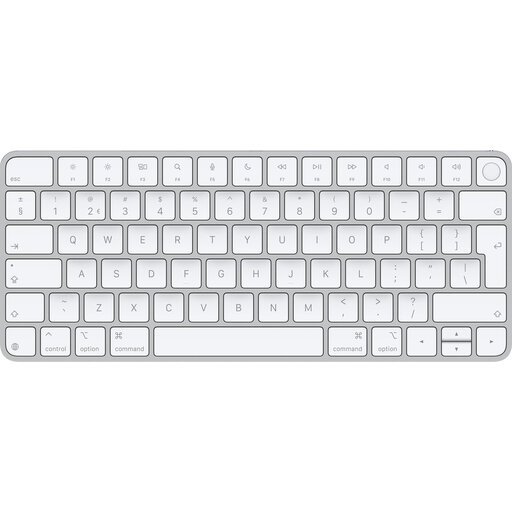
Apple Magic Keyboard with Touch ID for Mac models with Apple Silicon, Dutch version

Apple Magic Keyboard with Touch ID, Dutch version

A version to consider if you want to use Touch ID with a compatible Mac with Apple Silicon.

The description specifies macOS 11.4 or later for full functionality.

View at Joybuy

Frequently asked questions

Do I need to be able to use a separate keyboard when working from home?

According to Arboportaal, for employees who spend more than two hours a day working with a screen, the screen and keyboard must not be attached to each other. Employers also have a duty of care to provide good and safe working conditions when employees work from home. This does not mean that every individual buyer is required to choose a particular keyboard model.

How can I stop my keyboard from typing different characters than I expect?

Check that the labels on the keys match the selected input layout. Microsoft Support explains how to view, add and change input layouts in Windows through the language and region settings.

What can I do if I start experiencing discomfort during long periods at the computer?

Arboportaal recommends varying your posture and taking microbreaks. Employees can contact their occupational health physician if they start experiencing discomfort and ask for a workplace assessment; simply switching keyboards is no substitute for that assessment.

What are my rights when I buy a keyboard online?

For online distance purchases from a business, consumers generally have a statutory 14-day cooling-off period after delivery, according to the Dutch government. Products must also meet reasonable expectations. The Netherlands does not have a fixed, general statutory guarantee period, and the seller is the point of contact if a product is faulty. Consumer rights may differ for business purchases.
