
If you find keys hard to read
When transcribing information from enlarged newspaper scans, you may also need to identify the labels on the physical keys. Koninklijke Visio describes solutions with large, high-contrast lettering.


Choose based on what gets in your way most when transcribing: recognising the physical keys, keeping space for your mouse, or entering lots of numbers and text. Large-print key labels can make keys easier to find, but they won’t enlarge the newspaper on your screen. A compact keyboard can keep your mouse closer, while a full-size layout gives you a separate number pad. Then check the exact key layout, connection and shortcuts that work with your computer and data-entry software.
When transcribing information from enlarged newspaper scans, you may also need to identify the labels on the physical keys. Koninklijke Visio describes solutions with large, high-contrast lettering.
Transcribing information from scans makes archives searchable, as the National Archives explains. If you use your mouse a lot, the space between the keyboard and mouse may also influence your choice.
When entering information repeatedly, the layout, key feel and position of your screen and input devices also matter. Arboportaal also provides advice on screen-based work for employees.
When indexing historical newspapers with enlarged text on screen, the most practical layout depends on what matters most to you while entering information.
| What to consider | What should you check? | Who is this important for? |
|---|---|---|
| Key readability | Check the size and colour contrast of the key labels, and make sure the backlighting is comfortable for your workspace. | If I look at the keys while entering information, I want to be able to recognise the labels quickly. Around 33% of consumers say readable physical keys are their top priority. |
| Space for the mouse and navigation | Compare the width of the layout and check that the navigation keys and shortcuts work with your data-entry software. | If I often switch between the scan, entry fields and mouse, I consider the position of the devices and the navigation keys. Around 25% of consumers prioritise navigation and space for the mouse. |
| Comfort when typing repeatedly | Consider the key profile and feel; try them out if possible. | If I enter long passages of text, I want a key feel and setup that suit the way I type. Around 25% of consumers put typing comfort first. |
| Layout and connection | Check the exact regional and physical layout, the connection, and whether you need a separate number pad. | If I need special characters, familiar shortcuts or a particular connection, I check the exact version before buying. Around 17% of consumers say device and layout compatibility is their top priority. |
Large-print key labels won’t change how a newspaper scan appears on screen.
First adjust the magnification of the scan and entry fields; then choose physical keys that are easy to read.
The position of punctuation and other keys can vary between physical and regional layouts.
Check the image and version of the model on offer, especially if you use special characters or familiar shortcuts.
A compact keyboard may not have a separate number pad and may instead have an integrated numeric section.
Try entering a few dates and numbers before deciding whether that layout suits your work.
Worth considering if readable labels on physical keys are your main priority.
The UltraBoard 950 V2 Wired reviewed is a compact office layout worth comparing if you want to keep your mouse close to the keyboard.
The MX Keys S is a full-size, office-focused model with adjustable backlighting and customisable functions.
The KC 1000 is a conventional, wired office layout to compare if you don’t need large-print key labels or a compact design.
These keyboards suit different needs when entering information, such as typing numbers, navigating and keeping space for the mouse. Check the connection and layout of the version you choose.
 No image available
An option to compare if you often enter numbers and want a full-size layout.
The product information lists a wired plug-and-play connection, illuminated keys and a number pad.
 No image available
An option to consider if you’re looking for a mechanical keyboard for repeated typing.
The product name lists a 98% QWERTY layout; the product information lists Bluetooth, 2.4 GHz and USB-C as connection options.
 No image available
An option to compare if you’re considering a mechanical layout with an included wrist rest.
The product information lists a wired connection and a detachable wrist rest.
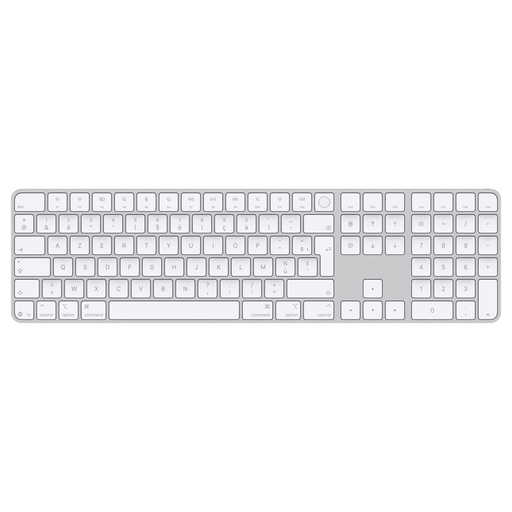 No image available
An option to consider if you need a number pad and document navigation keys; the product information positions this model for use with a Mac.
The product information lists Bluetooth and USB-C for charging and pairing.
 No image available
A compact layout to compare if space for the mouse is important to you.
The product name lists 61 keys and a US QWERTY layout; the product information does not mention a separate number pad.
No. Large-print refers to the labels on the physical keys. Use your computer, browser or data-entry application’s magnification features to make the newspaper appear larger on screen.
Check the exact regional and physical layout, as well as the connection, for the version you’ve chosen. The Logickeyboard NERO reviewed is wired with USB-A, the UltraBoard 950 V2 has USB-C with an included USB-A adapter, and the Logickeyboard Mini reviewed uses Bluetooth. This won’t necessarily apply to other models from those brands.
Make sure the key labels are easy to see without distracting glare, and consider the position of your screen, keyboard and mouse together. Arboportaal advises limiting intensive screen, keyboard and mouse use, and recommends that employees alternate screen-based work with other tasks or take a break.
For employees who work with a screen for more than two hours a day, Arboportaal states that the screen and keyboard must not be attached to each other. In that situation, laptop users must be able to use a separate screen or keyboard. This is not a general purchasing requirement for every volunteer or private buyer.
When buying online from a business, you usually have 14 days to change your mind; check the applicable terms and exceptions. The Dutch government also states that you’re entitled to a product that works as it should, with no fixed statutory guarantee period. If a product is faulty, contact the seller.