
The quiet genealogy researcher
You type while someone else is using the desk or room, and want to keep typing noise to a minimum.


Choose according to what matters most for your research: quiet typing alongside others, entering data for long periods, keeping desk space free or switching between devices. Then compare the layout, number pad and connection. An ergonomically shaped keyboard isn’t automatically the most practical choice for everyone at a shared desk.
You type while someone else is using the desk or room, and want to keep typing noise to a minimum.
You regularly enter names, dates or notes, and want to choose a keyboard shape and workspace that suit the way you type. Arboportaal recommends adapting the workstation to the user.
You share a small workspace and are weighing up whether a dedicated number pad matters more than having room for your mouse and documents.
When researching your family history at a shared desk, the main things to consider are typing noise, extended typing, space, switching between devices and legible keys.
A good fit if: you often enter years and archive references, and use the number pad. Trust describes the Ody II as a model with quiet keys.
Bear in mind: a full-size keyboard takes up more space. Check the layout and connection too.
A good fit if: space is limited and you can enter numbers without a separate number pad. CHERRY describes the STREAM KEYBOARD TKL as quiet and without a numeric keypad.
Bear in mind: you’ll be giving up the dedicated number pad and will have a cable on your desk.
A good fit if: the shape and any palm rest feel comfortable during longer typing sessions. Logitech describes Wave Keys as having a wavy shape and palm rest; Perixx lists a compact, split design for the PERIBOARD-413.
Bear in mind: a different shape may take some getting used to, and it doesn’t replace a properly set-up workstation or regular breaks.
A good fit if: you regularly switch between devices while researching. Logitech says the Signature Slim K950 can be paired with three devices.
Bear in mind: switching between devices tells you nothing about how noisy the keyboard is or whether it gives you access to separate accounts.
A good fit if: the key legends are hard to read in your workspace lighting. Trust describes adjustable key backlighting on the Primo Illuminated.
Bear in mind: backlit keys don’t remove the need for suitable lighting in your workspace.
| What to consider | What should you check? | Who is this important for? |
|---|---|---|
| Quiet typing | Check whether the manufacturer specifies quiet keys for the exact version, and see what connection and layout the keyboard has. | If you type while other people are working or spending time nearby, you’ll want to keep noise down. Around 29% of consumers say quiet operation is their top priority. |
| Longer typing sessions | Consider the shape, any palm rest and how the keyboard sits on your desk. An ergonomic design doesn’t guarantee that you won’t experience discomfort. | If you enter names and details for long periods, you’ll want a shape and workspace that feel comfortable for you. Around 24% of consumers prioritise typing comfort for longer sessions. |
| Space or number pad | Think about how often you use the number pad, and compare the space it needs with the room required for your mouse and paper records. | Space can be important at a small shared desk, but entering lots of dates may make a number pad useful. Around 18% of consumers give this consideration the greatest weight. |
| Switching between devices | Check which connections and operating systems the exact version supports. | If you consult research documents on several devices, you may want to switch between them without having to use a different keyboard each time. Around 17% of consumers say switching between devices is their top priority. |
| Legible keys | Check whether the version has backlighting and whether you can adjust the brightness. Make sure your workspace is suitably lit too. | If the key legends are hard to read in your desk lighting, backlighting may be worth considering. Around 12% of consumers prioritise legible keys. |
A TKL keyboard doesn’t have a dedicated number pad. That can be inconvenient if you enter dates frequently.
Decide in advance how often you use the number pad, then choose a layout to suit.
If you do need a number pad, you’ll have to enter numbers another way or use a separate solution.
A keyboard’s shape is no substitute for a properly set-up workstation and regular breaks.
Try the shape out if you can, and readjust the workstation when someone else takes over.
A wireless keyboard may use a USB receiver. Being wireless doesn’t, in itself, tell you what connection options or key layout are available.
Check the port, receiver and layout for the exact version.
If the port isn’t suitable, you may need to arrange a compatible connection solution first.
For this use, the quiet Ody II and the Primo Illuminated with backlit keys are worth considering.
The STREAM KEYBOARD TKL is a wired alternative for anyone who values quiet typing and a smaller workspace.
Wave Keys has a different shape and a palm rest; Signature Slim K950 is designed for switching between paired devices.
PERIBOARD-413 is a compact, wired option with split-shaped keys.
These Joybuy product picks are intended for quiet typing at a shared desk, with a range of layouts, connections and options for switching between devices.
 No image available
A compact option if you want to type quietly and keep desk space free.
The product information specifies quiet membrane keys and a wired USB connection.
The TKL layout has no numeric keypad; the specified layout is US-QWERTY.
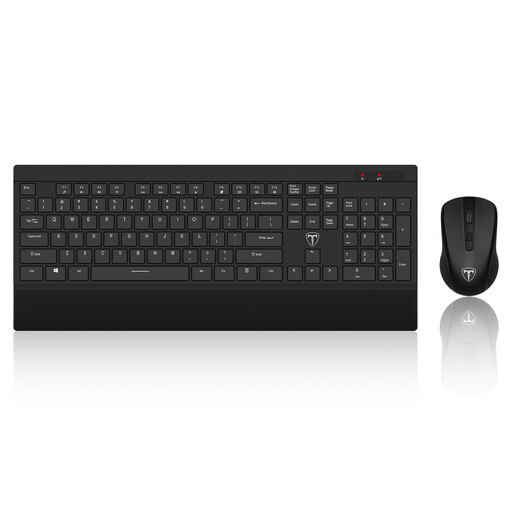 No image available
A full-size keyboard with a number pad for anyone who regularly enters dates or other number sequences.
The product information specifies quiet keys, 104 keys and a 2.4 GHz wireless connection via a single USB receiver for the keyboard and mouse.
The set also includes a mouse; the specified layout is US-QWERTY.
 No image available
An option for quiet typing and switching between devices, if you’re also looking for a mouse.
The product information specifies quiet scissor keys, Bluetooth and a USB receiver, and connection to up to three devices.
The TKL format has no numeric keypad. The set includes a mouse and has a US English QWERTY layout.
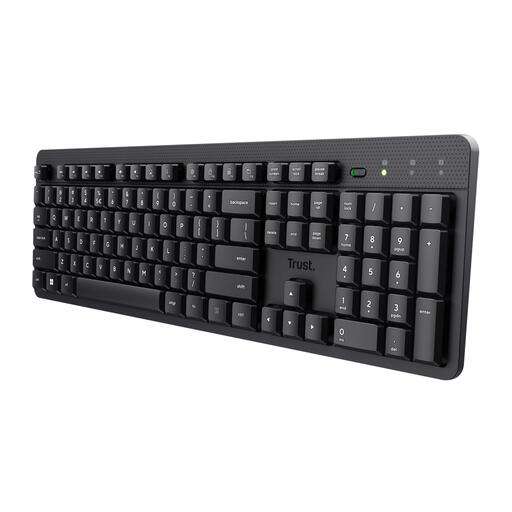 No image available
A full-size option for quiet typing if you use a numeric keypad.
The product information specifies quiet keys and a USB receiver for the wireless connection.
The specified layout is US-QWERTY. According to the product information, the keyboard runs on batteries and isn’t rechargeable.
 No image available
A full-size option if you want to keep a number pad and switch between several devices.
The product information specifies quiet scissor keys, a numeric keypad, a USB receiver and three Bluetooth channels for connecting up to four devices.
The specified layout is US-QWERTY.
Not necessarily. If you often enter dates or other number sequences, a dedicated number pad can be useful. If you rarely use one, a TKL keyboard leaves more space free.
Switch the keyboard off or disconnect it before cleaning, and follow the instructions for the exact model. Logitech describes cleaning tests for the education products mentioned; these aren’t general instructions for every keyboard.
Contact the seller: when you buy as a consumer, you’re entitled to a product that works properly and to a legal guarantee. For distance purchases, you’ll usually also have a 14-day cooling-off period. Check what applies to your purchase.
No. The rules mentioned on display screen work are aimed at employers and employees, and aren’t automatically a legal requirement for people pursuing hobbies in their own time. For employees who use a display screen for more than 2 hours a day, Arboportaal says, among other things, that the screen and keyboard shouldn’t be attached to each other.
No. Switching between paired devices is a keyboard feature and doesn’t control access to files or accounts. The Dutch Data Protection Authority stresses that organisations must prevent unauthorised access to personal data. When using a shared computer, use separate accounts and sign out when you’ve finished.