Choose a keyboard based on typing comfort, the space available on your desk and the layout you’re used to. A two-pane editor doesn’t, by itself, call for a physically split keyboard. Literature & Latte explains how to split the editor horizontally or vertically in Scrivener, while Arboportaal highlights repetitive hand movements and static strain when working at a screen. A compact keyboard without a number pad can save space, while a physically split model lets you position each half separately. Also check the exact layout, connection and support for any programmable keys.
Who is this advice for?
Writer working on long chapters
You want to write long passages in a working position that suits your setup, and are weighing up a standard compact keyboard against a physically split model. Arboportaal describes repetitive hand movements and static strain when working at a screen.
Writer sharing a desk
You want to take account of key noise and leave room for a mouse, notes and two editor panes; you may not need a number pad. CHERRY describes the STREAM KEYBOARD TKL as a compact wired model without a number pad.
Writer who does a lot of editing
You switch between story text and reference material, and want to check which pane and keyboard shortcut features your writing app actually offers. Literature & Latte explains how to split the editor in Scrivener.
What should you look for?
Start with what matters most to you: a comfortable working position, a quieter setup with more space, control of your editor, or a familiar layout and connection. Then compare the specific model and check that its features work with your writing app and device.
| What to consider |
What should you check? |
Who is this most important for? |
| Comfort during long sessions |
Compare the shape and position of the keys with the space and hand position that suit your workspace. An ergonomic shape doesn’t guarantee that discomfort will go away. |
If I’m writing long chapters, I want a keyboard that suits my setup. Around 33% of consumers prioritise typing comfort during long sessions. |
| A quieter setup and more desk space |
Check whether you need a number pad and consider the noise of the specific model; a description such as ‘quiet’ isn’t an independent noise measurement. |
If I’m working at a shared desk, I want room for my mouse and notes, and I pay attention to key noise. Around 27% of consumers prioritise a quieter setup and desk space. |
| Controlling editor panes |
Check which pane and keyboard shortcut features your writing app offers before factoring in programmable keys. Scrivener is one example, but it may not be the app you use. |
If I often switch between story and reference text, I want to make edits easily in my own editor. Around 20% of consumers put editor controls first. |
| Layout and connection |
Check the exact model, key layout, symbols and connection you need: wired, Bluetooth or another wireless connection. |
If I’m used to particular keys and characters, I want to know whether the layout and connection will work with my device. Around 20% of consumers give layout and connection top priority. |
Common buying mistakes
-
Confusing a split editor with a split keyboard
The editor layout is a software feature; a physically split keyboard changes the position of the keys. Literature & Latte explains how to split the software horizontally or vertically in Scrivener.
First, check how your writing app handles panes and keyboard shortcuts. Choose a physically split model only if you want to position the two keyboard halves separately.
-
Going by the model name alone
Key layouts and symbols can vary between versions, so the model name alone won’t always tell you which keys you’ll get.
Check the exact product version and look at the keys in the images before ordering.
-
Assuming a wireless keyboard also works when wired
For the Bluetooth version of the R-Go Split Break, Ergowerken states that it can’t be used via a cable. This may not apply to other versions.
Check whether the specific version can be connected by cable for data input.
Brands to consider
CHERRY
The STREAM KEYBOARD TKL is a compact wired option without a number pad.
- CHERRY lists a low-profile design, SX scissor mechanism and quiet keystrokes.
- It has no number pad and isn’t wireless; the description of its noise level isn’t based on an independent measurement.
Logitech
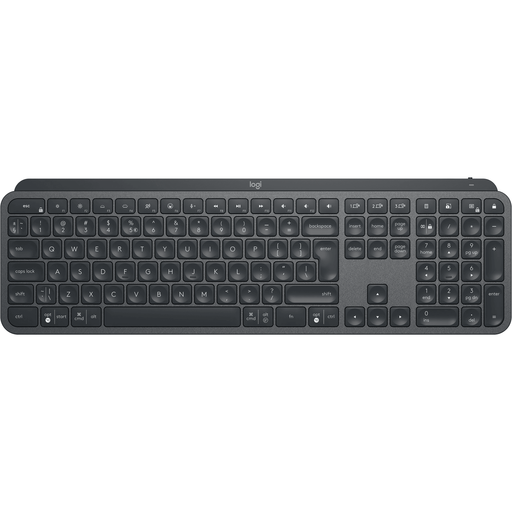
The MX Keys S and ERGO K860 are different keyboard options: the former has programmable keys, while the latter has a curved, split keyboard frame.
- Their features and designs can be considered as separate selection criteria.
- Features of the MX Keys S don’t automatically apply to the ERGO K860. Comfort claims don’t prove that a model prevents writing-related discomfort.
Keychron
The K3 Max ISO is a compact mechanical model for anyone who wants to customise their keys.
- Keychron lists wired, Bluetooth and 2.4 GHz connection options, and mentions key customisation.
- Check the ISO layout and switches on the exact version; a Dutch ISO version hasn’t been confirmed here.
R-Go Tools
The Split Break is designed for anyone who wants to position the two keyboard halves separately.
- Being able to position the halves separately is a distinctive design choice.
- For the Bluetooth version described, Ergowerken lists an ANSI-US-QWERTY layout and says it can’t be used as a wired keyboard. A different hand position alone doesn’t prove any medical benefit.
Keyboards at Joybuy
These Joybuy keyboards are suited to writing, with features to consider including programmable keys, layout, size and connection.
 No image available
Logitech MX Keys for Business, QWERTY US
An option if you want to use programmable keys for commands supported by your writing app.
The product information lists a QWERTY US layout and key customisation via Logi Options+; check whether the command you want is available in your software.
View at Joybuy
 No image available
HP 725 Multi-Device Rechargeable Wireless Keyboard
A wireless option if you want to customise keys and switch between devices.
The product name describes a rechargeable keyboard for multiple devices, and the product information lists programmable keys. Check that the commands you want work in your writing app.
View at Joybuy
 No image available
Trust Vaiya, full-size, QWERTY US
An option if you want a number pad while writing and prefer a wireless connection.
The product information lists a full-size layout with number pad, QWERTY US layout and low-profile scissor keys described as quiet.
View at Joybuy
 No image available
Ajazz AK820 Pro 75%, QWERTY US, Flying Fish Switch
A compact mechanical option if you want the choice of wired and wireless connections.
The product name lists a 75% layout, wired connection, Bluetooth and 2.4 GHz, as well as hot-swappable keys. This version has a QWERTY US layout.
View at Joybuy
 No image available
MageGee TS91 60%, 61 keys, QWERTY US
A compact option if you want to use less desk space and need a wired connection.
The product name lists a 60% layout with 61 keys, a wired connection and QWERTY US.
View at Joybuy
Frequently asked questions
Do I need a split keyboard for an editor with two panes?
No, not for that software feature. Literature & Latte explains how to split the editor horizontally or vertically in Scrivener. A physically split keyboard is a separate choice that affects where you position your hands; check the features of your own editor.
How can I set up my writing space for long typing sessions?
Consider your keyboard as part of your overall workspace, and remember to vary your activities during long periods of screen work. Arboportaal describes repetitive hand movements and static strain; this doesn’t prove that one keyboard can prevent discomfort.
Can I try a keyboard bought online and send it back?
For online purchases by consumers, a statutory cooling-off period of up to 14 days after delivery generally applies. ACM ConsuWijzer explains the conditions and exceptions for unpacking, trying out and returning a product; check these before using it further.
What can I do if my keyboard breaks too soon during normal use?
The seller is responsible for the statutory guarantee. If the product doesn’t meet what you could reasonably expect, you may be entitled to a repair, replacement or, in some cases, a refund; a manufacturer’s warranty period doesn’t automatically limit your statutory rights. ACM ConsuWijzer explains these rights.


