
Beginner blues player
You want to learn to play chord changes and a melody yourself, and decide whether learning features, a metronome or accompaniment would help.


Start by thinking about how you want to practise: playing the chords yourself, working with a metronome or using accompaniment. A compact keyboard with touch-sensitive keys may suit chords and melodies if it has enough range; if you also want to practise piano technique on weighted keys, consider a digital piano. Measure the space for the instrument, sheet music and your seating position, and check the headphone socket on the exact model.
You want to learn to play chord changes and a melody yourself, and decide whether learning features, a metronome or accompaniment would help.
You want to put the instrument away after practising, so you’re considering its width, depth and how easy it is to handle.
You want to practise on weighted piano keys as well as playing blues progressions, and check whether a wider instrument will fit in your space.
Best for: practising chords and melodies yourself, then putting the instrument away afterwards.
Keep in mind: compact size doesn’t tell you whether the keys are weighted. Check the keyboard range and headphone socket too.
Best for: practising chord changes with a rhythm or backing parts, without using a computer.
Keep in mind: an accompaniment style won’t automatically follow your exact blues structure. Check whether you can adjust the tempo and chord changes.
Best for: when piano-style keys and a full piano range matter more than a compact instrument with accompaniment styles.
Keep in mind: Yamaha specifies a width of 1.326 mm for the P-145. Measure your available space, and don’t assume it offers the same automatic accompaniment as a keyboard.
| What to consider | What should you check? | Who should consider this? |
|---|---|---|
| Chord changes and rhythm | Try your chord sequence and tempo with the metronome or accompaniment style. Check that the keyboard range suits your practice. | If I want to practise chords and melody myself, I’ll consider whether rhythmic support suits the way I learn. Around 33% of consumers prioritise learning chord changes and rhythm. |
| Space and storage | Measure the available width and depth, including space for sheet music and your seat. Casio specifies dimensions of 930 × 256 × 73 mm for the CT-S300; Korg lists 994 × 392 × 132 mm for the EK-50, without the music stand. | If I want to put the instrument away after practising, I need to know whether it will fit in my space alongside my sheet music and seating area. Around 27% of consumers put available space first. |
| Practising with headphones | Check the socket on the exact model and make sure it matches your headphone plug. Korg specifies a 3.5 mm stereo headphone socket for the EK-50. | If I practise in a shared space, I want to listen through headphones without using the speakers. Around 27% of consumers prioritise listening without speakers. |
| Keyboard action | Touch response isn’t the same as weighted keys. Yamaha describes the P-145 as having 88 weighted GHC keys and specifies a width of 1.326 mm. | If I also want to practise piano technique, I’ll weigh the feel of weighted keys against the space a wider instrument needs. Around 13% of consumers prioritise weighted piano keys. |
Yamaha Music describes a basic blues using I, IV and V chords, but chord shapes and sequences can vary. A built-in style doesn’t guarantee that it will follow your practice exactly.
Check how to set chord recognition and tempo on the exact model, and whether the accompaniment suits your chord changes.
Touch response affects how the sound reacts to your playing. Yamaha describes the weighted GHC keyboard on the P-145 separately; touch response alone doesn’t confirm that the keys are weighted.
Choose according to your learning goals, and try the keyboard action if piano technique is important to you.
Korg gives the EK-50’s dimensions without the music stand. Depth and space to sit down also matter when setting it up.
Measure the available width and depth, including space for sheet music and your seating position.
The PSR-E383 is a portable keyboard with 61 touch-sensitive keys, learning features and accompaniment styles. The P-145 is a separate digital piano option with 88 weighted keys.
The CT-S300 is a compact Casiotone keyboard with touch response.
The EK-50 is designed for playing with chord-controlled accompaniment styles.
The GO:KEYS 3 is a 61-key keyboard focused on sounds, chord patterns and accompaniment.
The Joybuy selection below includes 61-key digital keyboards for practice sessions. Compare the keyboard and practice features listed with what you need.
 No image available
With 61 keys, this keyboard gives you an instrument for practising chord changes and melodies. Check that its range suits your practice.
According to the product name: 61 keys, 300 rhythms, 300 sounds, LCD screen, USB-MIDI, speakers, headphone socket and music stand.
 No image available
The product name describes the keys as weighted. Compare the keyboard action with what you’re looking for in blues chords and piano technique.
According to the product name: 61 keys, MIDI controller, recording function, speakers, metronome and music stand.
 No image available
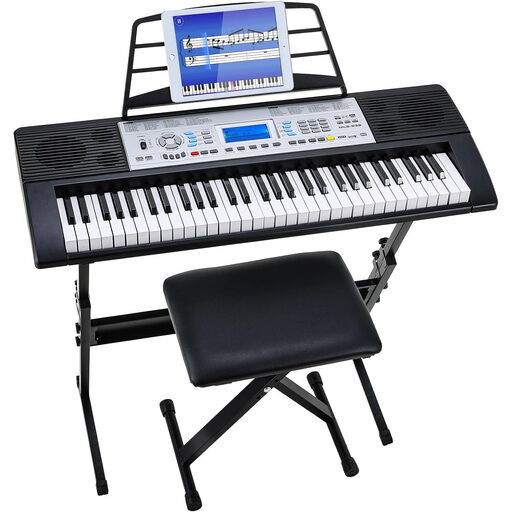
The included stand and stool may suit anyone looking for a complete practice set-up. Measure your space to make sure everything will fit.
According to the product name: 61 keys, stand, stool, 500 sounds, three-level learning mode, dual speakers and LCD screen.
No, you can practise the I, IV and V chords yourself, with a metronome if you like. If you want rhythmic support, check that the accompaniment on your chosen model suits your chord changes and tempo.
Measure the available width and depth, including space for sheet music and your seating position. Korg gives the EK-50’s dimensions without the music stand, so also measure the space your set-up will need for it.
Check what’s included in the specific offer and whether the connection is compatible with your headphones. Korg lists a mains adaptor and a 3.5 mm headphone socket for the EK-50; this doesn’t tell you what’s included with a set for another model.
No. Touch response describes how the sound reacts to the way you play; weighted keys are a separate feature. Check the keyboard description for the exact model and try the keys if piano technique is important to you.