
Independent melody learner
You want to learn a melody step by step and are looking for a suitable key range, touch sensitivity and useful practice features.


Start by identifying the lowest and highest notes in your melody. A touch-sensitive 61-key keyboard may be suitable if the melody and any accompaniment fit within its range. A 76-key model gives you a wider range, but takes up more space. Also check which practice features, headphone socket and set-up you need.
You want to learn a melody step by step and are looking for a suitable key range, touch sensitivity and useful practice features.
You share your home and mainly want to practise with headphones; the socket and volume for everyday use are key considerations.
You want to add left-hand chords or automatic accompaniment to the melody and check that the range and controls suit your needs.
| Point to consider | What to look for when buying | Who should prioritise this? |
|---|---|---|
| Playing the whole melody | Compare the lowest and highest notes in your arrangement with the range of the exact model. Then consider which practice features you need. | If I want to learn the melody note by note, I need to know whether all the notes fit on the keyboard. Around 36% of consumers say learning to play and range are their main concerns. |
| Practising without speaker sound | Check the headphone output, the compatible plug type and whether you need headphones or an adaptor. Headphones won’t eliminate the mechanical sound of the keys being pressed. | When I practise in a shared home, I want to avoid sound from the speakers and be considerate of others. Around 29% of consumers prioritise quiet practice. |
| Making sure your set-up fits | Measure the space for the keyboard, chair and sheet music. Casio Nederland lists the CT-S300 as measuring 930 × 256 × 73 mm; Medeli lists the MK61 as 916 × 305 × 92 mm. | If I use my practice space for other things too, I need to know whether the instrument and seating will fit together. Around 21% of consumers prioritise available space. |
| Melody with chords or accompaniment | Decide whether you want to play left-hand chords yourself or use automatic accompaniment. Check the controls and features of the specific version. | If I want to add chords or accompaniment to the melody, I need to choose features that suit the way I play. Around 14% of consumers say accompaniment or chords are their main concern. |
Extra sounds and styles won’t make up for a key range that’s too small for your arrangement.
First, compare the notes in your melody and any accompaniment with the keyboard’s range. Then consider which extra sounds you’ll actually use.
If you later want to play pieces outside the range, you may need a different instrument.
A touch-sensitive keyboard and a digital piano with weighted keys are different options; one feature doesn’t automatically mean the other.
Decide whether you mainly want to learn a folk melody on a keyboard or practise piano technique, then check the type of keys on the model.
What’s included varies by model and version.
Check the contents of the exact offer and measure the space for the keyboard, chair and sheet music before ordering.
Depending on what’s included, you may still need suitable headphones, a stand, a stool or a power supply.
The PSR-E383 is a 61-key keyboard with practice features; the PSR-EW320 has 76 keys for a wider range.
The CT-S300 is worth considering if compact storage and straightforward controls are important to you.
The E-X10 is an arranger keyboard to consider if you want to practise a melody with built-in accompaniment.
Medeli describes the MK61 as a 61-key model with built-in speakers and a headphone output.
These product picks focus on 61-key keyboards for practising at home. Check that your melody and any accompaniment fit within that range.
 No image available
Could suit a melody that fits within 61 keys; compare its range with your arrangement beforehand.
The product name lists 300 sounds, 300 rhythms, an LCD screen, USB-MIDI, speakers, a headphone socket and a music stand.
 No image available
Could suit you if your melody fits within 61 keys and you’d like to use a metronome when practising.
The product name lists a MIDI controller, recording function, speakers and music stand.
 No image available
Could suit a melody within 61 keys if you’re also looking for a stool and music rest for your set-up.
The product name lists a stand, stool, music rest, 300 tones, 300 rhythms, a three-level learning mode, LCD screen and USB-MIDI.
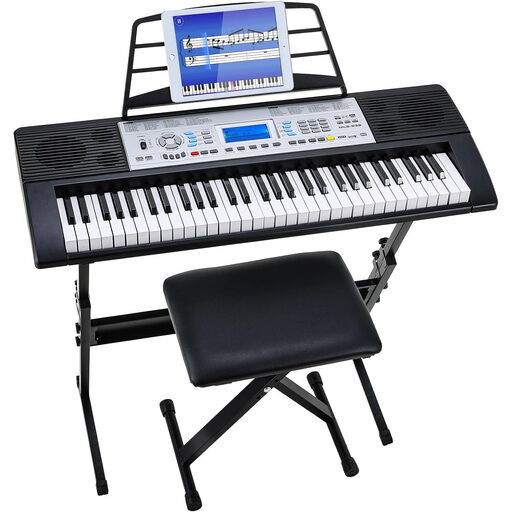 No image available
Could suit you if your melody fits within 61 keys and you want a stand and stool for your set-up.
The product name lists 500 sounds, a three-level learning mode, two speakers and an LCD screen.
It depends on the lowest and highest notes in your arrangement and whether you’ll be playing left-hand chords. Compare those notes with the keyboard’s range. If some fall outside it, consider a version with more keys.
Measure the space for the keyboard, a chair and your sheet music. Compare it with the dimensions of your chosen version and check whether the required stand, music rest and power supply are included.
Check whether headphones are included with each version and which plug fits the output. Medeli lists a 3.5 mm headphone output for the MK61; this doesn’t tell you whether headphones are supplied with other models.
ACM ConsuWijzer states that online purchases generally come with a statutory 14-day cooling-off period from delivery, subject to legal exceptions. This is separate from your statutory rights if a product doesn’t meet what you could reasonably expect; the seller must resolve issues with a faulty product in line with the applicable terms.
The Dutch Government states that electronic devices placed on the EU market must carry a CE mark. Check the marking and safety information for the keyboard itself and any mains adaptor.