If storage space is limited, a compact mini keyboard may suit you if the melodies you want to play fit within its smaller range. A 61-key keyboard gives you more room to play and may include learning features or accompaniment, but it needs a larger space. So first compare the notes in your music with the keyboard, then measure the space available. Also check the connections, power supply and details of the exact product on offer.
Who is this suitable for?
Melody player with limited storage space
You want to practise short melodies and put your instrument away afterwards. Compare the range of your music with a mini keyboard and measure the space you have available. Yamaha specifies 37 mini keys for the PSS-A50; Casio gives the CT-S300's width as 930 mm.
Beginner looking for accompaniment
You want to try chords, rhythms or learning features as well as playing melodies, and have room for a larger keyboard. Yamaha describes the PSR-E383 as having learning features and automatic accompaniment; Roland lists lessons and automatic accompaniment for the E-X10.
Player in a shared living space
You want to practise using headphones rather than the built-in speakers. Check the model's headphone socket and whether it fits your headphones' plug. Yamaha lists a headphone output for the PSS-A50, as does Korg for the EK-50.
What should you look for when choosing?
| What to consider |
What should you check? |
Who is this important for? |
| Playing and storage space |
Measure the available width and depth, then compare them with the instrument's dimensions. Remember to allow space for your hands and sheet music, too. |
If I need to put my keyboard away after practising, I want to know whether it will fit without leaving me with too few keys. Around 36% of consumers prioritise storage space. |
| Key range and ease of learning |
Compare the lowest and highest notes in a few melodies with the keyboard; also consider key size and any practice features. |
When I want to learn a particular melody, it matters whether the range and keys suit my music and the way I practise. Around 29% of consumers prioritise ease of learning. |
| Accompaniment |
Listen to the available rhythms and check whether you can set the chords and accompaniment you want. |
If I want to try chords or rhythms as well as playing the melody, I look for accompaniment that suits my music. Around 21% of consumers prioritise accompaniment. |
| Practising with headphones |
Check the type of headphone socket, the plug you need and what is included with the version on offer. |
In a shared living space, I want to practise without using the built-in speakers. Around 14% of consumers prioritise being able to practise with headphones. |
Common pitfalls
-
Comparing only the number of keys
The number of keys doesn't tell you whether the keyboard suits your music: the PSS-A50 has 37 mini keys, while 61-key models also vary in size and practice features.
Compare the range of a few melodies, the key size and the space you have measured.
-
Assuming lots of rhythms will include your folk music
A number of preset styles doesn't tell you which regional rhythms are available.
Check the specific list of styles or listen to a demonstration of the rhythm you want.
-
Assuming the power supply and accessories are included
The supplied power supply and connections can vary by model and version.
Check the contents, power supply specifications and headphone socket for the exact product on offer.
For the Yamaha PSS-A50, Yamaha states that the USB power adapter is sold separately, so check which power supply is included with the version on offer.
Brands to compare
Yamaha
The models discussed range from the compact PSS-A50 mini keyboard to 61-key keyboards such as the PSR-E383 and EZ-310.
- Yamaha describes the PSR-E383 as having learning features and automatic accompaniment; according to Yamaha, the EZ-310 has illuminated keys.
- The PSS-A50 has 37 mini keys. Decide for yourself whether the range and key size suit the melodies you want to play.
Casio
The CT-S300 is worth comparing if you're looking for a slim 61-key keyboard.
- Casio gives its dimensions as 930 × 256 mm and lists Touch Response, which adjusts the volume and sound according to how firmly you press the keys.
- Measure the space available and check that the features suit your music; the product specifications can't tell you whether a particular folk melody will fit.
Roland
According to Roland, the E-X10 is aimed at beginners who want to combine lessons with automatic accompaniment.
- Roland describes it as having built-in lessons and automatic accompaniment.
- The description of world music sounds doesn't confirm that a particular regional folk melody or style is included. Check the available sounds and dimensions.
Korg
The EK-50 is a 61-key keyboard with accompaniment features; compare its dimensions with your available space.
- Korg lists more than 280 preset Styles and dimensions of 994 × 392 mm without the music stand.
- Its depth may be a concern if space is limited. The number of Styles doesn't tell you whether a specific regional style is available.
Joybuy products for practising melodies
These 61-key keyboards and sets are for anyone looking for learning features, accompaniment or extra ways to practise.
 No image available
MLS-931 digital piano, 61 keys
Worth comparing if you're looking for a longer keyboard and want to use accompaniment while practising.
61 touch-sensitive keys; the product description lists automatic bass chords, a metronome and USB-MIDI.
Joybuy
 No image available
Electronic keyboard piano, 61 keys
Worth comparing if you're looking for a 61-key layout and features to support guided practice.
The product name lists a MIDI controller, recording function, speakers, metronome and music stand.
Joybuy
 No image available
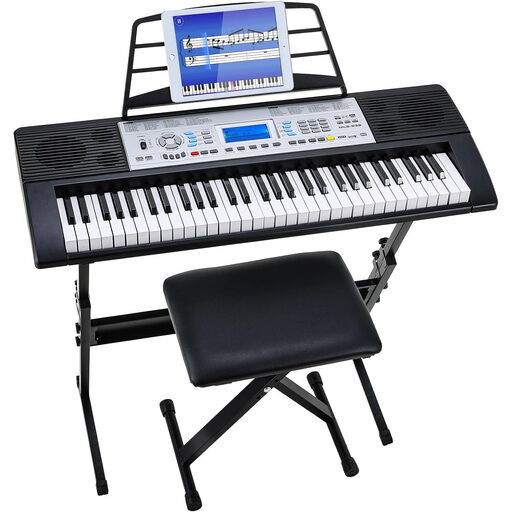
Digital keyboard set, 61 keys
Worth comparing if you want to pair a keyboard with a stand and stool in your practice space.
The product name lists a stand, stool, three-stage learning mode, 500 sounds and two speakers.
Joybuy
Frequently asked questions
Are 37 keys enough for your folk melodies?
It depends on the lowest and highest notes, and on what you want to play at the same time. Yamaha lists 37 mini keys for the PSS-A50; compare its range with a few melodies you want to learn.
Can you use a keyboard without a separate amplifier?
You can with models that have a built-in speaker or a headphone output. Yamaha lists both for the PSS-A50, as does Korg for the EK-50; check the connections on the model you're considering.
Is a mains adapter always included?
No, it varies by model. Yamaha says the USB power adapter for the PSS-A50 is sold separately, while Korg lists a mains adapter as included with the EK-50. Check what's included with the exact version.
Which product safety rules apply when buying in the Netherlands?
Electrical and electronic products offered for sale on the Dutch market must comply with the applicable European requirements. Ondernemersplein explains that, for products covered by CE rules, the manufacturer affixes a CE mark after carrying out a conformity assessment. Check the product information for the exact item.
Does a CE image in an advert prove that the keyboard complies with the rules?
An image on its own doesn't prove that the exact product on offer meets the applicable requirements. Ondernemersplein explains that the CE mark and EU declaration of conformity are the manufacturer's responsibilities when the rules apply to that product; check the relevant product information.


