
Planner with limited desk space
You write schedules and messages while also needing room for your mouse and papers. TNO, as published via Arboportaal, notes that a slim keyboard may make it possible to keep the mouse closer for many tasks.


Start by considering how much space you need beside the keyboard for your mouse and planning materials. If you mainly work with text, a compact design is an obvious choice. If you often enter prices or quantities, weigh the convenience of a number pad against the space it takes up, and check the keyboard layout and how it connects to your devices.
You write schedules and messages while also needing room for your mouse and papers. TNO, as published via Arboportaal, notes that a slim keyboard may make it possible to keep the mouse closer for many tasks.
You use more than one device for the same activity and want to check whether your keyboard can switch between them. Compare the connections and features listed by the manufacturer for the exact model, for example on models from Logitech and CHERRY.
You mainly enter quantities or budget items and want to decide whether a number pad is worth the extra desk space. BakkerElkhuizen describes the S-board 840 as having an integrated numeric keypad that you activate with NumLock.
First measure the space you need for your keyboard, mouse and planning materials together. Then decide which task and connection matter most to you.
| What to consider | What to look for | Who is this important for? |
|---|---|---|
| Room for your mouse and papers | Measure the available width with your mouse in place and check the dimensions of the model you’re considering. | If I want to keep my mouse and planning papers on the same small desk, I’ll consider how much space is left overall; around 33% of consumers prioritise space for their mouse and documents. |
| Typing messages and schedules | Check the keyboard layout and the position of the keys you use often. Where possible, try the feel and readability of the keys for yourself. | If I write invitations, messages and schedules, I want a layout that suits the way I type; around 27% of consumers give typing top priority. |
| Switching between devices | Check which connection modes your devices support and which receivers or ports you’ll need. | If I switch between, say, a laptop and tablet while planning, I want to know whether the connection I need works with both; around 20% of consumers prioritise switching between devices. |
| Entering figures | Compare a separate number pad with an integrated numeric keypad or the standard number row, and bear in mind how much desk space you have. | If I enter lots of prices or quantities, I want a number layout that suits the task without making my workspace unnecessarily cluttered; around 20% of consumers prioritise entering figures. |
A smaller keyboard won’t necessarily leave enough room for your mouse and planning materials; the overall layout determines how much workspace you have left.
Measure the space you need for your keyboard, mouse and papers together before choosing a layout.
The controls can work differently. According to BakkerElkhuizen, NumLock activates the integrated numeric keypad on the S-board 840.
If you enter figures often, compare the layout with a separate number pad and see whether that way of working suits you.
Bluetooth, a 2.4 GHz connection and a cable each have different requirements for your device and the available ports.
For the exact model, check which connection modes your devices support and whether you need a receiver or a free port.
The Pebble Keys 2 K380s and MX Keys Mini are compact models with different features. Compare the exact version with your workspace and devices.
The KW 9200 MINI is a compact option if you want to compare different ways of connecting.
The S-board 840 is a compact option for a fixed workspace where you sometimes enter figures.
This selection features compact keyboards. Before using one for schedules and figures, check that the layout, connection and listed features suit the way you work.
 No image available
The compact design may be useful if you want to free up desk space. Check that the layout includes the keys you need for planning.
The product name lists Hall effect magnetic switches, rapid trigger, an 8K polling rate and adjustable actuation from 0.01 mm.
 No image available
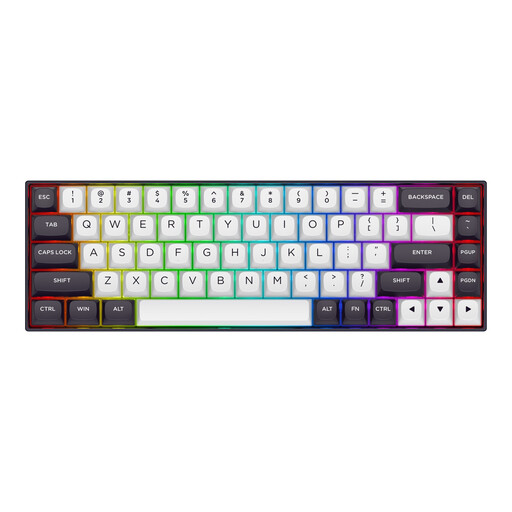
The compact design may suit a desk where you also need room for a mouse. Check the keyboard layout for your everyday planning tasks.
The product name lists 68 keys, magnetic switches and an 8000 Hz polling rate. The listed layout is US Layout.
 No image available
This model is worth considering if you’re looking for a US Qwerty layout. Check that it suits the way you use punctuation and frequently used keys.
The product name lists Purple Switch and a US Qwerty layout.
 No image available
This model may be useful if you switch between a computer, tablet or smartphone while planning. Check that the Bluetooth connection works with your devices.
The product name describes a foldable Bluetooth keyboard with touchpad for tablets, smartphones and computers.
 No image available
The compact design may suit a small workspace. Check beforehand that the layout works for your writing and number-entry needs.
The product name lists a wired 60% layout, 61 keys, US QWERTY and RGB lighting.
Position your keyboard and mouse to suit your work, and consider how far you have to reach for the mouse. For employees who work at a screen for more than two hours a day, Arboportaal lists specific requirements, including that the screen and keyboard must not be attached to each other. This rule applies to employees under that condition; it is not a general requirement for every volunteer planning an event at home.
That depends on the keyboard model and your devices. Logitech lists Easy-Switch for three devices on the Pebble Keys 2 K380s; for the KW 9200 MINI, CHERRY lists Bluetooth and wired connections, among others. Check in advance that the connection mode you want works with both your laptop and tablet.
According to the Dutch government, online purchases from a business often come with a 14-day cooling-off period; check the terms that apply to your purchase. You also have statutory rights against the seller if a product is faulty. According to the Dutch government, there is no fixed statutory warranty period in the Netherlands that applies to all products.
For radio equipment placed on the EU market, the European Commission sets out requirements covering areas such as safety, electromagnetic compatibility and radio spectrum use. CE marking is only required when the relevant EU rules say so; a logo or advertising claim alone does not confirm that a specific model complies. These are product rules, not a licence for everyday keyboard use.