
Writers switching between text and references
If you refer to instructions and a second document while writing, easy-to-reach navigation keys and shortcuts that work in your software matter more than a keyboard feature for split document view.


Start by considering your main writing needs: switching between text and references, adjusting your hand position or keeping your desk clear. A compact keyboard can save space, while a fixed split keyboard keeps its halves together. Two separate halves give you more freedom to position them. You arrange documents side by side in your writing software, not with your keyboard.
If you refer to instructions and a second document while writing, easy-to-reach navigation keys and shortcuts that work in your software matter more than a keyboard feature for split document view.
If you want to adjust your hand position to suit your workspace, compare a fixed split keyboard with models whose halves can be positioned separately.
If you want to leave room beside your keyboard for a mouse and craft materials, a compact layout may be a good fit. Just check that it still has the keys you use most often.
First, check whether your writing software can display documents side by side and which shortcuts you need. Then choose a keyboard layout to suit your workspace and the hand position you want to be able to set.
| Key consideration | What should you check? | Who is this important for? |
|---|---|---|
| Switching between documents | Test the keys and shortcuts you need in your own writing software. Also check the physical layout and any configuration software. | If I often switch between booklet text and references, I want commands to be easy to reach. Around 33% of consumers in this writing scenario make navigation their top priority. |
| Hand position | Compare the adjustable spacing and angle, the overall width and any accessories included with the specific version. | If I type for long periods, I want to assess whether a fixed or adjustable layout suits my workspace. Around 25% of consumers make hand position their top priority. |
| Desk space | Measure the space available for your keyboard, mouse and materials. Check whether you need a number pad and the navigation keys you want. | If I need room beside my keyboard for a mouse and craft materials, the overall layout matters. Around 25% of consumers make desk space their top priority. |
| Quiet typing and switching between devices | Check the connection options for the exact version, the key layout and whether you can try out the feel of the keys. | If I work in a shared space or switch between devices, I want to know whether the keyboard suits that situation. Around 17% of consumers make quiet typing or device use their top priority. |
Your writing software controls how documents are displayed; a keyboard with split halves does not create that view itself.
First check whether your writing software supports the window layout you want. Then choose a keyboard shape to suit your hands and workspace.
Compact and full-size keyboards do not necessarily have the same key layout. This means that keys you use when writing may be in different positions or missing altogether.
Think through the tasks you regularly perform and check the exact layout before choosing a compact model.
If you often enter numbers, a separate number pad can take up extra desk space.
A fixed split frame does not give you the same freedom of placement as two separate halves. Adjustment options and included accessories also vary between versions.
Check the space available, the connecting cable and which accessories are included with the specific model.
The MX Keys S and ERGO K860 are different models to consider if you are looking for programmable keys or a fixed split design, respectively.
The European Freestyle2 versions are an option if you want to choose the distance between two separate keyboard halves.
The Compact Break and Split Break offer different layouts: a compact model and halves that can be positioned separately.
According to Trust, the Keyra combines a fixed ergonomic layout with connection options for multiple devices.
This selection includes compact keyboards for keeping your desk clear, as well as models with programmable keys or connection options for multiple devices.
 No image available
A compact layout may suit you if you want to keep your desk clear while retaining navigation keys.
75% layout; US QWERTY; wired, Bluetooth or 2.4G; Reaper Switch.
 No image available
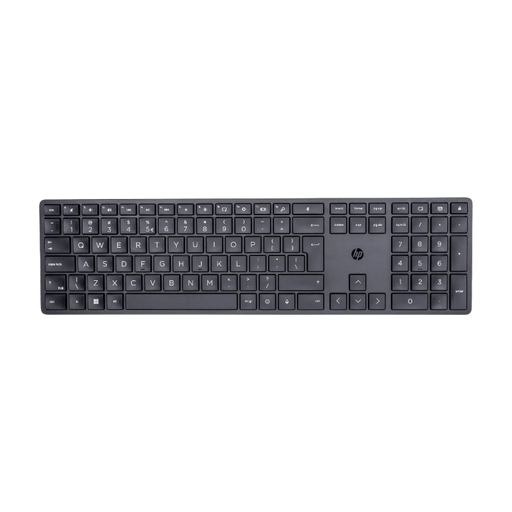
This model may be worth considering if you want to set up programmable keys for tasks you perform often.
Check whether HP Accessory Center and the available settings work with your writing software.
 No image available
A full-size model may suit you if you want a number pad and need to switch between devices.
Full-size with number pad; scissor switches; US QWERTY.
 No image available
The compact layout may be useful if you want to keep your desk clear.
75% layout; wired; US QWERTY; hot-swappable linear switches.
 No image available
An extra-compact layout may suit you if you want to keep as much desk space free as possible.
60% layout; wired; 61 keys; US QWERTY. No number pad.
No. In supported desktop versions of Word, you can display two open documents using the ‘View Side by Side’ option, as described by Microsoft Support. For other programmes and versions, check their own window features and keyboard shortcuts.
The Word shortcuts described by Microsoft Support refer to a US keyboard layout and may differ on other layouts. So check both the physical layout and the settings on your computer and in your writing software.
With a fixed split model, the keyboard halves remain part of one unit. With an adjustable model, you can position the halves separately. Check the space needed, the cable and any accessories included with the specific version.
Check the length of the connecting cable and the spacing and angle you can adjust. Kinesis describes different cable versions for the Freestyle2; tenting accessories are optional.
No. The Dutch Arboportaal describes alternating screen work with other tasks or taking a break as an employer obligation. This does not guarantee that a particular keyboard will prevent physical discomfort.