
Sheet-music reader with a limited range
You want to read and play new pieces. A more compact keyboard may be suitable if all the notes fall within its range; Yamaha lists the PSR-E383 as a 61-key model.


First, choose an instrument with a range that covers the lowest and highest notes in your sheet music. Then check whether the instrument, music stand and seat will all fit in the spare room. A keyboard with 61 or 76 keys may be suitable if its range covers your pieces; if you need a wider range or want to practise on weighted piano keys, a portable 88-key digital piano is a more likely fit. For each version, check the headphone socket and which stand, music rest and pedals are included.
You want to read and play new pieces. A more compact keyboard may be suitable if all the notes fall within its range; Yamaha lists the PSR-E383 as a 61-key model.
You also want to play pieces with a wider range or practise piano technique on weighted keys. Yamaha, Roland and Kawai all describe portable 88-key piano models.
You want to avoid using the speakers when other people are at home. Roland lists headphone use for the FP-10; check the socket on the version you choose.
Suitable if: your sheet music falls within its range and you want a more compact setup. Yamaha lists touch-sensitive keys on the PSR-E383.
The trade-off: touch-sensitive keys are not the same as a weighted hammer-action mechanism.
Suitable if: 61 keys aren’t enough for your pieces, but you don’t automatically want to choose an 88-key model. Casio lists the CT-S1-76 as a 76-key model.
The trade-off: it has a wider range than a 61-key model, but not the full range of an 88-key piano.
Suitable if: your sheet music calls for a wider range or you want to practise on weighted piano keys. Yamaha lists a GHC keyboard for the P-145, while Roland lists a PHA-4 Standard keyboard for the FP-10.
The trade-off: measure your available space first; Yamaha lists the P-145 as 1.326 mm wide.
| What to consider | What to look for | Who it matters most to |
|---|---|---|
| Range of the sheet music | Compare the lowest and highest notes with the model’s range; also check whether a music rest is available. | I want to be able to play every note in my pieces before looking at extra features; around 33% of consumers give range their top priority. |
| Space for the setup | Measure the available width and depth for the instrument, music rest and seat. Yamaha lists the P-145 as 1.326 mm wide. | If the spare room has little free space, I want to make sure the whole setup will fit. Space comes first for around 25% of consumers. |
| Practising when others are at home | Check the headphone output and the correct plug; headphones won’t eliminate the physical sound of the keys being pressed. | When other people are at home, I want to practise without sound from the speakers; around 17% of consumers list this as their main concern. |
| Key feel for piano technique | Check whether the exact model has touch-sensitive keys or a weighted keyboard mechanism. | I want to practise piano technique, so I look at the mechanism type, not just touch sensitivity. Around 25% of consumers give key feel their top priority. |
A suitable keyboard range doesn’t tell you whether the instrument, music rest and seat will all fit in your practice space.
Compare the lowest and highest notes in your pieces with the keyboard’s range, then measure the whole setup.
Yamaha describes different keyboard mechanisms for the 61-key PSR-E383 and the 88-key P-145.
If piano-like key feel matters to you, check the mechanism type of the exact model.
What’s included varies by model and version. Yamaha lists an optional LP-5A three-pedal unit for the P-145; Roland lists an optional DP-10 pedal with half-pedalling for the FP-10.
Check what’s included with the specific version and which connections you’ll need before ordering.
The PSR-E383 and P-145 offer different options: a compact 61-key keyboard or a portable 88-key digital piano.
The FP-10 is a portable 88-key digital piano for anyone looking for a full piano keyboard.
The Casiotone CT-S1-76 offers a 76-key option between a shorter keyboard and an 88-key piano.
The ES120 is a portable digital piano option for anyone looking for piano-playing and practice features.
This Joybuy selection features 61-key instruments for pieces whose notes fall within that range; compare the version and included accessories for each product.
 No image available
A 61-key option for sheet music where every note falls within the keyboard’s range.
The product name lists a weighted keyboard, 300 tones, 300 rhythms, an LCD screen, USB-MIDI, speakers, a headphone socket and a music rest.
Notes beyond the range of 61 keys can’t be played without adaptation.
 No image available
A compact choice for pieces where every note falls within the range of 61 keys.
The product name lists a MIDI controller function, recording function, speakers, metronome and music rest.
Notes beyond the range of 61 keys can’t be played without adaptation.
 No image available
This set may suit a practice space that needs an instrument, stand, stool and music rest, provided the 61-key range covers your sheet music.
The product name lists 300 tones, 300 rhythms, a three-level learning function, an LCD screen and USB-MIDI.
Notes beyond the range of 61 keys can’t be played without adaptation.
 No image available
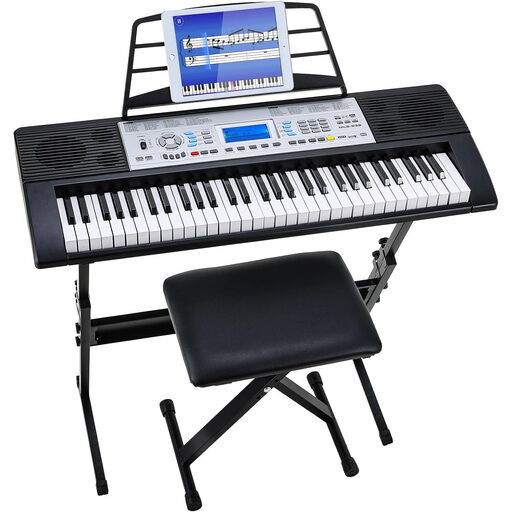
A 61-key set for sheet music where every note falls within the keyboard’s range.
The product name lists 500 tones, a three-level learning function, dual speakers and an LCD screen. According to the product name, the set includes a stand and stool.
Notes beyond the range of 61 keys can’t be played without adaptation.
No. Yamaha describes the 61-key PSR-E383 as touch-sensitive, and lists a weighted GHC keyboard for the 88-key P-145. Check the mechanism type of the exact model you’re considering.
Measure the space for the instrument, seat and music rest. Check what’s included with each version, including the stand and any pedals; Casio lists a pedal as an option for the CT-S1.
With a suitable headphone socket, you can practise without sound from the speakers; Roland lists headphone use for the FP-10. Check the socket and plug on the model you choose. Headphones won’t eliminate the physical sound of the keys.
According to ACM ConsuWijzer, online purchases usually come with a statutory cooling-off period of up to 14 days after delivery, subject to legal exceptions. The seller is also responsible if a product, when used normally, doesn’t meet what you were entitled to expect. Don’t assume there’s one fixed statutory warranty period for every keyboard.