What should you look for when choosing?
Start by considering who will be playing and how wide a range the score requires. A duo function is only useful if both parts fit within the shared keyboard layout.
Digital piano with a Duo function
Choose this when: you want two players to practise on one instrument or you play a piano part. Yamaha lists Duo for the P-145; Roland describes Twin Piano for the FP-10.
Consider: compare both parts with the range available on each allocated half of the keyboard, and allow for the space the instrument needs.
Compact keyboard
Choose this when: you’re mainly practising your own part and it fits within 61 keys. The Yamaha PSR-E383 has 61 touch-sensitive keys.
Consider: touch-sensitive keys aren’t the same as a weighted piano keyboard. Check the lowest and highest notes in your part.
Keyboard with practice features
Choose this when: you practise on your own and would find built-in rhythms or practice material helpful. Casio describes the CT-S400 as offering rhythms and practice options for left- and right-hand parts in built-in songs.
Consider: built-in accompaniment won’t necessarily be the other part in your duet. Check that the practice material suits your part.
| What to consider |
What should you check? |
Who is this important for? |
| Two players sharing one keyboard |
Compare the lowest and highest notes in both parts with the keyboard halves, and check how the Duo function works. |
If I want to play with my duet partner on one instrument at the same time, I need to know whether we can both play our parts. Around 33% of consumers prioritise practising together. |
| Note range and touch |
Compare the range and key action with your part and the requirements of your course. |
If my part needs a wide range or I want to practise piano technique, that will influence my choice of instrument. Around 27% of consumers prioritise range and touch. |
| Practising with headphones |
Check the headphone socket on the exact model and work out how two players can hear the sound. |
If I’m practising in a shared space without using the speakers, I need to know whether the listening setup will work for me. Around 20% of consumers prioritise quiet, individual practice. |
| Practising independently and moving the instrument |
Compare the weight and dimensions, and check whether the built-in accompaniment is useful for your part. |
If I need to put the instrument away after practising or want to practise on my own, portability and suitable accompaniment both matter. Around 20% of consumers prioritise practising independently and moving the instrument. |
Joybuy products for practising on your own
These 61-key keyboards are suitable for practising on your own if your duet part fits within that range.
 No image available
Electronic keyboard with 61 keys and MIDI controller
Worth considering if your part fits within 61 keys.
The product description lists a headphone socket. The title mentions recording, speakers, a metronome and a music stand.
Joybuy
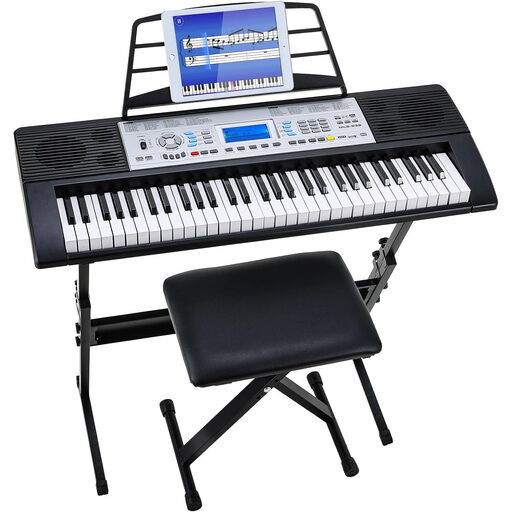 No image available
61-key keyboard set with stand and stool
Worth considering if your part fits within 61 keys and you’re looking for a set that includes support and seating.
The product information lists 500 tones, an LCD screen and a three-level learning mode. The title mentions two speakers.
Joybuy
Frequently asked questions
Do I need a Duo function to practise a duet part?
No, not if you’re only practising your own part. In that case, focus on the note range you need and the key action. If two people are playing on one instrument, check that both parts fit within the Duo layout.
Can two players practise on the same instrument with headphones?
You can’t tell from a single PHONES socket or a Duo function. Check how many outputs the exact model has and how both players can hear the sound in the setup you have in mind.
What should I check before setting up and putting the instrument away?
Measure the available space, including room to play, and store the instrument according to the manual for your chosen model. Check which power supply, stand, headphones and any pedal are included with that version; Yamaha lists the three-pedal unit for the P-145 as optional.
Who should I contact about a fault, and what about returns?
According to the Rijksoverheid, for a consumer purchase the seller must offer a solution if the product doesn’t meet reasonable expectations. For a standard online consumer purchase, you generally have up to 14 days after delivery to change your mind; ACM ConsuWijzer lists some exceptions. Check the terms and conditions for your specific purchase.
Is a CE marking an independent assessment of playing quality?
No. The European Commission describes CE marking as a declaration by the manufacturer that applicable EU product requirements have been met, not as an independent assessment of playing quality. The requirements that apply to a particular version must be established separately.


