What should you look for when choosing?
When practising a duet part in a spare room, the key considerations are range and touch, the ability to practise quietly, the space available and, if relevant, playing together.
| Key consideration |
What to look for when buying |
Who is this important for? |
| Range and touch |
Compare the lowest and highest notes in your part with the keyboard. Also decide whether you want to practise on weighted piano keys or a different type of keyboard action. |
If I want to play my part in the intended register, I first check that all the notes fit on the keyboard. Around 36% of consumers give range and touch the highest priority. |
| Quiet practice |
Check the headphone socket, the correct plug and, if you’re listening together, the number of outputs. |
When I practise while other people are at home, I want to listen through headphones; a second socket may be needed if we’re practising together. Around 29% of consumers prioritise being able to practise quietly. |
| Room space |
Measure the available space and allow for the set-up, music rest and any stand. The Yamaha PSR-E383 measured in this guide is 941 mm wide; Yamaha lists the Yamaha P-145 as 1.326 mm wide. |
If the spare room has another purpose too, I want to know in advance whether the instrument and playing set-up will fit. For around 21% of consumers, available space is the top priority. |
| Playing together |
Check how the specific duo or duet mode splits the keyboard, then compare that with the registers of both parts. |
If we practise together, I want to know whether the split works with our sheet music. Around 14% of consumers give playing together the highest priority. |
Joybuy products
These product picks are 61-key keyboards for parts that fit within that range. Before buying, check that the touch, connections and included accessories suit your practice set-up.
 No image available
MLS-931 keyboard, 61 keys, black
An option if your part fits within 61 keys and you’re looking for a weighted keyboard.
The product information lists a headphone socket and metronome. Check that your part’s range fits on the keyboard.
View at Joybuy
 No image available
Electronic keyboard, 61 keys, black
An option for practising a part that falls within the range of 61 keys.
The product name lists a recording function, speakers, metronome and music rest. The description mentions USB-MIDI and a headphone socket.
View at Joybuy
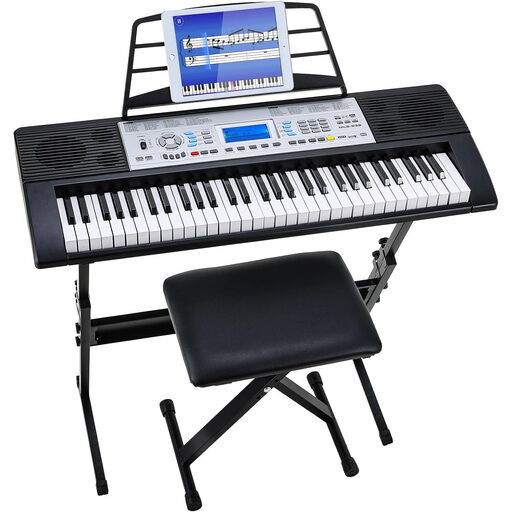 No image available
61-key keyboard set with stand and stool
A set to consider if you’re looking for a keyboard with a stand and stool, and your part fits within 61 keys.
The product name lists 500 sounds and a three-level learning mode.
View at Joybuy
Frequently asked questions
Do I need a duo or duet mode to practise my own part?
No, not if you’re practising your part on your own. The duet mode on the Casio CDP-S160RDSET splits the keyboard into two halves with the same tonal range. If you’re playing with someone else, check that the registers in both your parts fit.
Should I choose a 61-key keyboard or an 88-key digital piano?
Choose based on the range of your part and the key feel you want. A 61-key model is suitable if your part fits within that range; 88 keys offer a wider range, but also measure whether the model and playing set-up will fit in the spare room.
What should I look for if I want to practise with headphones?
Check that the exact model has a suitable headphone socket. If two players want to listen at the same time, check the number of outputs too; Roland lists two headphone outputs for the FP-30X.
What should I check before putting the instrument in the spare room?
Measure the available space and check that there’s room for the playing set-up, music rest and any stand. Also check whether you need a pedal or headphones, and whether these are included with the exact version.


