Who is this choice relevant to?

Two players at one keyboard

You want to practise together in the loft and check that the shared playing zones suit your parts and that you can both listen. Yamaha describes Duo mode for the PSR-E383; Roland lists Twin Piano and two headphone outputs for the FP-30X.

Pianist practising a duet part

You’re learning your own part and want the keyboard’s range and touch to suit the passages you’re practising. Yamaha describes the P-145 as having 88 weighted keys.

Practising in a shared home

You want to practise at home while considering where the instrument will go and the people in or around your home. Roland lists headphone sockets for the FP-30X; using headphones doesn’t, in itself, tell you how noisy the keys are when played.

What should you look for when practising a duet part in the loft?

Compact keyboard

A good fit if: your part falls within the keyboard’s range and you’re looking for a shorter keyboard.

Consider: a 61-key keyboard is not the same as an 88-key keyboard with weighted keys.

Portable digital piano

A good fit if: your part calls for a piano-like touch or a wider keyboard range.

Consider: measure the space for the instrument and the rest of your playing setup.

76-key keyboard

A good fit if: you want to compare a wider range with that of a 61-key keyboard.

Consider: 76 keys don’t automatically mean weighted piano keys or a two-player mode.

Consideration What should you check? Who is this important for?
Playing together Compare both parts with the playing zones and check the number of headphone outputs. Yamaha describes Duo mode for the PSR-E383; Roland lists Twin Piano and two outputs for the FP-30X. If we’re sharing one keyboard, our parts need to fit within the playing zones and we both want to be able to listen. Around 36% of consumers put playing together first.
Quiet practice Check the headphone socket and try the setup where you plan to use it. If necessary, agree practice times with housemates or neighbours. When I practise at home, I want to be considerate of audible sound and any disturbance to others. Around 29% of consumers make quiet practice their top priority.
Range and touch Note the lowest and highest notes in your part, including any changes of octave, and compare them with the keyboard. Yamaha lists 61 keys for the PSR-E383 and 88 weighted keys for the P-145; Casio lists 76 keys for the CT-S1-76. If the notes and touch required for my own part are what matter most, I want to compare them with the keyboard first. Around 21% of consumers prioritise the range of their part and a piano-like touch.
Loft setup Measure the usable space, including the stand, music rest and seat; check which accessories are included with each version. Yamaha lists the LP-5A pedal unit for the P-145 as an optional extra. If space is limited or I want to move the instrument, the whole playing setup needs to fit. Around 14% of consumers look at this first.

Buying pitfalls to avoid

  • Assuming Duo mode works for every duet

    A shared keyboard can limit the range available to each player, while a duet may consist of two different parts.

    Compare the lowest and highest notes in both parts with the playing zones. If you’re practising alone, focus on whether your entire part fits on the keyboard.

  • Assuming one headphone socket is enough for two players

    A two-player mode and two headphone outputs are separate features. Roland lists two outputs for the FP-30X.

    Check both features on the exact model and see what wired listening setup you’ll need.

    To listen together, you may need suitable wired accessories or a different listening setup.

  • Measuring only the length of the instrument

    You’ll also need enough usable space for the music rest, stand, any pedals and a seat.

    Measure the complete setup and check what’s included with the version on offer. Yamaha lists the LP-5A pedal unit for the P-145 as an optional extra.

    You may need to buy a stand or pedal separately, so check whether it’s included with the version you’re considering.

Brands and models compared

Yamaha

The PSR-E383 is a 61-key keyboard; the P-145 is a portable digital piano with 88 weighted keys.

  • Yamaha lists touch-sensitive keys, accompaniment features and Duo mode for the PSR-E383; the P-145 has a GHC keyboard with 88 keys.
  • Check that your part fits within the available playing zone. Duo mode doesn’t prove that two players can each keep the full original range of their parts.

Roland

The FP-30X is a portable digital piano worth considering if a full-size keyboard and listening together are important to you.

  • Roland lists 88 PHA-4 Standard keys and two headphone outputs for the FP-30X; the manual describes Twin Piano.
  • These features don’t show that every combination of two duet parts will fit within the shared playing zones.

Casio

The CT-S1-76 is a keyboard option with a mid-range number of keys.

  • Casio lists 76 keys and a portable design for this model.
  • Don’t assume it has weighted piano keys or two headphone outputs; check the connections on the exact version.

Kawai

The ES120 is a portable digital piano worth comparing if a piano-like touch and practising at home are priorities.

  • Kawai describes the ES120 as having Responsive Hammer Compact keyboard action, a metronome and a recorder.
  • Kawai also lists Dual and Split; those feature names alone don’t show that two players can play separate parts at the same time.

Joybuy products for a part within 61 keys

These Joybuy products have 61 keys and are suitable for practising a part that falls within that range. Also compare the connections and accessories listed for each version.

MLS-931 digital piano with 61 keys, black

MLS-931 digital piano, 61 keys, black

This may suit you if the notes in your part fall within the range of 61 keys.

The product name lists a weighted keyboard, 300 tones, 300 rhythms, USB-MIDI, speakers, a headphone socket and a music rest.

Check that your part fits within the range of 61 keys.

View at Joybuy
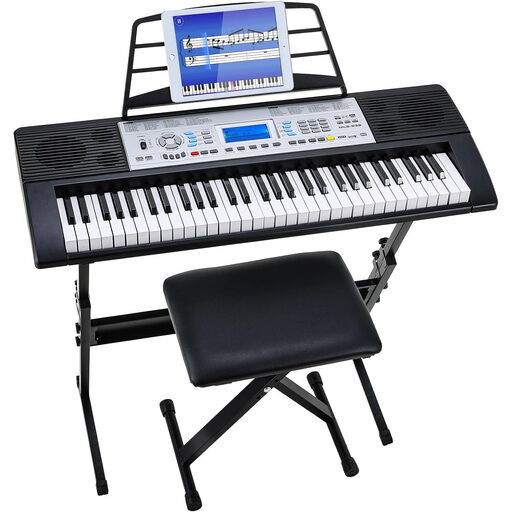
61-key digital keyboard with stand and stool

Digital keyboard, 61 keys, set with stand and stool

This may suit you if the notes in your part fall within the range of 61 keys.

The product name lists 500 tones, a three-level learning function, two speakers and an LCD screen.

The set includes a stand and stool; check that the keyboard’s touch suits what you’re looking for when playing your part.

View at Joybuy

Frequently asked questions

Do you need Duo or Twin Piano mode for your duet part?

Not if you’re only practising your own part: start by checking the range and touch you need. If two players are sharing one keyboard, check that both parts fit within their allocated zones. Yamaha describes Duo mode for the PSR-E383 and Roland describes Twin Piano for the FP-30X; Kawai lists Dual and Split for the ES120, but those names alone don’t prove that it has a two-player mode.

Can two people practise with headphones at the same time on the Roland FP-30X?

Roland says the FP-30X has two headphone outputs, so two people can use headphones at the same time. Also check that the playing mode suits your parts.

How should you set up a practice space in the loft?

Measure the entire playing setup, not just the instrument’s casing. Check whether a stand, music rest and any pedals are included with the version you’re buying; Yamaha lists the LP-5A pedal unit for the P-145 as an optional extra.

What rules apply to online purchases in the Netherlands?

For online consumer purchases, you generally have a statutory 14-day cooling-off period after delivery, although exceptions apply. ACM ConsuWijzer explains how this period works. The Netherlands Authority for Consumers and Markets states that the seller is responsible for the statutory guarantee if a product is faulty; the appropriate solution depends on the circumstances.

Can you play the keyboard at any time at home if your neighbours can hear it?

There isn’t one set practice time that applies to every home: local rules and circumstances matter. The Dutch government says that in many municipalities, nuisance caused to neighbours may be covered by the General Local By-law, and advises you to agree arrangements with your neighbours first.
