Choose a keyboard with touch-sensitive keys and accompaniment if you mainly want to practise chord changes and solos with a rhythm. A digital piano with 88 keys is a better fit for two-handed piano playing across a wider range. Also compare the key action, available space, headphone socket and included accessories.
Who is each option suitable for?
Blues student who wants to play along with accompaniment
You want to practise chord progressions and try a melody or solo over them. Compare how a keyboard controls rhythm and chord accompaniment; these features don’t replace learning to play for yourself. Yamaha and Roland describe these kinds of accompaniment and chord features on their models.
Student practising piano parts
You want to use both hands and value keyboard range and touch response more than a wide range of accompaniment features. Also compare the different keybeds on the 88-key instruments mentioned: Korg describes the Liano as having an LS keybed, while Yamaha lists a GHC keybed for the P-145.
User of a shared music room
You want to be able to set up or store the instrument, or use it with headphones while sharing the room with others. Check the connections, the dimensions of the model you choose and the room’s rules for use.
What should you look for when choosing?
Keyboard with automatic accompaniment
Choose this option: if you want to play blues chords yourself and switch between rhythm, accompaniment and a melody or solo. Yamaha describes automatic accompaniment styles on the PSR-E383; Roland says you can create your own chord progressions on the GO:KEYS 3.
Bear in mind: the keyboards mentioned have 61 keys, compared with 88 keys on the digital pianos mentioned. Check that your lesson pieces fit within the range and that the controls suit your practice goals.
Lightweight 88-key digital piano
Choose this option: if you want to practise two-handed parts across a wider range and need to move the instrument regularly. Korg says the Liano has 88 touch-sensitive LS keys, a metronome and a headphone socket.
Bear in mind: Korg lists the Liano as 1.282 mm wide and weighing 6,0 kg without batteries and music rest. The stand is sold separately; the LS keybed is not the same as the GHC keybed on the Yamaha P-145.
Digital piano with GHC keybed
Choose this option: if, alongside blues progressions, you mainly want to practise piano and pieces across 88 keys. Yamaha specifies that the P-145 has 88 keys with a GHC keybed.
Bear in mind: Yamaha lists the P-145 as 1.326 mm wide and weighing 11,1 kg. The optional LP-5A three-pedal unit is not automatically included with every purchase.
| What to consider |
What should you check? |
Who is this most important for? |
| Rhythm and accompaniment |
Check whether you can control the chords yourself, which rhythm and metronome features the model has, and how the accompaniment works. |
I want to practise chord changes and solos with a rhythm without handing over control of the chords; around 36% of consumers prioritise accompaniment for blues progressions. |
| Two-handed playing and touch response |
Compare the range with your lesson pieces and check which type of keybed the instrument has; try the key action if possible. |
If I mainly practise parts with both hands, range and piano-style key action matter more than built-in accompaniment; around 29% of consumers have this piano-focused priority. |
| Quiet practice |
Check whether the exact model has a headphone socket, whether you need an adaptor and what the music room’s rules are. |
I want to practise without disturbing others unnecessarily, so I’m looking for a suitable way to connect headphones; around 21% of consumers prioritise quiet use in a shared space. |
| Setting up and storing |
Measure the available space and check the dimensions, weight, power supply and any accessories needed for setting it up. |
If I need to store or move the instrument, ease of handling and a suitable place to set it up are decisive; around 14% of consumers prioritise size and ease of handling. |
Common buying mistakes
-
Assuming that a wide range of sounds will help you learn blues progressions better
The number of sounds doesn’t tell you whether you’ll play the chord changes yourself or whether the accompaniment will suit your lessons.
Try the chord, rhythm and tempo controls with an exercise similar to what you want to learn.
-
Assuming that all touch-sensitive keybeds feel the same
Korg describes the Liano as having an LS keybed, while Yamaha lists a GHC keybed for the P-145. So having the same number of keys doesn’t mean they have the same type of keybed.
Compare the stated keybed types and try the key action if possible before choosing.
-
Assuming that the stand and pedals are included as standard
Korg says the stand for the Liano is sold separately. Yamaha describes the LP-5A three-pedal unit for the P-145 as optional.
Check what’s included in the specific offer and decide which accessories you really need.
A separate stand, pedal or suitable headphones may mean extra items to arrange and additional equipment for setting up.
Brands worth comparing
Yamaha
The PSR-E383 is a 61-key keyboard with accompaniment styles; the P-145 is a digital piano with 88 keys.
- Yamaha says the PSR-E383 has touch-sensitive keys and 260 accompaniment styles.
- The PSR-E383 has fewer keys than the P-145. Yamaha lists the P-145 as 1.326 mm wide; the optional LP-5A unit is not automatically included with every purchase.
Roland
The GO:KEYS 3 is a 61-key option for anyone wanting to explore chord progressions and automatic accompaniment.
- Roland says you can create your own chord progressions on this model and switch between accompaniment parts.
- Check that the controls suit your practice goals; the features described don’t, on their own, determine whether the model is right for your lessons.
Casio
The CT-S300 is a compact keyboard option for comparing touch-sensitive keys and rhythms.
- Casio lists touch response and a function for recalling saved settings.
- Casio’s Dance Music mode doesn’t, on its own, prove that the available rhythms are suitable for a blues lesson. Check the rhythms and chord controls.
Korg
The Liano is a lightweight 88-key option for anyone looking to combine range with portability.
- Korg says the Liano has touch-sensitive LS keys, a metronome and a headphone socket. Its listed weight is 6,0 kg without batteries and music rest.
- Korg says the stand is sold separately. The LS keybed is not the same as the GHC keybed on the Yamaha P-145.
Joybuy keyboards for blues progressions
These Joybuy picks are 61-key keyboards for practice sessions with rhythms. For each model, check whether the chord accompaniment and connections suit your lessons and the arrangements for using the shared music room.
 No image available
MLS-931 61-key keyboard with weighted keys
This model could suit you if you’re looking for a 61-key keyboard with rhythms and weighted keys.
The product name lists 300 rhythms and a headphone socket. Check that the chord controls suit your practice; with 61 keys, the range is smaller than on an 88-key instrument.
View at Joybuy
 No image available
Electronic keyboard, 61 keys, with MIDI controller
This model could suit you if you’re looking for a 61-key keyboard with a metronome and recording function.
The product name lists speakers and a music rest. Check that the rhythms and chord controls suit your practice goals; the range is limited to 61 keys.
View at Joybuy
 No image available
61-key keyboard set with bench and stand
This set could suit you if you’re looking for a keyboard that comes with a bench and stand.
The product name lists 300 rhythms and a three-step learning mode. Check that the chord accompaniment suits your lessons; with 61 keys, the range is smaller than that of an 88-key instrument.
View at Joybuy
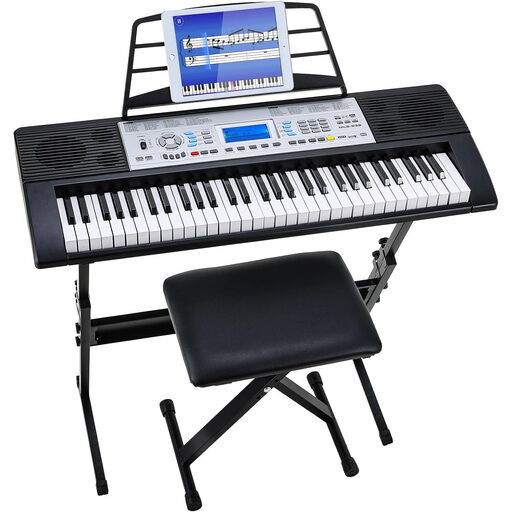 No image available
61-key keyboard set with stool and learning function
This set could suit you if you’re looking for a keyboard with a matching stand and stool.
The product name lists 500 sounds and a three-step learning mode. Check separately whether the model offers the rhythms and chord controls you need for blues progressions.
View at Joybuy
Frequently asked questions
How can you practise a blues progression without letting the accompaniment take over the chords?
Play the chord changes yourself first, then add rhythm or accompaniment. The teaching material used describes the blues form as 12 bars; accompaniment and chord features don’t replace the playing technique your lessons require.
What should you check before using a keyboard in a shared music room?
Check the room’s rules, the space available for setting up and whether the model you choose has a suitable headphone socket. Korg specifies a socket of this kind for the Liano; check this feature separately on other models.
What’s the difference between the keybeds on the Korg Liano and Yamaha P-145?
Korg specifies an LS keybed for the Liano, while Yamaha specifies a GHC keybed for the P-145. Both models have 88 keys, but that doesn’t mean they have the same type of keybed; compare the specifications and try the key action if possible.
Are a stand and pedals always included?
No, accessories vary by model and offer. Korg says the stand for the Liano is sold separately; Yamaha describes the LP-5A three-pedal unit for the P-145 as optional. Check which parts are included in the specific offer.
What are your rights if an online keyboard doesn’t meet your expectations or develops a fault?
According to ACM ConsuWijzer, for a standard online consumer purchase you generally have up to 14 days after delivery to change your mind, subject to legal exceptions. Your statutory guarantee is separate from any manufacturer’s warranty offered: if a product doesn’t meet what you could reasonably expect when used normally, the seller is responsible for providing an appropriate solution.


