Who is this choice relevant to?

Piano accompanist playing full parts

You play fully written-out musical parts with both hands and want to assess the range and key action of a piano-focused keyboard first. Yamaha describes the P-145 as having 88 keys; Roland also lists an 88-key keyboard for the FP-10.

Accompanist for different singers

You mainly accompany singing and want to choose between piano sounds, other sounds and accompaniment features. Check that the number of keys on each instrument suits the parts you play. Yamaha describes the PSR-E383 as having accompaniment styles; Korg lists transposition for the Liano.

Player sharing an attic space

You need to be able to set up or move the instrument around the room, and want to practise solo with headphones. Group singing rehearsals also require some consideration of noise; the Dutch Government notes that local municipal by-laws may be relevant.

What should you consider when choosing?

Compact 61-key keyboard

Choose this if: your parts fit within its range and you accompany singers with chords, other sounds or backing.

Trade-off: more sounds or styles won’t make up for missing keys if a passage falls outside the keyboard’s range.

88-key digital piano

Choose this if: you want to play full piano parts and are looking for a piano-style action. The Yamaha P-145 and Roland FP-10 are examples with 88 keys.

Trade-off: check the space and setup you’ll need. According to Yamaha, the P-145 is 1.326 mm wide and weighs 11,1 kg.

Lightweight 88-key digital piano

Choose this if: full key range and portability matter to you. Korg lists the Liano as having 88 touch-sensitive keys and weighing 6,0 kg.

Trade-off: Korg specifies an LS keyboard; don’t assume it feels the same as a weighted piano keyboard. The stand is sold separately.

What to consider What should you look for? Who will find this most important?
Key range and action Try the lowest and highest notes in your most challenging passage. Yamaha lists 61 keys for the PSR-E383 and 88 for the P-145; try the feel of the keyboard, too. If I want to play my full part with both hands, I first check that every note falls within the keyboard’s range. Around 31% of consumers prioritise being able to play their own piano part.
Flexibility for accompanying singers Check the exact model to see whether it can transpose and which sounds and accompaniment styles are available. Yamaha lists accompaniment styles for the PSR-E383; Korg lists transposition and eight sounds for the Liano. If I accompany different singers, I want to be able to adjust the key or sound. Around 25% of consumers prioritise this flexibility when accompanying singers.
Sound during solo and group rehearsals Check whether the model has a headphone socket. Headphones let you practise solo without using the instrument’s speakers, but won’t silence singing; the Dutch Government notes that municipal by-laws may apply. If I want to practise solo without using the speakers, but also need to consider group rehearsals, I keep those two situations separate. Around 25% of consumers prioritise managing noise.
Space and portability Measure the available width and depth for the instrument, stand and chair. Yamaha lists the P-145 as 1.326 mm wide; Korg lists the Liano as 1.282 mm wide and weighing 6,0 kg. If I share my attic space with others or want to move the instrument after playing, the complete setup needs to fit. Around 19% of consumers make positioning and portability their top priority.

Common buying mistakes

  • Confusing lots of sounds with having enough keys for your part

    According to Yamaha, the PSR-E383 has 61 keys; extra sounds and styles don’t extend its key range. A part with notes outside that range won’t fit fully on the keyboard.

    First check the lowest and highest notes in your most challenging passage, then compare the extra sounds.

  • Assuming all 88-key instruments feel the same

    Korg describes the Liano as having a touch-sensitive LS keyboard, while Yamaha specifies a GHC keyboard for the P-145. So the same number of keys doesn’t mean the keyboard action is the same.

    Try the action for yourself if you want to practise piano technique.

  • Only allowing for the instrument in your setup

    According to Korg, the stand for the Liano is sold separately. You’ll also need to allow for a chair and enough space to play.

    Measure the full playing area and check which accessories are included with each version.

    A suitable stand may need to be purchased separately as part of your setup.

Brands to compare

Yamaha

The PSR-E383 is a compact 61-key keyboard with accompaniment styles; the P-145 is an 88-key digital piano. Yamaha’s specifications make it easy to compare the features and range of these models.

  • According to Yamaha, the PSR-E383 has touch-sensitive keys and accompaniment styles.
  • The PSR-E383’s 61 keys offer a narrower range than the P-145’s 88. Yamaha lists the P-145 as 1.326 mm wide.

Roland

The FP-10 is a piano-focused model with an 88-key PHA-4 Standard keyboard and built-in speakers. Roland also says it can be used with headphones.

  • Its listed features make the FP-10 worth comparing if you’re looking for a full keyboard and the option to use headphones.
  • Roland’s descriptions of the feel and sound are the manufacturer’s claims; try the action for yourself.

Korg

According to Korg, the Liano combines 88 touch-sensitive keys with a listed weight of 6,0 kg. This may be useful if you plan to move the instrument regularly.

  • Korg lists features for the Liano including transposition and a headphone socket.
  • Don’t assume the LS keyboard is the same as a weighted piano keyboard. According to Korg, the stand is sold separately.

Joybuy picks for accompanying singers

These are compact 61-key keyboards for accompanying singers and practising solo. Check that your full piano part fits within their range.

Digital keyboard with 61 keys

Digital keyboard, 61 keys

May suit accompanying singers with different sounds or keys; its range is limited to 61 keys.

The product information lists a weighted keyboard, 300 sounds, 300 rhythms, transposition, accompaniment styles and a headphone socket.

View at Joybuy

Electronic keyboard with 61 keys

Electronic keyboard, 61 keys

May suit practising with different sounds and rhythms; check that 61 keys are enough for your parts.

The product information lists a recording function, metronome, speakers, MIDI and a headphone socket.

View at Joybuy
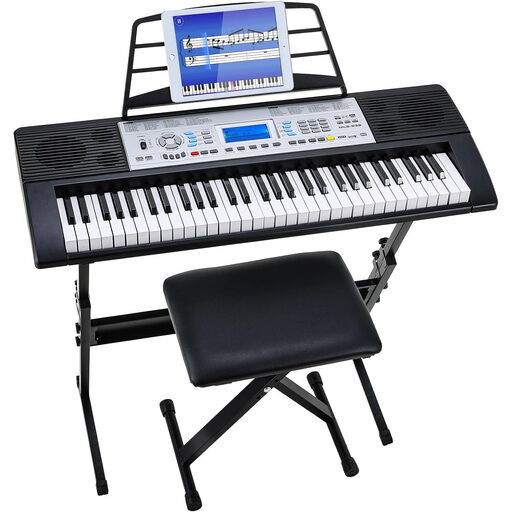
61-key keyboard set with stand and stool

Keyboard set, 61 keys, with stand and stool

May suit a ready-to-use practice space; check that the included setup fits in your attic.

The product information lists 500 sounds, a three-stage learning function, speakers, a stand and a stool. The keyboard has 61 keys.

View at Joybuy

Frequently asked questions

Are 61 keys enough to rehearse a musical number?

It depends on your part. Check the lowest and highest notes in your most challenging passage: Yamaha lists 61 keys for the PSR-E383 and 88 for the P-145.

Can I rehearse in the attic with headphones without disturbing the neighbours?

Headphones can let you practise solo without using the instrument’s speakers, but they won’t silence singing or other rehearsal noise. The Dutch Government notes that municipal by-laws may apply; if noise could affect your neighbours, it’s also worth agreeing some ground rules with them.

What do I need besides the instrument?

Check whether your chosen version needs a suitable stand, a seat, a power supply, a pedal and headphones, and what’s included. Korg lists an adapter and pedal switch with the Liano, but the stand is sold separately. Don’t assume other models come with the same items.

What are my rights when buying a keyboard online?

For eligible consumer purchases made at a distance, you generally have a 14-day cooling-off period. According to the Dutch Government, this does not apply to an online purchase from a private individual. In addition, under the statutory guarantee, the seller must resolve the issue if a product used normally doesn’t do what you could reasonably expect, according to ACM ConsuWijzer.

What should I look for in electrical product safety?

Specific conformity rules may apply to electronic equipment sold on the EU market. According to Your Europe, CE marking is only compulsory when the applicable harmonised EU rules require it; it is not an independent test of playability or quality. Check the version and the power supply included.
