
Route planner at a small desk
You want to keep space beside your keyboard for precise mouse movements while plotting routes. The compact Trust Lyra Compact is one model to compare if desk space matters.


Choose a compact keyboard if you want to keep more space free for your mouse; a model that switches between devices is a better fit if you use several computers. A split keyboard gives you another way to position your hands, but it needs space and takes some getting used to. Also check the physical key layout, connection options and available desk space.
You want to keep space beside your keyboard for precise mouse movements while plotting routes. The compact Trust Lyra Compact is one model to compare if desk space matters.
You use more than one computer or tablet at the same workstation and want to switch between them. Trust describes the Lyra Compact and Vaiya as supporting connections to multiple devices.
You type for extended periods and want to position your hands as you prefer. R-Go Tools describes the Split Break version 2 as a keyboard with two separately positioned halves; Arboportaal recommends readjusting your workstation to suit you each time.
First, work out how much space you need for map navigation and whether you use multiple devices. Then compare the key layout, connection options and positioning choices with your own workstation.
| What to consider | What to look for | Who is this important for? |
|---|---|---|
| Space for your mouse and maps | Compare the width and layout; check which navigation or numeric keys you need. | When I plot routes, I want to move my mouse freely without the keyboard getting in the way. Around 33% of consumers give top priority to space for their mouse and map navigation. |
| Typing noise | Check how the keys are described; a claim such as ‘quiet’ is not a sound measurement. | When I work at a shared desk, I want to be considerate of others while typing. Around 25% of consumers focus mainly on typing noise around other people. |
| Connection and switching between devices | Check which Bluetooth or USB connections are available for each device and how to switch between paired devices. | If I want to use the same keyboard with several devices, its connection options need to work with each one. Around 25% of consumers make connecting and switching their main consideration. |
| Hand position when typing for a long time | Compare a split layout with a flat keyboard, and bear in mind the space needed and time to get used to it. | When I type route directions for a long time, I want to position the two keyboard halves to suit my hands. Around 17% of consumers focus mainly on being able to adjust their hand position. |
US, UK and other physical layouts can differ, even when the letters are in QWERTY order.
Look at the product photo and check the exact regional variant, especially the positions of Enter, Shift and the punctuation marks you use often.
A different layout may take time to get used to or lead you to return the product.
A keyboard with a numeric keypad may take up space you need to edit the map with your mouse. CHERRY lists the KC 6000 SLIM as 440 mm wide.
Measure the space available at the shared desk and decide whether you need the numeric keypad.
A split shape describes how a keyboard is designed; a description such as ‘quiet’ does not prove how much noise you will hear at your workstation. Neither feature proves on its own that discomfort will disappear.
Consider the setup, adjustment period and key feel for the way you use it. Don’t treat product claims as medical promises.
The Lyra Compact and Vaiya are ranges to compare if compactness or switching between devices matters to you.
The Split Break version 2 is an option if you want to position the two keyboard halves separately.
The KC 6000 SLIM is a flat, wired model to consider for a fixed workstation.
The MX Keys S is a wireless keyboard with illuminated keys and customisable functions for anyone who uses them.
This selection includes compact keyboards that leave extra room for your mouse, as well as models with wired or wireless connections. It also includes a full-size keyboard for use with multiple devices.
 No image available
A compact set to consider if you want to keep space free beside your keyboard.
US QWERTY layout; wireless connection via USB receiver and Bluetooth. The product description mentions scissor-switch keys and connection to up to three devices.
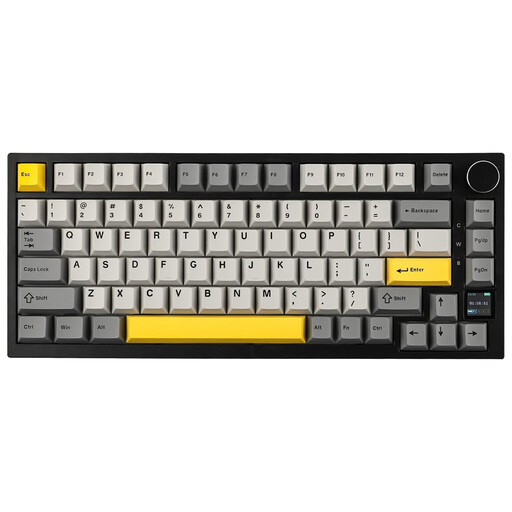 No image available
The 75% layout could suit you if you’re looking for a more compact keyboard and the listed connection options work with your devices.
US QWERTY; Bluetooth, 2.4 GHz and USB-C. The product name mentions sound-dampening foam.
 No image available
This compact wired model is an option if you want to leave room for your mouse and prefer a fixed connection.
US QWERTY; wired Type-C connection. The product description lists a 75% layout with 83 keys.
 No image available
The compact layout without a numeric keypad could suit you if you have little space beside your keyboard.
61 keys; US QWERTY; wired connection.
 No image available
This model could suit you if you want to switch between devices and have room for a full-size keyboard with a numeric keypad.
US QWERTY; connects via USB receiver and three Bluetooth channels. Trust lists support for up to four devices and low-profile scissor-switch keys.
Check both QWERTY and the physical US, UK or other regional layout. Look at the positions of Enter, Shift and the punctuation marks you need; the product range name alone won’t tell you which version you’ll get.
For employees who work with screens for more than two hours a day, Arboportaal says the screen and keyboard must not be attached to each other. This is a conditional workplace rule for employees, not a general requirement for every individual buyer. Adjust a shared workstation to suit you each time you use it.
For a consumer purchase, the seller must arrange a solution if the product is faulty, according to Rijksoverheid; you don’t have to rely solely on the manufacturer. For distance purchases, you’ll usually have a 14-day cooling-off period, subject to conditions and exceptions that depend on the specific purchase.
CE marking is only compulsory for products covered by the relevant harmonised EU rules, as Your Europe explains. The marking is not an independent product test; the requirements that apply depend on the product version. Radio equipment is also covered by the EU Radio Equipment Directive.