
Student running input-intensive simulations
You test software or games using several keys at once and want to distinguish missed inputs from errors in the collision logic.


First, check that your keyboard registers the key combinations you need. In a software test, collision detection is handled by the physics engine, not the keyboard. If inputs are missed, choose a model with rollover specifications suited to your combinations. In a student room, also consider the keyboard’s sound profile and whether you need direct access to specific keys.
You test software or games using several keys at once and want to distinguish missed inputs from errors in the collision logic.
You want to run repeated tests without making a noticeably clicky keyboard your default choice.
You need to decide how much desk space your keyboard can take up and whether you need dedicated arrow, function or navigation keys.
Start with the key combinations your project actually uses, then decide which sound profile and size suit your workspace.
| What to consider | What to look for | Who is this important for? |
|---|---|---|
| Simultaneous key input | Test the combinations used in your project and compare them with the rollover specification for the exact model variant. | If I want to know whether missed key presses are affecting my input test, I test my own combinations first; around 36% of consumers prioritise reliable simultaneous input. |
| Sound during testing | Check the switch type on the specific variant. A description such as ‘quiet’ isn’t an independent sound measurement. | In a shared room, I want to type repeatedly without a pronounced clicking sound; sound is the top priority for around 29% of consumers. |
| Desk space and dedicated keys | Compare TKL with 60% layouts and check which navigation and function keys are directly accessible. | At a small desk, I want to save space while knowing that my most-used keys are still within easy reach; around 21% of consumers prioritise size and access to keys. |
| Use beyond testing | Check the physical QWERTY or AZERTY layout, the connection and the keys you need every day. | If I also use the same keyboard for studying, its layout and controls need to suit that too; around 14% of consumers give this versatility top priority. |
Anti-ghosting relates to keyboard input. In a software project, collision detection is handled by the physics engine and colliders.
Check separately that the intended keys register and that the colliders and collision settings are working correctly.
A smaller layout may mean that keys you need for testing or studying aren’t directly accessible.
Make a note of the keys you use most before comparing a 60% model with a TKL layout.
Using functions through secondary key combinations can mean extra steps.
Switch variants can have different sound profiles. Razer describes the Huntsman Mini variant reviewed as clicky.
Check the full variant name and switch type, not just the model range.
The K55 CORE TKL is a membrane TKL model suited to anyone looking for a compact keyboard while keeping dedicated arrow and function keys.
The Apex 3 TKL is a TKL option for anyone looking for a model the manufacturer describes as quiet.
The G413 TKL SE is a mechanical TKL model for anyone looking for tactile keys and dedicated keys in a compact layout.
The G80-3000N RGB TKL is a mechanical TKL option. Check the switch and physical layout for the specific variant you’re considering.
The Huntsman Mini is a 60% option for anyone looking for a very small keyboard who doesn’t need direct access to every key.
This selection mainly features TKL keyboards for compact desks, with both membrane and mechanical options. Check the listed QWERTY or AZERTY layout for each model.
 No image available
The TKL layout suits anyone looking for a keyboard without a numeric keypad.
Wired; QWERTY; compatible with PC and PS5.
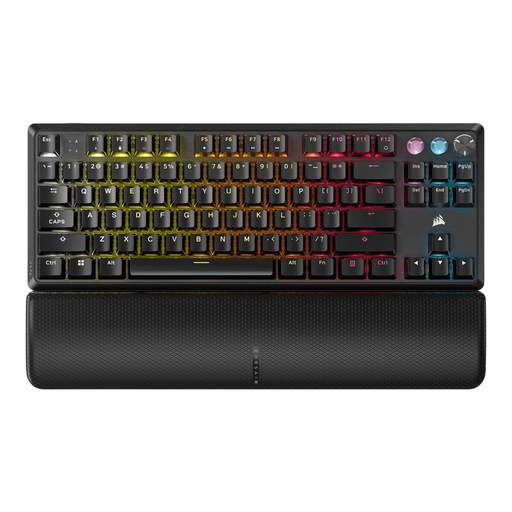 No image available
The TKL model is designed for anyone looking for a compact layout. Check that the US QWERTY layout suits the way you use it.
US QWERTY; MGX v2.
 No image available
The TKL layout is an option for anyone looking for a compact size who wants to check the physical layout in advance.
US QWERTY.
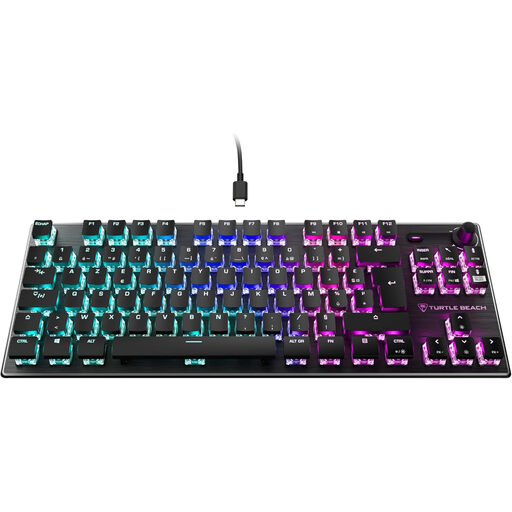 No image available
The TKL layout and linear Titan switch are worth considering. Check that the listed AZERTY layout suits you.
Mechanical; wired; RGB; AZERTY.
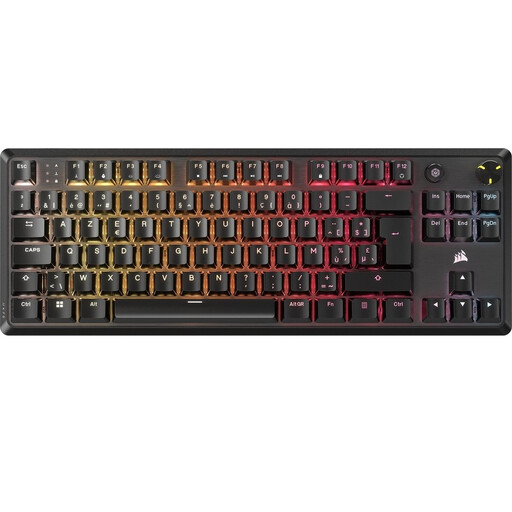 No image available
The TKL model has a compact layout. Check that the physical BE AZERTY keys suit the way you use it.
BE AZERTY; MLX Red.
No. In a software simulation, collision detection is handled by the physics engine and colliders. A keyboard matters if the required inputs aren’t registering reliably, so test the key input and collision logic separately.
First, test the key combinations your project actually uses and check which key presses the computer receives. With a US model, bear in mind the difference between the keyboard layout selected in your settings and the physical key labels.
For online consumer purchases, you generally have a statutory 14-day cooling-off period after delivery. Exceptions may apply, as explained by ACM ConsuWijzer. Separately, if a product is faulty, you may be entitled to an appropriate remedy under the applicable statutory conditions. The Dutch government explains that there is no fixed, general statutory warranty period.