Enlarging text on screen doesn’t make the legends on physical keys any larger: Microsoft Support describes Magnifier as a feature for on-screen content. If you look at the keys while coding, compare the size and contrast of their legends, as well as the position of punctuation marks. If you mostly touch-type, pay extra attention to the layout and your workstation setup. Backlighting can help if you work in low ambient light, but it doesn’t replace checking the layout and connection.
Who is this relevant to?
Coders who want to read the key legends
You enlarge text on screen, but also look at the physical keys. In that case, clearly distinguishable letters, numbers and punctuation marks matter. Optelec Nederland and Sensotec describe keyboards with high-contrast legends.
Coders who use lots of keyboard shortcuts
You often find keys by touch, but when programming you also use symbols, navigation keys or keyboard shortcuts for screen magnification. Sensotec describes a US International QWERTY version, while Microsoft Support points out that shortcut key positions can vary between layouts.
People who work from home and type for long periods
During longer coding sessions, the space on your desk and the position of your keyboard and mouse matter too. TNO notes via Arboportaal that a narrower keyboard can help you position the mouse closer to your body for many tasks.
What should you look for when choosing?
First decide whether you need to read the physical key legends; then compare the layout, your workstation setup and any backlighting.
| What to consider |
What to look for |
Who is this most important for? |
| Readable key legends |
Check the exact version and inspect the letters, numbers, punctuation marks and function keys. Compare the contrast too, not just the size of the lettering. |
If I look at the physical keys while coding, I want to be able to distinguish letters and symbols quickly. Around 36% of consumers prioritise readable key legends. |
| Layout and symbols |
Compare the keyboard layout with your computer settings and check the position of the punctuation marks and shortcuts you use. |
When I often use symbols, navigation keys or magnification shortcuts, I want familiar key positions. Around 29% of consumers give coding layout their top priority. |
| Size and workspace |
Check the width and whether you need a numeric keypad. Make sure your keyboard and mouse fit comfortably together on your desk. |
During long coding sessions, I want to position my keyboard and mouse so I can work comfortably. Around 21% of consumers prioritise posture and desk space. |
| Visibility in low light |
Consider the backlighting, how readable the characters are and the USB connection required as separate features. |
If I look at the keys in low ambient light, I want to know whether both the backlighting and the legends will work for me. Around 14% of consumers make backlighting their top priority. |
What to watch out for when buying a keyboard for programming
-
Confusing screen magnification with larger key legends
Magnifier enlarges on-screen content; large-print key legends are a separate feature of the physical keyboard. Microsoft Support describes this screen feature separately from keyboards with large-print keys.
Before buying, decide whether you mainly want to see on-screen text, the physical keys or both more clearly.
-
Focusing only on large lettering
When programming, the position of punctuation marks and shortcut keys can be just as important. Microsoft Support notes that the Magnifier shortcuts it describes assume a US keyboard layout.
Check the exact layout and compare the symbols you use often with your computer settings.
-
Mistaking backlighting for large-print key legends
Backlighting and the size of the key legends are different features. Perixx describes the PERIBOARD-317 as having large-print legends and backlighting; HP lists backlighting for the 400 Backlit.
Assess the lettering size, contrast and backlighting separately for the conditions in which you type.
Brands to consider
ClearKeys
Sensotec describes the yellow-and-black version as an option for anyone looking for high-contrast legends on physical keys.
- Sensotec lists large characters, a matt finish, navigation keys, a numeric keypad and US International QWERTY.
- Check that the position of the punctuation marks and the layout suit the way you code.
Perixx
Perixx describes the PERIBOARD-317 as a keyboard with large-print legends and backlighting for use in low light.
- According to Perixx, the model has switchable white backlighting and a wired USB-A connection.
- Perixx shows several language versions; check which layout and connection apply to the version on offer.
ZoomText
The large-print keyboard described by Optelec is designed for anyone looking for high-contrast key legends who may also use ZoomText.
- Optelec describes two contrast options and keyboard shortcuts for ZoomText features.
- The shortcuts control ZoomText features; the physical key legends don’t enlarge on-screen text by themselves.
HP
The HP 400 Backlit is a standard backlit keyboard to consider if large-print key legends aren’t your main requirement.
- HP lists a numeric keypad, three backlight levels and a USB-C cable with a USB-A adapter.
- Check separately whether the legends are large and high-contrast enough for your needs.
CHERRY
The KC 6000 SLIM is a low-profile, full-size keyboard for anyone who is mainly interested in layout and typing feel.
- CHERRY lists a scissor mechanism, Windows support and USB-A for this model.
- The model doesn’t have backlit keys; also check which country layout the version uses.
Keyboards at Joybuy
The product options below are mechanical keyboards in a range of layouts and sizes. Check the exact version for the position of coding symbols, the connection you need and whether the key legends are easy for you to read.
 No image available
AJAZZ AK980 V2, 98% QWERTY, Gift Switch V2, Starry Night Gray
Could suit you if you’re looking for a mechanical QWERTY keyboard with several connection options; check that the layout works for the coding symbols you use.
The product title lists a 98% layout, wired, Bluetooth or 2.4 GHz connectivity, RGB lighting and a TFT display.
View at Joybuy
 No image available
Redragon M68 Magnetic Switch, 68 keys, US layout
Could suit you if you’re looking for a compact keyboard with a US layout; compare the position of the punctuation marks with the layout you’re used to.
The product title lists 68 keys and a metal top plate.
View at Joybuy
 No image available
AJAZZ AK820 MAX, wired, 82 keys
Could suit you if you’re looking for a wired connection and a compact 82-key layout.
The product title lists magnetic switches and RGB lighting.
View at Joybuy
 No image available
AJAZZ AK820 Pro, 75%, tri-mode, US QWERTY, Gray
Could suit you if you’re looking for a 75% layout and a choice of connection types; check that the US QWERTY layout works for the symbols you use.
The product title lists wired, Bluetooth and 2.4 GHz connectivity, RGB lighting and hot-swappable switches.
View at Joybuy
 No image available
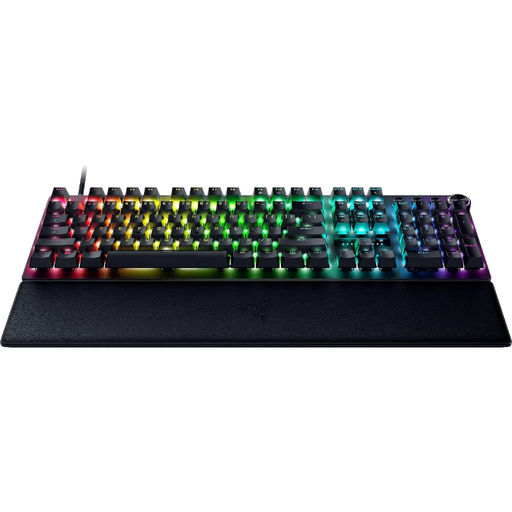
Razer Huntsman V3 Pro, US QWERTY
Could suit you if you specifically want a US QWERTY layout; check in advance that the physical position of the punctuation marks works for your coding.
View at Joybuy
Frequently asked questions
Does a large-print keyboard also enlarge the code in your editor?
No. Large lettering on a keyboard refers to the physical key legends. Microsoft Support describes Magnifier as a feature for on-screen content; Optelec describes ZoomText separately as magnification software.
What should you check when connecting a keyboard and using shortcuts?
Check the connection and the layout of the version you’re buying. Microsoft Support bases the Magnifier shortcuts it describes on a US layout, so keys may not be in the same place on other layouts. For connection problems, Perixx recommends, among other things, trying a direct USB connection.
What can you do if the keyboard isn’t comfortable to type on or becomes faulty?
If you buy online as a consumer from a business in the Netherlands, the Dutch government says you’ll often have a 14-day cooling-off period; check which terms apply to your purchase. If the product is faulty, your rights against the seller are also relevant; a manufacturer’s warranty isn’t your only possible remedy.
Does a keyboard sold in the Netherlands need a CE mark?
CE requirements apply to product groups covered by European regulations. The Dutch government lists many consumer products placed on the EU market; check which marking applies to the specific version. A product listing on its own doesn’t prove that a particular version meets all the applicable requirements.


