Start by choosing a physical layout that gives you access to the characters and shortcuts you use in your editor and Git workflow. Prioritise a numeric keypad if you often enter test amounts; only choose key remapping if you’re prepared to configure it, and assess noise and hand position separately. None of these features, on its own, proves that you’ll code faster.
Who is this keyboard choice relevant to?
Programmers who use lots of shortcuts
If you write and edit the calculator, a layout that puts commonly used coding characters, navigation keys and editor or Git commands within easy reach can be useful. RTINGS’ programming keyboard guide and information from Keychron support these selection criteria.
Developers who test lots of amounts
If you often enter numbers when checking calculations, it’s worth considering whether a separate numeric keypad is worth the extra desk space. RTINGS discusses the numeric keypad as a selection criterion, while CHERRY describes a full-size keyboard with one.
Developers with specific workspace needs
For long typing sessions or a shared workspace, hand position and keyboard noise may be important alongside the layout. Arboportaal, Logitech and R-Go Tools provide information on these separate considerations.
What should you look for?
| What to consider |
What to look for when buying |
Who is this most relevant to? |
| Coding characters and shortcuts |
Compare the physical ANSI or ISO layout with the layout set in your operating system. Test the symbols and commands you actually use. |
If I code often and use editor or Git commands, I want to be able to enter the characters and use the keys I need in a logical place. Around 36% of consumers prioritise coding and navigation features. |
| Entering test amounts |
Think about how often you type in amounts yourself and whether you want a separate numeric keypad. Bear in mind that a full-size keyboard takes up more width. |
When I check lots of amounts, I want to be able to enter numbers directly on a separate keypad. Around 29% of consumers make number entry their top priority. |
| Hand position |
Compare the keyboard’s height and position with your workspace and the space available for your mouse. Try a different layout if possible. |
When typing for long periods, I want to choose a setup that suits where my hands rest. Around 21% of consumers give hand position top priority. |
| Keyboard noise |
Assess the exact keyboard or switch version in the context of your workspace. Don’t take a description such as ‘quiet’ as a measurement of the noise in your workspace. |
If I share a workspace, I want to take the noise of the version I’m choosing into account before making a decision. Around 14% of consumers prioritise keyboard noise. |
Common mistakes when choosing
-
Assuming all QWERTY versions have the same physical layout
QWERTY alone doesn’t tell you where every coding character is on a specific version. The Keychron K2 Max ISO and CHERRY KC 6000 SLIM are available with different country layouts.
Check the exact version and your operating system’s layout before buying. Test the symbols you use for programming.
If commonly used characters turn out to be in different places, you may need extra time to get used to the layout or have to arrange an exchange.
-
Choosing a compact keyboard without considering how you enter test data
Compact and full-size keyboards have different numbers of dedicated keys. This can make a difference when entering amounts and using navigation keys.
Base your choice on how often you enter amounts and whether you need dedicated navigation keys. Also consider how much desk space you want to keep free.
-
Assuming descriptions such as ‘ergonomic’ or ‘quiet’ guarantee a particular result
A product description about hand position or noise reduction doesn’t prove what the result will be in your workspace, nor does it guarantee that you won’t experience discomfort.
Assess the exact version and your overall workspace. If you experience discomfort, consider your workspace setup and discuss it with the appropriate person if necessary.
Brands worth comparing
Keychron
The K2 Max ISO we looked at is a compact model, while the V6 Max is full-size. These models are worth considering if you want to customise the layout and key functions.
- According to Keychron, both of these models support key remapping.
- The K2 Max ISO doesn’t have a separate numeric keypad; the V6 Max takes up more space. Check the country layout and version.
Logitech
The MX Keys S we looked at is a low-profile wireless keyboard with customisable functions and device switching.
- Logitech describes programmable functions and switching between up to three devices.
- The claim of quieter keystrokes is made by Logitech. Check that the software and version suit the way you work.
CHERRY
The KC 6000 SLIM we looked at is a full-size wired keyboard with scissor switches, for anyone who wants a numeric keypad.
- According to CHERRY, this model has a numeric keypad and a USB-A connection.
- The versions available have different country layouts. A full-size keyboard takes up more space than a compact model.
R-Go Tools
The Split Break Version 2 we looked at is worth considering if you want to position the two keyboard halves separately.
- R-Go describes two halves that can be positioned separately.
- A different layout may take some getting used to and isn’t a proven treatment for discomfort. Check the connection and layout of the version.
Keyboards at Joybuy
This selection includes compact models for smaller workspaces and keyboards with numeric input options, for coding and testing amounts.
 No image available
Wired QWERTY keyboard with numeric keypad
An option to consider if you often enter amounts when testing and want a full-size keyboard.
QWERTY layout, numeric keypad and plug-and-play wired connection.
View on Joybuy
 No image available
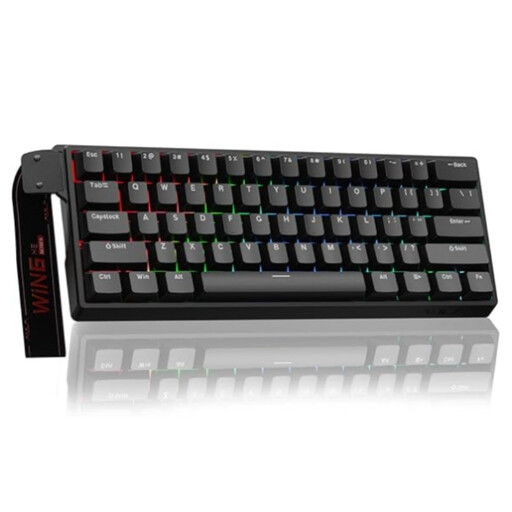
AULA WIN60HE 60% wired keyboard
A compact layout to consider if you want to use less desk space for your keyboard.
60% layout, Hall effect magnetic switches and adjustable 0.01 mm actuation. The product name also mentions Rapid Trigger.
View on Joybuy
 No image available
AULA F75 MAX 75% keyboard, US QWERTY
A compact option to consider if you want a narrower keyboard while keeping the navigation keys.
Mechanical keyboard with US QWERTY layout and wired, Bluetooth and 2.4 GHz connectivity.
View on Joybuy
 No image available
AJAZZ AK980 V2 98% QWERTY keyboard
An option to consider if you want numeric input in a 98% layout.
Mechanical keyboard with numeric keypad and wired, Bluetooth and 2.4 GHz connectivity.
View on Joybuy
 No image available
REDRAGON wired mechanical keyboard, 94 keys
A wired option to consider if you use a fixed workstation and want mechanical keys.
Metal casing, phone holder and wrist rest. The description mentions hot-swappable switches and a removable wrist rest.
View on Joybuy
Frequently asked questions
Do I need special Git keys for version control?
No. Start by checking which key combinations your editor and Git workflow use. Remapping or macros are only relevant if you want to configure them; according to Keychron, the K2 Max ISO supports this customisation.
How do I check a keyboard’s layout?
Set the layout in your operating system, then test the coding characters, navigation keys and shortcuts you use often. Also check the connection on the version you’re considering; CHERRY lists USB-A for the KC 6000 SLIM.
Can a split keyboard replace breaks during long periods of computer work?
No. R-Go describes two keyboard halves that can be positioned separately, but this product feature doesn’t prove that discomfort will be prevented or that breaks are unnecessary.
What are my rights when buying a keyboard online?
According to the Dutch government, when you buy from a business remotely, you usually have a 14-day cooling-off period; exceptions and the terms of purchase still matter. If a product doesn’t comply with the contract, contact the seller. There is no fixed statutory warranty period in the Netherlands.
Is a specific ergonomic keyboard required by law?
No, Dutch regulations don’t specify a particular ergonomic keyboard model. According to Arboportaal, for employees who work at a screen for more than two hours a day, the screen and keyboard must not be attached to each other.


