
Developer who writes a lot of code
You build the responsive pages yourself and want symbols, navigation keys and shortcuts close to hand. A Dutch-language guide to keyboards for programming points out that coding involves using symbols frequently.


If you mainly write code for the website, start by checking the position of symbols and navigation keys. For longer work sessions, the layout may matter more, while quiet keys can be more practical in a shared space. Keychron describes the V1 Max as a compact model with customisable keys, Logitech positions the ERGO K860 as a split keyboard, and Trust describes the Ody II as quiet. Always check the physical layout, connection and adjustment period: none of these features alone proves that you’ll code faster or prevent discomfort.
You build the responsive pages yourself and want symbols, navigation keys and shortcuts close to hand. A Dutch-language guide to keyboards for programming points out that coding involves using symbols frequently.
You spend a long time working on the website and take the position of your hands, mouse and screen into account. Arboportaal outlines rules for screen-based work; an ergonomic keyboard is no substitute for setting up your entire workstation appropriately.
You work while others are rehearsing or having a meeting and want to be mindful of typing noise. Trust describes the Ody II as quiet; also check that its connection is compatible with your computer.
Choose this option if: you often use code, shortcuts and different devices, and want to set up key functions yourself.
Bear in mind: a compact layout may take some getting used to; an ISO designation doesn’t tell you which Dutch key legends you’ll get.
Choose this option if: hand position matters to you during long work sessions. Logitech describes the ERGO K860 as a split keyboard with a number pad.
Bear in mind: the design may take some getting used to and won’t guarantee a particular benefit for you; the rest of your workstation still matters.
Choose this option if: you work alongside others and a simple connection matters more than extensive key customisation. Trust describes the Ody II as quiet and lists a USB receiver.
Bear in mind: the receiver needs a compatible USB port; ‘quiet’ is not an independent sound comparison.
| What to consider | What should you check? | Who is this important for? |
|---|---|---|
| Key layout and navigation | Check where the symbols, arrow keys and function keys are on both the physical layout and your software layout. See whether you can customise the functions. | If I write a lot of code, I want to reach symbols and navigation keys without awkward workarounds. Around 36% of consumers give coding layout top priority. |
| Working posture | Assess the keyboard’s width, mouse position and how long it may take to adjust to the key shape; also adapt your chair and screen to your workstation. | During long work sessions, I want a keyboard that suits the position of my hands and mouse, without expecting one design to solve every workstation issue. Around 29% of consumers put working posture first. |
| Quiet typing | Check the key type and whether you’re choosing a standalone keyboard or a set with a mouse. A description such as ‘quiet’ is not a comparative sound measurement. | If I work alongside choir rehearsals or meetings, I want to be mindful of typing noise. Around 21% of consumers make a quiet workspace their top priority. |
| Connections and switching between devices | Check the connection type, any receiver, available ports and whether the exact model can switch between devices. | If I work on the website across different devices, I want to know in advance how to connect them and switch between them. Around 14% of consumers start by looking at connection and switching options. |
A compact design and an ISO designation don’t automatically tell you where the symbols are on the version you’re ordering.
Check the exact regional version and try the physical keys with the software layout you use.
The position of your screen and mouse, along with the layout of your workstation, still matters. A split design does not guarantee a personal health benefit.
Assess the keyboard as part of your entire workstation, and treat benefits listed on a product page as manufacturer claims.
The Trust Ody II is available as a standalone keyboard and as a set; the contents differ.
Read the full product name and check what’s included in the box before ordering.
The V1 Max ISO range is designed for anyone looking for a compact mechanical keyboard with customisable keys.
The MX Keys S and MX Keys Mini are designed for work and customisable keys; the ERGO K860 is a split option.
The Ody II is a low-profile, wireless work keyboard; it’s also available as a keyboard and mouse set.
The PERIBOARD-536 is a wired, split keyboard for anyone who wants to try a different hand position without a wireless connection.
The Split Break Version 2 consists of two separately positioned parts and has a break indicator.
This selection includes compact keyboards for coding, as well as models for anyone who wants to switch between devices or is mindful of typing in a shared space. Check the layout, connection and any USB port you may need for each version.
 No image available
A compact option to consider if you want to combine navigation keys with multiple connection methods.
75% layout with navigation keys; QWERTY US; wired, Bluetooth or 2.4 GHz. Check that the American physical layout suits your software settings.
 No image available
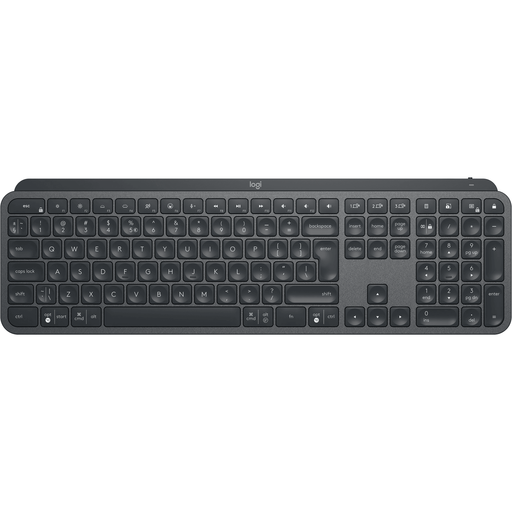
An option to consider if you want to customise key functions and regularly switch between devices.
Full-size layout and QWERTY US; Bluetooth or Logi Bolt; Easy-Switch for up to three devices and customisable key functions.
 No image available
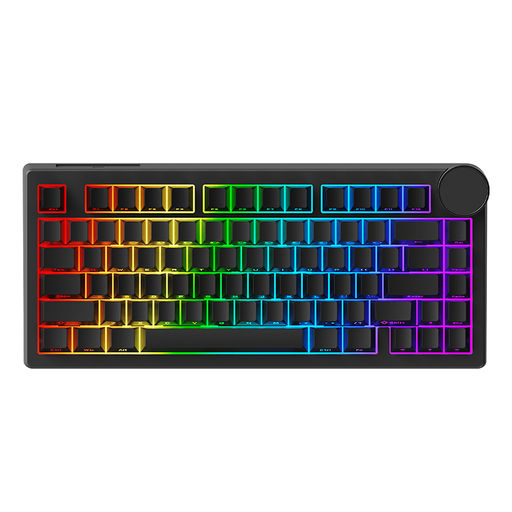
A compact option to consider if you want to customise key functions to suit your way of working.
75% layout; wired; HE magnetic switches. The product description mentions key remapping and macro settings via a web driver.
 No image available
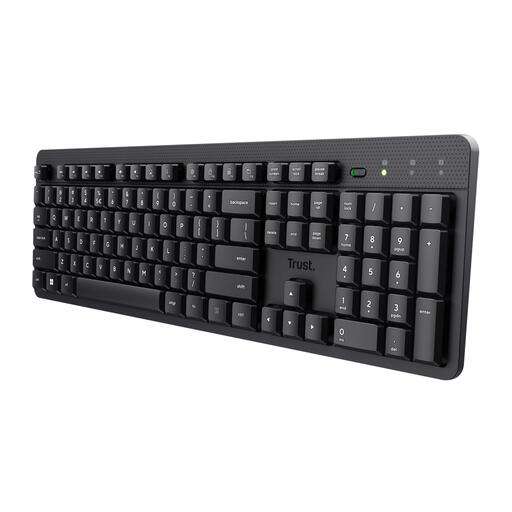
A model to consider if you work in a shared space and want a wireless connection with a receiver.
Full-size layout with number pad and QWERTY US. Trust describes the keys as quiet; connecting via the USB receiver requires a compatible port. ‘Quiet’ is not a comparative sound measurement.
 No image available
An option to consider if you want a full-size layout with the ability to connect to multiple devices.
QWERTY US, number pad and scissor keys. The product description lists connections to up to four devices via receiver and Bluetooth, and describes the keys as quiet.
Check the exact version to see where the code symbols are, and try the corresponding software layout. The physical layout and selected keyboard language can differ, so test whether you can comfortably type both code and Dutch text.
For the ERGO K860, Logitech recommends aligning the split with the centre of your body and screen, and placing the mouse close by. Adjust the rest of your workstation too; this is the manufacturer’s advice for that model.
For a standard online purchase as a consumer, you usually have a cooling-off period of up to 14 days after delivery, with some exceptions. ACM ConsuWijzer also explains that the seller is responsible for the statutory guarantee if a product doesn’t perform as you could reasonably expect under normal use.
Dutch government guidance does not specify a particular ergonomic keyboard model. Arboportaal does state that for employees who work at a screen for more than 2 hours a day, the screen and keyboard must not be attached to each other; laptop users must be able to use a separate screen or keyboard. This requirement concerns employees’ workstations, not a purchase requirement for every individual developer.