What should you consider when choosing?
Start with the physical layout and how easily you can reach coding symbols. Then consider how often you enter numbers manually and whether saving space, hand position or quiet typing matters most to you.
| What to consider |
What should you check? |
Who might this matter more to? |
| Layout and coding symbols |
Check the regional variant and key legends, then compare them with your Windows or macOS input layout. Apple Support explains that the keys you see and the characters you type may differ. |
If I often type braces, brackets and other coding symbols, I want to know which key combinations produce them on my computer. That’s why around 28% of consumers prioritise easy access to coding symbols. |
| Navigation and test shortcuts |
Check where the arrow, navigation and function keys are, and make sure any key customisation you want works with your system. |
If I run tests repeatedly, I want to use important keys without awkward combinations. Around 22% of consumers prioritise easy-to-reach navigation and test shortcuts. |
| Hand position and workspace |
Consider the space available on your desk, where you place your mouse, and whether you want a fixed or adjustable split. Assess the rest of your workspace too. |
During long typing sessions, I want to position my keyboard and mouse so my hands feel comfortable. Around 22% of consumers prioritise hand position and workspace layout. |
| Manual number entry |
Think about how often you type long strings of numbers and check whether your chosen model has a separate numeric keypad. |
If I enter game scores manually, I want to type numbers quickly. Manual score entry is a top priority for around 11% of consumers. |
| Noise in a shared space |
Check the type of key mechanism. CHERRY describes the keystrokes on its STREAM models as quiet; this is not an independent noise measurement. |
If I code in a shared space, I want to be mindful of how much noise my typing makes. Around 17% of consumers prioritise quiet typing in this situation. |
Keyboards for coding and entering scores
This selection includes compact TKL and 75% keyboards for coding and testing, plus a full-size option with a numeric keypad for manual score entry.
 Image unavailable
GXTrust Thado TKL keyboard
A compact option for coding and testing if you don’t need a numeric keypad.
Wired; US QWERTY; for PC and PS5.
Joybuy
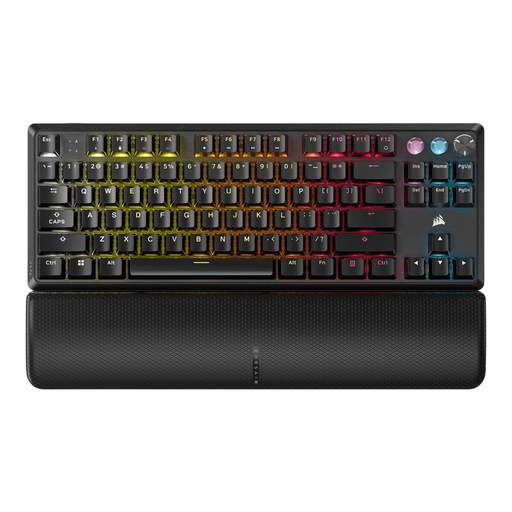 Image unavailable
Corsair K70 PRO TKL Magnetic-Mechanical Gaming Keyboard
A TKL option for a compact testing set-up if you can do without a numeric keypad. Check that the software and model support the key customisations you want.
US QWERTY; MGX v2.
Joybuy
 Image unavailable
Wired full-size keyboard with numeric keypad
An option if you often enter scores or other strings of numbers manually while testing.
QWERTY layout; wired; numeric keypad and arrow keys.
Joybuy
 Image unavailable
AULA F75 MAX 75% Mechanical Wireless Keyboard
A compact 75% option if you want to save desk space. Check that the US layout suits the coding symbols you use.
US QWERTY; tri-mode: wired, Bluetooth and 2.4G.
Joybuy
 Image unavailable
AJAZZ AK820 75% Wired Mechanical Keyboard
A wired 75% option for a compact set-up. Check the key layout suits the symbols you use when developing.
US QWERTY; 83 keys; hot-swappable linear switches; volume knob; compatible with PC, Windows and Mac.
Joybuy
Frequently asked questions
How can I check whether my coding symbols are on the keys I expect?
Compare the physical regional layout of the exact product variant with your computer’s input layout. Windows lets you manage your keyboard layout; on a Mac, Keyboard Viewer shows which key combinations produce symbols.
Do I need macro keys for automated testing?
No, automated testing doesn’t require macro keys in itself. If you want to customise keys or combinations, check the features of the specific model: Keychron lists remapping and macros for the Q1 Max via Launcher; Logitech lists Smart Actions for the MX Keys S via Logi Options+.
Who can help if my keyboard develops a fault during normal use?
In the Netherlands, the retailer must provide a solution if a product is faulty. The Dutch government explains that there is no fixed statutory warranty period for all products; a manufacturer’s warranty is additional.
Can I return a keyboard bought online if I don’t like the layout?
For online purchases, you generally have a statutory 14-day cooling-off period. The Dutch government advises checking the applicable terms and conditions; this is separate from your statutory rights if the product is faulty.
What rules apply to a wireless keyboard in the Netherlands?
Radio equipment must meet European requirements covering areas such as health, electrical safety and resistance to interference. The Dutch Authority for Digital Infrastructure states that radio equipment must bear a CE mark before it is placed on the EU market; a product listing alone does not prove that a specific item meets the requirements.


