
Practising in a shared home
You want to repeat chords while other people are nearby. So pay attention to the headphone socket, listening volume and the sound of the keys themselves.


To practise chord changes at low volume, choose a standalone keyboard with a suitable headphone socket. Yamaha also lists a metronome for the PSR-E383, while Korg describes chord-controlled accompaniment for the EK-50. Practise the chord shapes on your own first, and add accompaniment only if it responds to the chords you want to play. Headphones reduce the electronic sound, but not the mechanical noise of the keys. If piano lessons and the feel of piano keys are your priorities, compare a digital piano too; Yamaha specifies 88 weighted GHC keys for the P-145.
You want to repeat chords while other people are nearby. So pay attention to the headphone socket, listening volume and the sound of the keys themselves.
You want to switch between chord shapes yourself, perhaps with a metronome or accompaniment that responds to left-hand chords. Yamaha and Korg describe these kinds of practice and accompaniment features for specific models.
You’re comparing touch-sensitive keyboard keys with weighted piano keys, especially if piano lessons are also on your agenda. Yamaha lists 88 weighted GHC keys for the P-145.
| What to consider | What to look for | Especially suited to |
|---|---|---|
| Quiet practice | Check that the socket is compatible with your headphones. Headphones reduce the electronic sound, but not the noise of the keys. | If I practise while other people are at home, I want to avoid sound from the speakers without expecting the keys to be inaudible. Around 36% of consumers prioritise quiet practice. |
| Tempo and chord shapes | Check whether there’s a metronome and how accompaniment mode responds to chords you play yourself. For the EK-50, Korg describes control using either one finger or played chords. | I want to learn to switch between full chord shapes in time, adding accompaniment only later. Around 29% of consumers prioritise timing and playing chord shapes themselves. |
| Key feel and range | Compare touch sensitivity, key type and the range you need to play with both hands. Yamaha lists 88 weighted GHC keys for the P-145. | If piano lessons are also part of the picture, I want to know whether the key feel and range are suitable. Around 21% of consumers prioritise key feel and range. |
| Storage and accessories | Measure the space available and check whether a power supply, headphones, stand or bench is included with the specific version. | I want to be able to put the instrument away after practising and know whether the version I choose includes everything I need for my practice space. Around 14% of consumers prioritise compact storage and a starter bundle. |
A chord sequence can play without you having to play each full chord shape in time. Roland describes preset and user-created sequences, but these are not the same as practising every chord shape.
Decide whether you want to form full chords yourself. To check, try the metronome or chord recognition with the shapes you want to practise, rather than just listening to a demonstration sequence.
Touch sensitivity and weighted piano keys are different features. Yamaha specifies 88 weighted GHC keys for the P-145; don’t assume this applies to the entire Yamaha range or to a keyboard with touch-sensitive keys.
If you take piano lessons, compare a digital piano too and discuss any key requirements with your teacher.
Connections and package contents vary by model and version. The Casio manual covers a separately available pair of headphones for the CT-S300.
Check the socket and the contents list for the exact version. Follow the chosen model’s manual for power and accessories.
The PSR-E383 is a standalone 61-key keyboard; the P-145 is a separate digital piano option.
The CT-S300 is a compact option if you want touch-sensitive keys and regularly put your instrument away.
The EK-50 is designed for playing with automatic Styles that can respond to left-hand chords.
The GO:KEYS 3 is worth considering if you want to experiment with accompaniments and chord sequences as well as playing by yourself.
The Harmony 61 MK3 is a bundle option for beginners who also need a practice setup.
This selection includes 61-key keyboards and sets for practising at home. Check the listed features and included accessories for each version.
 No image available
An option to compare if you’re looking for a 61-key instrument and key feel matters to you.
The product name lists 300 sounds, 300 rhythms, an LCD screen, USB-MIDI, speakers, a headphone socket and a music stand.
 No image available
An option to compare if you want to practise chord changes at a steady tempo.
The product name lists a recording function, speakers, a metronome and a music stand.
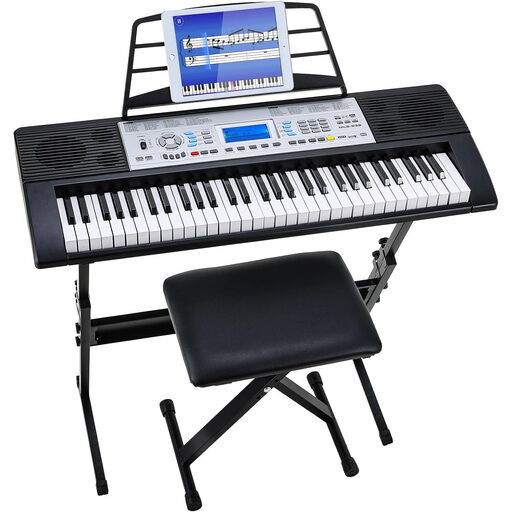 No image available
A set to compare if you want to create a dedicated practice space for a beginner.
The product name lists 500 sounds, a three-level learning mode, two speakers and an LCD screen.
No. With a suitable connection, you’ll hear the electronic sound through your headphones, but the keys being pressed may still be audible. Start with a low listening volume; the World Health Organization stresses that both sound level and listening time matter.
First, play the full chord shapes yourself at a relaxed metronome tempo. You can then add an accompaniment mode that responds to the chords you play; one-finger control or a preset chord sequence offers a different kind of practice.
Check that your headphone plug fits and use a power supply suitable for the exact instrument. The Casio manual warns against unspecified accessories for the CT-S300; follow your model’s manual for power and maintenance.
For an online product purchase, you generally have 14 days to change your mind after delivery, subject to legal exceptions. ACM ConsuWijzer explains that the statutory guarantee depends on what you could reasonably expect from the product with normal use; it isn’t simply limited to any manufacturer’s warranty offered.
No. According to Dutch government information, electrical and electronic appliances sold in the Netherlands must comply with the applicable European rules. The manufacturer applies the CE marking once the technical and administrative requirements have been met; when considering a specific offer, also check the product identity, documentation and suitable power supply.