
Writer beside a bright window
Writes feedback for students in changing daylight and wants to see the keys clearly without disruptive sunlight falling on the workspace.


Start by positioning your screen: Arboportaal advises placing your line of sight parallel to the window when working with a screen. Then choose according to what matters most to you: keys that are easy to read in daylight, a comfortable posture for long writing sessions, or less disruptive noise in a shared space. Backlighting can illuminate the keys, but it won't prevent glare on your screen.
Writes feedback for students in changing daylight and wants to see the keys clearly without disruptive sunlight falling on the workspace.
Types a lot of continuous text and wants to weigh up the keyboard shape, mouse distance and working posture carefully.
Wants to disturb others as little as possible or works on more than one computer; keyboard noise, connectivity and layout all play a part in the choice.
First assess the light and your screen position. Then choose the keys, shape and connection that suit the way you write.
| What to consider | What to look for | Who is this important for? |
|---|---|---|
| Readability in daylight | Check the key legends and key surface in similar lighting; also consider your screen position and window coverings. Backlighting won't prevent screen glare. | If I often look at the keys in daylight, I want to be able to distinguish the letters clearly. Around 33% of consumers say readability in bright daylight is their top priority. |
| Comfort when typing a lot | Try the key shape, feel and distance from the mouse. A compact keyboard may not have a separate numeric keypad. | For long writing sessions, I want a shape and position that feel comfortable to me. Around 27% of consumers put comfort during prolonged typing first. |
| A quieter shared workspace | Look for keys described as quiet and judge the sound for yourself; product descriptions aren't comparable sound measurements. | If other people are working nearby, I want to take my keyboard's noise into account. Around 20% of consumers say minimising disruption to others is their main consideration. |
| Layout and connection | Check the physical key layout, the selected input language and the USB port or Bluetooth support you need. | If I want to use a familiar layout and suitable connection on my computer(s), I check these points in advance. Around 20% of consumers give layout and connection top priority. |
Backlit keys can make it easier to see the keys when ambient light varies, but they won't prevent reflections or glare on your screen. Arboportaal advises positioning your line of sight parallel to the window when working with a screen.
First assess your screen position and any window coverings; treat backlighting as a separate choice for the keys.
A wireless keyboard with a USB receiver needs a suitable port. The physical key layout and the computer's selected input layout together determine which characters appear.
Check the ports, the keys on the version you've chosen and your input settings. Microsoft explains how to manage your keyboard layout in Windows.
The UltraBoard 950 Wireless we reviewed doesn't have a separate numeric keypad on the right. This could matter if you often enter numbers as part of your work.
Decide in advance how often you use numbers and check whether your chosen layout has a numeric keypad.
The UltraBoard 950 Wireless is a compact option for anyone who looks at the keys in daylight and wants to keep the mouse close by.
The Ody II is an option if you're looking for a full-size keyboard with keys described as quiet; the Lyra range is designed for compact working across multiple devices.
The MX Keys S has adjustable backlighting; the Wave Keys has a wave-shaped design with a palm rest.
The KC 6000 SLIM is a slim, full-size keyboard for a fixed workspace.
This Joybuy selection includes keyboards for quiet typing, compact working, numeric keypads and different types of connection. Check each version's layout and connection to make sure they're right for your computer.
 No image available
An option for anyone looking for keys described as quiet for a shared workspace.
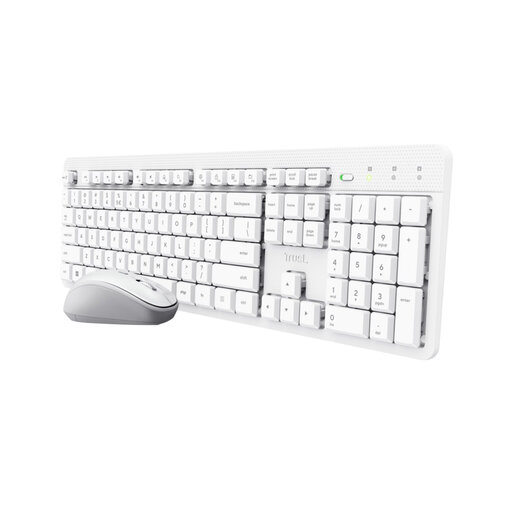
Wireless keyboard and mouse set; the physical layout is US QWERTY and it connects via a USB receiver.
 No image available
A compact layout could be a good fit if you need less space for your keyboard.
TKL layout without a numeric keypad; the physical layout is US QWERTY.
 No image available
Ideal if you want a numeric keypad and prefer a wired connection.
Full-size, QWERTY layout with a numeric keypad and plug-and-play connection, according to the product name.
 No image available
An option if you switch between devices and want a full-size keyboard with a numeric keypad.
The product name specifies wireless, full-size, a numeric keypad and scissor-shaped keys; the stated physical layout is US QWERTY.
 No image available
An option if you're looking for a keyboard with the Dutch QWERTY layout named in the product title.
The product name specifies USB + Bluetooth and Dutch QWERTY. Check which connection and layout are right for your computer.
Backlighting can illuminate the keys in changing light, but it isn't a substitute for good screen positioning or window coverings to prevent reflections from daylight. Arboportaal advises positioning your line of sight parallel to the window when working with a screen.
Check both the physical layout of the keyboard version you've chosen and the input layout selected on your computer. Microsoft explains how to check and change your keyboard layout in Windows.
When you buy as a consumer in the Netherlands, you're entitled to a product that works properly; if a product is faulty, the seller must provide a solution. According to the Dutch government, there is no fixed legal warranty period of two years in the Netherlands. For online purchases from a business, you will often also have a 14-day cooling-off period; check the applicable terms and conditions.
According to Arboportaal, for employees who work with a screen for more than 2 hours a day, the screen and keyboard must not be attached to each other. When using a laptop, it must therefore be possible to use a separate screen or keyboard. This is a conditional rule for the workplace, not a product specification for every keyboard.