Who is this for?

Blues beginner with limited storage space

You want to practise a chord progression and then be able to move the instrument off your table or stand. You’re comparing the dimensions of standalone mini and 61-key models with the space you have for playing and storage.

Player combining chords and melody

You want more room to play on the keyboard or automatic accompaniment while practising, and may have space to set up and store a larger keyboard.

Home recorder with music software

You already have a computer set-up and are considering a slim MIDI controller instead of an instrument with its own sounds.

What should you look for?

Standalone mini keyboard

Choose this if: putting it away after practising is your priority and a smaller keyboard suits the way you practise. Yamaha lists 37 mini keys for the PSS-A50; Alesis lists 32 mini keys for the Harmony 32.

Bear in mind: an octave button changes the range, but doesn’t add physical keys for playing low bass notes and higher melodies at the same time.

Standalone 61-key keyboard

Choose this if: you’d like to practise chords and melodies together more often and have room for the instrument. Yamaha lists 61 touch-sensitive keys and automatic accompaniment styles for the PSR-E383.

Bear in mind: the width and storage space you’ll need; Casio gives the dimensions of the CT-S300 as 930 × 256 × 73 mm.

Compact MIDI controller

Choose this if: you already use a computer and suitable music software. Korg lists the microKEY2-37 as 565 mm wide and powered via USB.

Bear in mind: you’ll also need suitable software, connections and audio equipment to hear the instrument.

What to consider What should you check? Who is this important for?
Playing and storage space Measure the available playing width, table depth and storage space. Compare these with the dimensions of the exact model; Yamaha lists the PSS-A50 as 506 × 201 × 54 mm. If I want to put the instrument away after practising, I first check that it fits both my playing space and storage space. Around 36% of consumers give storage space top priority.
Chords, melody and accompaniment Decide whether you’ll be practising chords on their own or want to play bass and melody at the same time. Berklee describes a 12-bar blues using I, IV and V chords; when choosing, also check the instrument’s physical key range and features. If I want more room to play chords and melody, that matters more to me than the smallest dimensions. Around 29% of consumers prioritise playing range and practice options.
Quiet practice Check whether the exact model has a headphone socket and whether connecting headphones mutes the built-in speakers. Alesis says this happens with the Harmony 32. If I want to practise at home with headphones, I check how they connect to the model I’m considering. Around 21% of consumers give quiet practice top priority.
Built-in sounds or software Check whether you need built-in sounds and speakers, or already have suitable music software, audio output and USB connections. Korg describes the microKEY2 as a controller for use with music software. If my existing computer set-up is the deciding factor, I want to know whether the controller connects to it and what I can already use for sound. Around 14% of consumers prioritise compatibility with their existing music software.

Avoid common buying mistakes

  • Comparing only the number of keys

    The size and layout of the keys also affect whether you can play the parts you want at the same time. An octave button on a model with 37 mini keys doesn’t add any physical keys.

    Before choosing, try mapping out the parts you want to play with your left and right hands across the keyboard’s range.

  • Mistaking a MIDI controller for a standalone keyboard

    Korg describes the microKEY2 as being for use with a computer and music software. That’s a different set-up from a keyboard with built-in speakers and sounds.

    Check in advance which computer, software, audio output and connections you already have.

  • Choosing a complete set without measuring all the parts

    Alesis says the Harmony 61 MK3 comes with items including a stand and bench, which also take up space.

    Measure the space for the whole set-up and think about where you’ll store all the parts after practising.

Brands and models to consider

Yamaha

The PSS-A50 is a standalone mini keyboard, while the PSR-E383 has 61 keys and automatic accompaniment.

  • Yamaha lists the PSS-A50 as measuring 506 × 201 × 54 mm, with 37 mini keys, a built-in speaker and a headphone socket.
  • Yamaha lists 61 touch-sensitive keys and automatic accompaniment styles for the PSR-E383.
  • Compare the playing and storage space needed for the exact model with the space you have available.

Casio

The CT-S300 is a standalone 61-key model for those weighing up touch sensitivity against the space required.

  • Casio lists touch-sensitive keys and dimensions of 930 × 256 × 73 mm.
  • Check for yourself that the stated dimensions will fit; a description such as ‘compact’ is no substitute for measuring.

Korg

The microKEY2-37 is a slim, USB-powered MIDI controller for use with an existing computer set-up.

  • Korg lists dimensions of 565 × 139 × 54 mm and describes it as suitable for use with music software.
  • This controller isn’t a standalone option with built-in speakers and sounds; check what else you’ll need to hear audio.

Alesis

The Harmony 32 is a standalone mini keyboard with rhythms; the Harmony 61 MK3 has 61 keys and comes with accessories.

  • Alesis lists the Harmony 32 as having 32 mini keys, built-in speakers and rhythms. According to Alesis, connecting headphones mutes the speakers.
  • Alesis says the Harmony 61 MK3 comes with items including a stand and bench.
  • With the 61 MK3, allow space for the accessories as well as the keyboard.

Roland

The GO:KEYS 3 is a standalone 61-key model for anyone who wants to experiment with sounds and chord accompaniment.

  • Roland lists more than 1,000 sounds and the ability to create your own chord progressions.
  • These model descriptions don’t prove that the instrument is a better choice for every blues beginner or small room; consider the features and space you need.

Joybuy products for practising blues

This selection focuses on standalone 61-key keyboards for practising at home. If you choose a set, remember to allow space for the included stand and seat too.

MLS-931 digital keyboard with 61 keys, black

MLS-931 digital keyboard, 61 keys, black

An option to compare if you’re looking for 61 keys and built-in speakers for practising at home.

The product name describes the keys as weighted. The product description lists 300 sounds, 300 rhythms, a headphone socket, USB-MIDI, automatic bass chords and a metronome.

View at Joybuy

Black electronic keyboard with 61 keys, recording function and music stand

Electronic keyboard, 61 keys, with recording function and music stand

An option to compare if you’re looking for a 61-key keyboard with features for practising independently.

The product description lists 500 sounds, 300 rhythms, built-in speakers, USB-MIDI, a metronome, a recording and playback function, and a headphone socket.

View at Joybuy
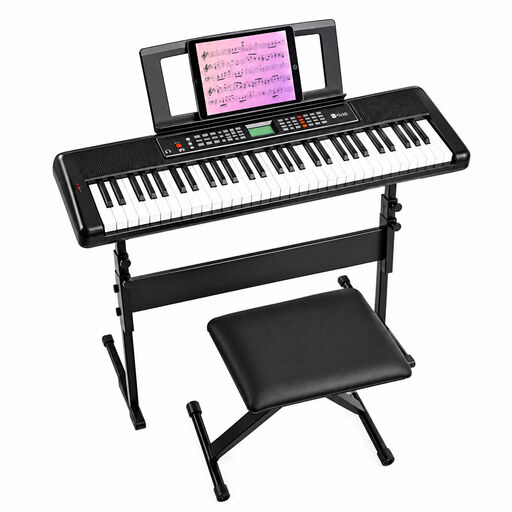
Black digital keyboard set with 61 keys, stand and bench

Digital keyboard set, 61 keys, with stand and bench

An option to compare if you’re looking for a 61-key keyboard with a stand and bench included; remember to make room for those too.

The product description lists 300 sounds, 300 rhythms, a three-level learning function, an LCD screen, USB-MIDI and a headphone socket.

View at Joybuy
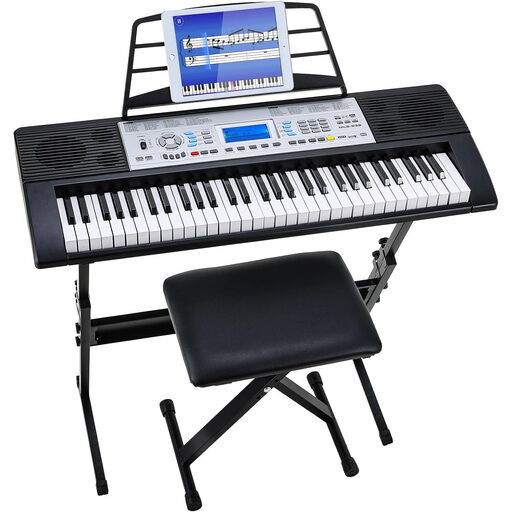
61-key keyboard set with stand, stool and dual speakers

Keyboard set, 61 keys, with stand and stool

An option to compare if you’re looking for a 61-key keyboard with a stand and stool; allow space to store the whole set.

The product description lists 500 sounds, rhythms, a three-level learning function, dual speakers and an LCD screen.

View at Joybuy

Frequently asked questions

Do you need 61 keys for your first blues chord progression?

No, not necessarily for a simple start. Berklee describes a 12-bar blues using I, IV and V chords. If you also want to play lower bass notes and a higher melody at the same time, compare the physical key range before choosing a mini keyboard. An octave button doesn’t add physical keys.

Can you connect a MIDI controller and play straight away without a computer?

Don’t assume so. Korg describes the microKEY2 as a USB-powered controller for use with music software, so check your computer, software and audio output first. Yamaha does list a built-in speaker for the PSS-A50.

What should you check before setting it up and connecting it?

Measure the space for the instrument and any stand before you choose. Also check the manual for the exact model for power requirements and connections; Yamaha, for example, says the USB power adaptor for the PSS-A50 is sold separately.

What are the cooling-off period and warranty for an online purchase in the Netherlands?

For a standard online consumer purchase, you generally have a statutory cooling-off period of up to 14 days after delivery, subject to legal exceptions. According to ACM ConsuWijzer, the statutory guarantee depends on what you could reasonably expect from the product under normal use; this doesn’t mean there is a fixed warranty period of exactly two years. Check the seller’s information for the terms that apply to your purchase.
