
Piano student with a wide-ranging repertoire
Practises arpeggios that span a wide range of keys or call for a piano-like touch, so compares the number of keys and the type of keyboard action.


For arpeggios spanning a wide range and practising piano technique, an 88-key digital piano with weighted keys is usually the better choice. If your exercises fit within 61 keys and portability or saving space matters more, a more compact keyboard may be enough. Also check that the instrument has a suitable headphone socket, fits in your music room and offers the pedal and power options you need.
Practises arpeggios that span a wide range of keys or call for a piano-like touch, so compares the number of keys and the type of keyboard action.
Wants to practise with headphones and checks both the socket on the exact instrument and the rules of the music room. Korg and Roland describe headphone options for specific models.
Weighs up dimensions and power options against the range of keys and playing feel. Yamaha, Korg and Casio publish specifications for the models mentioned; check the details for each version.
Choose this option: if you play arpeggios across a wide keyboard or want to practise with a piano-like touch.
Bear in mind: according to their manufacturers, the Yamaha P-145 and Korg B2+ are each over 1.3 metres wide; check that you have enough space.
Choose this option: if your exercises fit within 61 keys and portability or limited space is important.
Bear in mind: touch-sensitive keys are not the same as weighted keys, and your exercises may extend beyond the available range.
| What to consider | What to look for | Who is this important for? |
|---|---|---|
| Key range and touch | Compare the range of your exercises with the number of keys, and check whether the keyboard has weighted or touch-sensitive keys. | If I play arpeggios across several registers, I want enough keys and a suitable piano-like touch; around 36% of consumers give key range and touch the highest priority. |
| Quiet practice | Check the headphone output and whether your headphones need a suitable plug or adapter. | Anyone who wants to practise in a shared music room without using speakers should check the connection on the specific model; around 29% of consumers prioritise quiet practice. |
| Space and portability | Measure the available space and compare it with the dimensions and weight of the version you’re considering. According to Yamaha and Korg, the Yamaha P-145 is 1.326 mm wide and the Korg B2+ is 1.312 mm wide. | If I have limited space or want to move my instrument, I weigh up size and power options against the key range; around 21% of consumers prioritise space and portability. |
| Pedal setup | Check whether a damper pedal is included and whether the instrument supports half-pedalling, if you need it. | Anyone who wants to practise with pedals should check which controls are included with their chosen version and what is sold separately; around 14% of consumers prioritise pedals and practice equipment. |
The number of sounds tells you nothing about how many keys an instrument has. Casio describes the CT-S1BK as having 61 touch-sensitive keys; check the number of keys and the type of keyboard action separately.
Check the specifications for the number of keys, touch sensitivity and keyboard action separately.
Connections, included accessories and optional pedal features vary by model and version.
Check what’s included in the exact offer and which connections your headphones and pedal need.
You may need to buy suitable headphones, an adapter or a pedal unit separately; check what’s included with the version you’re considering.
According to Yamaha and Korg, the Yamaha P-145 and Korg B2+ are 1.326 mm and 1.312 mm wide respectively.
Measure the usable space in your music room and allow room for a stand and music rest too.
The P-145 is a portable digital piano for anyone looking for a full-size weighted keyboard for playing arpeggios.
The B2+ is an 88-key option for piano-focused practice.
The CT-S1BK is a compact keyboard to consider if your exercises fit within 61 keys.
The FP-10 is another 88-key option for anyone looking for a weighted piano action and headphone listening.
The products below are 61-key models for exercises that fit within this range. Compare the keyboard description, connections and included parts for the specific version.
 No image available
Worth considering if your exercises fit within 61 keys and you want to practise with headphones.
The product name describes it as having a weighted keyboard. The product description lists USB-MIDI and a headphone socket; check that the connection and key action are right for your exercises.
 No image available
Worth considering for exercises that fit within 61 keys; the product description also lists a headphone socket.
The description also mentions USB-MIDI, a recording function, a metronome and a music rest. Check that these connections and features suit your practice setup.
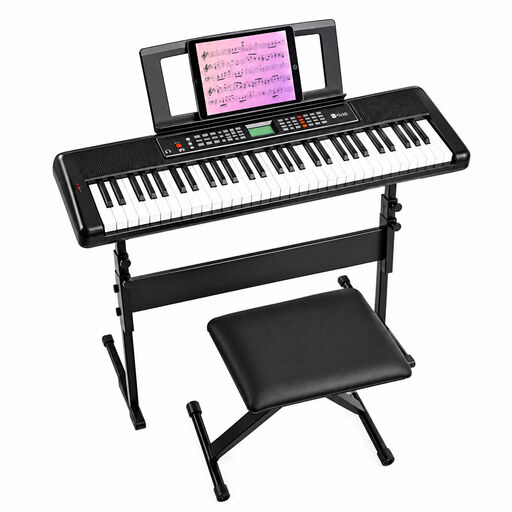 No image available
Worth considering if your exercises fit within 61 keys and you’re looking for a setup with a stand and bench.
The product name also mentions a music rest. The description lists a headphone socket and USB-MIDI; check the connections and what’s included with the exact version.
They can be, as long as the lowest and highest notes in your exercises fit within the available keyboard range. Compare your sheet music with the range. If your exercises require a full piano keyboard, an 88-key instrument is the option to consider.
No, not with every model. Roland says the FP-10 does not support Bluetooth headphones or earbuds, so you’ll need wired headphones. For other models, also check which connection and any adapter you’ll need.
That depends on your exercises and the exact version. Korg says the B2+ includes a damper pedal and specifies the PU-2, sold separately, for half-pedalling. Yamaha lists the optional LP-5A three-pedal unit for the P-145.
For a consumer purchase in the Netherlands, the seller must offer a solution if the product does not conform to the agreement, according to the Dutch government. There is no fixed statutory guarantee period in the Netherlands. Distance purchases are also generally covered by a 14-day cooling-off period; check whether it applies to your particular purchase.
The Netherlands Food and Consumer Product Safety Authority says that CE marking is compulsory for electrical products. Check the instrument’s markings and product information, as well as those of any relevant electrical components, such as the mains adapter. A product listing alone does not confirm that a specific item meets the requirements.