What should you look for when choosing?
First check that the physical layout and configured OS layout meet your test requirements. Then weigh up noise, desk space and the type of connection you need.
| Consideration |
What to look for |
Who it matters most to |
| Typing noise |
Compare the key mechanism and look for a review of the exact model; a manufacturer’s claim is not a comparative noise measurement. |
If you type repeatedly alongside colleagues, you’ll want to minimise unnecessary noise. Around 33% of consumers prioritise quiet keystrokes above all else. |
| Keys and layout |
Compare your test plan with the physical keys and check the configured OS layout, especially for navigation, shortcuts and special characters. |
For full input testing, you’ll want to use the required keys and characters as planned. Around 27% of consumers prioritise this type of test input. |
| Mouse and desk space |
Check the width of the exact model, where your mouse will sit and which keys a compact model leaves out. |
If you often use your mouse alongside your keyboard, you’ll want to arrange your workspace accordingly. Around 20% of consumers put workspace space first. |
| Connection and switching |
Check the available ports, Bluetooth support and how many devices the model can remember; find out whether any configuration software is permitted. |
If you switch between test computers, the right type of connection may matter more to you than the other considerations. Around 20% of consumers prioritise switching between devices. |
Keyboards at Joybuy
This selection includes wired keyboards for a fixed testing workstation, as well as models with a compact layout or multi-device connectivity.
 No image available
Full-size wired keyboard with numeric keypad, QWERTY
An option for a fixed testing workstation if you need numeric, navigation and function keys.
The product information lists a wired plug-and-play connection, a numeric keypad, function keys and backlit keys.
View at Joybuy
 No image available
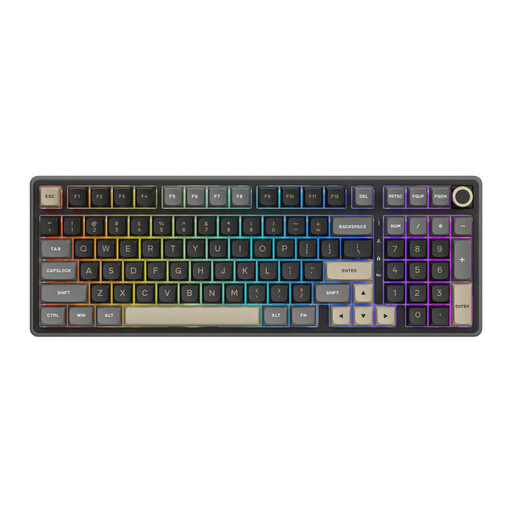
RK ROYAL KLUDGE R98 Pro wired mechanical keyboard
The wired model may suit a fixed testing workstation where a numeric keypad and volume knob come in handy.
The title lists hot-swappable switches. The variant description mentions linear Beige switches and sound-dampening layers; this is not an independent noise measurement.
View at Joybuy
 No image available
Trust Vaiya wireless keyboard, full-size, US QWERTY
An option for switching between test computers without opting for a compact key layout.
The product information lists a numeric keypad, scissor switches and connectivity for up to four devices via a USB receiver and Bluetooth. The stated physical layout is US QWERTY; check that it’s suitable for tests involving key labels and characters.
View at Joybuy
 No image available
AJAZZ AK820 75% wired mechanical keyboard, US QWERTY
A compact wired model for a testing workstation where desk space is a consideration.
The title lists 83 keys, hot-swappable linear switches and a volume knob. Check the exact key layout against your test plan before choosing a 75% model.
View at Joybuy
 No image available
MageGee TS91 60% wired keyboard, 61 keys, US QWERTY
A compact option for limited desk space, provided the keys it leaves out aren’t part of your test plan.
The product information lists a wired membrane model with 61 keys and RGB lighting. It has no numeric keypad and uses a US QWERTY physical layout.
View at Joybuy
Frequently asked questions
How can you check whether a keyboard is suitable for your app tests?
Compare the keys and characters required by your test plan with the physical layout and the configured OS layout. Also test navigation and keyboard shortcuts without custom key functions if you’re assessing standard controls. Microsoft Learn covers keyboard navigation and shortcuts for interacting with apps, and documents the US-International layout separately.
Do you need software for the break indicator on the R-Go Compact Break?
Yes. R-Go says the indicator is controlled by R-Go Break Software. Check whether you’re allowed to install the software on your work computer. The indicator is separate from alternating screen work with other tasks or breaks, as described by Arboportaal.
What are the rules on returns and warranties in the Netherlands?
For online purchases by consumers from a business, there is usually a 14-day cooling-off period, with some exceptions. The Rijksoverheid states that the Netherlands has no fixed statutory warranty period and that you should contact the seller for a solution if a product is faulty. Check the terms separately if the keyboard is bought for business use.
Does an employee need to be able to use a separate keyboard?
According to Arboportaal, if you work at a screen for more than two hours a day, the screen and keyboard must not be attached to each other. If you use a laptop, it must be possible to use a separate screen or keyboard. This is a conditional rule for setting up an employee’s workstation, not a requirement to buy a particular type of keyboard.


