Who is this relevant for?

Writers in a shared office

If you write or edit a lot of text alongside colleagues, you may want to consider typing noise and key feel. RTINGS discusses noise as one of the key differences between keyboard switches; ideally, assess the exact version you are considering.

Documentation writers considering their hand position

If you type for long periods, you can compare a different keyboard shape with your full workstation setup and the time it may take to get used to a new layout. Arboportaal points out that a keyboard is part of the workstation setup for screen-based work.

Writers with a set editor workflow

If you regularly use punctuation, navigation keys or custom shortcuts, it’s worth checking the exact physical layout and any customisation options before choosing a keyboard.

What should you consider when choosing?

Compact scissor-switch keyboard

Choose this if: you mainly write text, want short key travel and rarely use the number pad.

Bear in mind: a TKL model has no number pad, and its physical layout and connection need to suit your desk.

Flat keyboard with a full-size layout

Choose this if: you want to keep a familiar layout with short key travel and a number pad, or regularly switch between computers.

Bear in mind: a full-size keyboard takes up more desk space than a more compact layout.

Curved, split layout

Choose this if: you want to try a different hand position and the keyboard fits into your complete workstation setup.

Bear in mind: the different shape takes time to get used to and, by itself, is no guarantee of relief from individual issues.

Compact mechanical keyboard

Choose this if: you want to customise keys and can carefully check the switch and layout options.

Bear in mind: mechanical doesn’t automatically mean quiet; assess the noise from the version you choose.

Consideration What should you check? Who should give this more weight?
Typing noise Compare the noise from the exact switch option, including the sound of larger keys; don’t rely on a label such as ‘quiet’ alone. If I type frequently in a shared space, I want to know what the keyboard sounds like in normal use. Around 28% of consumers put quietness first.
Hand position Try the layout if possible, and check that the keyboard, mouse, arms and screen fit comfortably into your workspace. During long writing sessions, I want to be able to assess a different hand position without losing sight of the rest of my workstation setup. Around 22% of consumers prioritise hand position.
Layout and punctuation Compare the physical QWERTY, ANSI or ISO version with the punctuation and navigation keys you use. If I use lots of code-style punctuation and editor navigation, I want to check the exact placement of those keys. Around 22% of consumers choose layout as their first consideration.
Desk space Measure the space available for your keyboard and mouse, and work out how often you need a number pad. If my mouse needs to sit close to the main keys, the keyboard’s width matters. Around 17% of consumers prioritise the desk space available.
Connection and customisation Check which connection methods are supported and whether you’re allowed to use any configuration software on your work computer. If I switch between computers or want to set up custom keys, I want to know which features I can use on my work computer. Around 11% of consumers give workflow features top priority.

Common mistakes

  • Assuming every mechanical keyboard is quiet

    Noise can vary depending on the switches and construction; larger keys can also make a difference. RTINGS distinguishes between switch types and sound dampening.

    Check the details for the exact version and, where possible, assess the noise while typing normally.

  • Looking only at ‘QWERTY’

    A general layout name doesn’t tell you exactly where punctuation and navigation keys are on the physical version. This can matter if you often write API examples and code-style text.

    Compare images and specifications for the precise language layout with the keys you use in your editor.

  • Seeing a split keyboard as a complete workstation solution

    A different keyboard shape doesn’t just affect your hand position; the position of your mouse and screen, and varying your tasks, matter too.

    Try the shape if possible. Arboportaal advises contacting the occupational physician if symptoms begin, and arranging a workstation assessment if necessary.

Brands to consider

Logitech

The MX Keys S and ERGO K860 show two different options: a flat, full-size layout or a curved, split design.

  • Logitech says the MX Keys S can switch between up to three devices.
  • The ERGO K860’s shape takes time to get used to; a product description is no guarantee of relief from individual issues.

CHERRY

The STREAM KEYBOARD TKL is a compact, wired scissor-switch model; the KC 200 MX is a mechanical range with different switch options.

  • CHERRY describes the STREAM KEYBOARD TKL as quiet and confirms that it has no number pad.
  • Don’t choose the KC 200 MX based on the ‘mechanical’ label alone: the switch option matters.

Keychron

The K3 Max is a compact mechanical model for anyone considering connectivity and key customisation.

  • Keychron lists a 75% layout, cable, Bluetooth, 2.4 GHz and key customisation for the K3 Max.
  • Check the exact switch and language layout; hot-swapping is only available on compatible versions. The product information doesn’t describe every option as quiet.

NuPhy

The Air75 V3 is a low-profile mechanical model with a compact 75% layout.

  • NuPhy lists different switches and ANSI and ISO layouts.
  • Check the exact version; the product information doesn’t provide a noise rating for every option.

Keyboards at Joybuy

This selection includes keyboards for anyone considering a compact or full-size layout, or features for a customised workflow. Check the physical layout and features of each version.

Corsair K55 CORE TKL, US QWERTY

Corsair K55 CORE TKL, US QWERTY

The TKL layout suits anyone who wants to work without a number pad; check that the physical US layout works for the punctuation you use.

View at Joybuy

Ticktype DP104, full-size, 108 keys, US layout, Silent Tactile Switches

Ticktype DP104, full-size, 108 keys, US layout, Silent Tactile Switches

The product title lists Silent Tactile Switches; assess the noise from this specific version if you’ll be using the keyboard alongside colleagues.

The title describes a mechanical keyboard with 108 keys and a US layout.

View at Joybuy

Trust Vaiya, wireless keyboard with scissor keys, number pad and US QWERTY

Trust Vaiya, full-size, scissor keys, US QWERTY

The full-size layout with a number pad is useful if you regularly enter figures as well as writing documentation.

The product name describes a wireless keyboard with scissor keys and a US QWERTY layout; check that the physical layout suits your editor.

View at Joybuy
Razer DeathStalker V2 Pro Tenkeyless, US layout

Razer DeathStalker V2 Pro Tenkeyless, US layout

The TKL layout is an option if you want to work without a number pad; check that the US layout suits the punctuation in your editor.

The product information lists programmable keys; check whether the associated features can be used on your work computer.

View at Joybuy
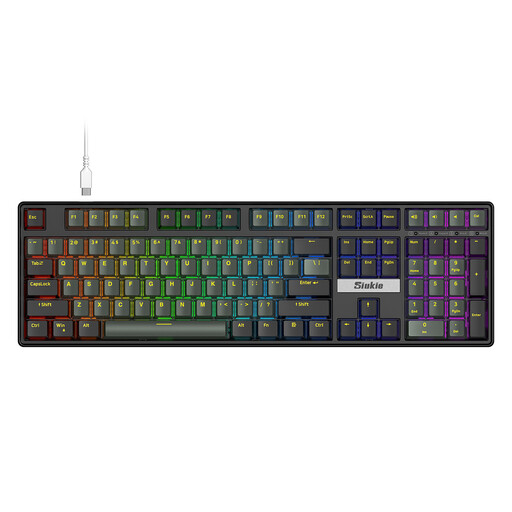
Siukie CR108, 108 keys, wired mechanical keyboard

Siukie CR108, 108 keys, wired mechanical keyboard

This model may suit you if you’re considering a wired mechanical keyboard with 108 keys.

Before buying, check the physical language layout, the placement of the navigation keys and whether the connection suits your work computer.

View at Joybuy

Frequently asked questions

Should you use a separate keyboard when working on a laptop for long periods?

According to Arboportaal, for an employee who works at a screen for more than 2 hours a day, the screen and keyboard must not be attached to each other. In that case, laptop users must be able to use a separate screen or keyboard. Arboportaal says employers may make an exception in certain circumstances, provided health and safety are protected.

Can an ergonomic keyboard on its own help prevent discomfort?

A different keyboard shape may change your hand position, but you should also consider the rest of your workstation setup and how you vary your tasks. Arboportaal advises contacting the occupational physician if symptoms begin, and arranging a workstation assessment if necessary; a product description is no guarantee of an individual result.

What should you consider when connecting to a managed office computer?

Before buying, check whether you can use a cable, Bluetooth or a receiver, and whether any customisation software is permitted on that computer. Keychron lists several connection methods and key customisation for the K3 Max, but check that these features can be used in your work environment.

What rights do you have when buying online in the Netherlands?

According to the Dutch government, when you buy online from a business, you often have a 14-day cooling-off period. You’re also entitled to a product that is fit for purpose; according to the Dutch government, the Netherlands has no fixed statutory warranty period. Check who the seller is and which terms apply to your particular purchase.
