
If you spend a long time writing documentation
You type for extended periods at a screen and want to consider the position of your hands, arms and mouse. Your keyboard is just one part of your overall workspace.


Start with what matters most to you: hand position during long typing sessions, key feel and sound, or the layout and accessibility of shortcuts. A split keyboard gives you more freedom to position your hands, but may take some getting used to. A standard or compact model offers a different key layout, with implications for desk space and key positions. Check the exact layout, connection and compatibility, and assess the keyboard alongside your mouse position and workspace.
You type for extended periods at a screen and want to consider the position of your hands, arms and mouse. Your keyboard is just one part of your overall workspace.
You want a familiar key feel and can decide for yourself how much keyboard noise is acceptable in your space. Manufacturer descriptions are not directly comparable sound tests.
You switch between text and technical examples, and want to tailor the keys and key combinations to the way you work.
Choose this option: if you mainly write continuous text and don't want to learn a different hand position.
Bear in mind: a full-size keyboard takes up more desk space than a 75% layout. Product specifications won't tell you which model will be quietest or most comfortable for you.
Choose this option: if hand position is your priority during long typing sessions. The Logitech ERGO K860 has a fixed split frame; the R-Go Split Break consists of two halves that can be positioned separately.
Bear in mind: a fixed design gives you less freedom to position each half separately, while separate halves take up space and may take some getting used to.
Choose this option: if desk space and custom key functions matter to you, and you don't need a numeric keypad.
Bear in mind: check the ISO language variant, switch type and position of the keys you use for code examples. The specifications won't predict how loud the keyboard will sound in your space.
| Consideration | What should you check? | Which consumers is this for? |
|---|---|---|
| Hand position during long typing sessions | Compare a standard model, a fixed split model and separate halves in your own setup. | If I type for a long time, I want to position my hands and mouse comfortably and assess the keyboard's shape on my desk. Around 33% of consumers prioritise hand position. |
| Key feel and sound | If possible, try the exact version; don't judge its noise level based solely on the description of the key mechanism. | When writing lots of continuous text, I want to know how the keys feel to me and how much noise I find acceptable in a shared space. Around 27% of consumers give key feel and sound the highest priority. |
| Layout and keyboard shortcuts | Check the exact language variant and test your usual punctuation and key combinations using your computer's keyboard language. | If I often write technical examples, I want to enter punctuation and commands quickly. Around 20% of consumers choose mainly on the basis of layout and keyboard shortcuts. |
| Space and connection | Measure the available space and check the port, connection and compatibility for the exact version. | For my home workspace, I want to know whether the keyboard will fit and connect to the devices I use. Around 20% of consumers prioritise space and connection. |
Strain is also affected by the rest of your workspace and your working habits. A product claim about posture doesn't prove what effect a keyboard will have for you.
Assess the shape in your own setup, and consider your mouse position and how varied your tasks are.
A keyboard may have a different language variant or key position from the one you expect, affecting punctuation and technical examples.
Before buying, check the exact version and the keys you use most often.
Manufacturer information about key construction or switches is not a directly comparable measurement of how loud a keyboard will be in your workspace.
If possible, try the version you're considering and, when buying online, check the returns period.
The MX Keys S is a standard model with programmable keys; the ERGO K860 has a fixed split frame. They have different designs and are not interchangeable versions.
According to CHERRY, the KC 6000 SLIM is a standard-size, flat, wired keyboard for a fixed workstation.
The Split Break consists of two keyboard halves that you can position separately.
The K3 Pro ISO combines a compact 75% layout with reprogrammable keys and several ISO variants.
This selection includes keyboards for anyone looking for a compact, mechanical or programmable layout, as well as versions for different connections and workspaces.
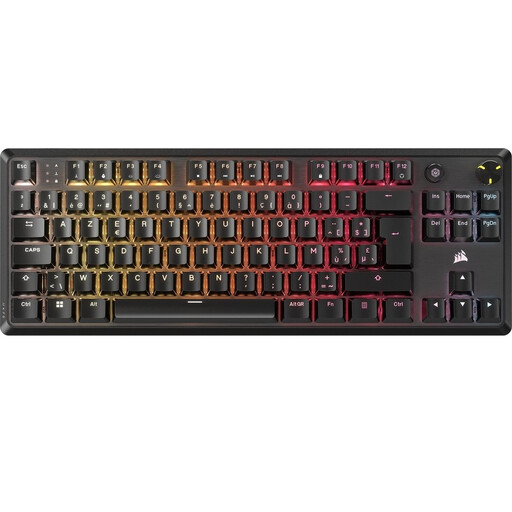 No image available
A wired option for anyone looking for a mechanical keyboard with a compact TKL layout.
The product details list linear switches, a programmable media key with a rotary dial and a detachable USB-C cable. The stated layout is BE AZERTY.
 No image available
A good fit if you're looking for a compact layout and can use the stated QWERTY US key layout.
The product details list wired, Bluetooth and 2.4G connections, a TFT screen and hot-swappable switches. Check the layout and connection are suitable for your computer.
 No image available
A flat option for anyone looking for a familiar keyboard design with a stated Dutch QWERTY layout.
The product details list Bluetooth, a numeric keypad, document navigation keys and a rechargeable battery. Check that the connection and layout suit your devices.
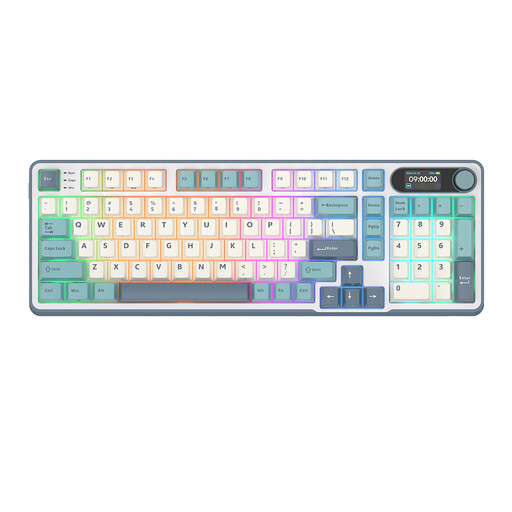 No image available
An option for anyone looking for a mechanical keyboard with a 96% layout and several connection options.
The product details list 98 keys, Bluetooth, 2.4G and USB-C. Software control and hot-swappable switches are also mentioned; check which features suit the way you use your keyboard.
 No image available
A good fit if you're looking for a very compact, wired layout and can use QWERTY US.
The product details list 61 keys and a membrane design with a mechanical feel. Check that the layout gives you access to the punctuation and functions you use most often.
For employees who work at a screen for more than 2 hours a day, Arboportaal says the screen and keyboard must not be attached to one another. When using a laptop, a separate screen or keyboard must be available in that case. This requirement does not automatically apply to every individual consumer or every short work-from-home session.
That's not certain: a split design doesn't guarantee a reduction in discomfort. Arboportaal describes repetitive hand movements and static strain, so assess your entire workspace and don't treat product claims as a form of treatment.
Check the connection and the exact layout of the version you're buying. CHERRY lists USB-A for the KC 6000 SLIM; Keychron lists Bluetooth and USB-C for the K3 Pro ISO. Then test your usual punctuation and keyboard shortcuts using the keyboard language set on your computer.
According to ACM ConsuWijzer, online consumer purchases generally come with a statutory 14-day cooling-off period from the date of delivery, although exceptions apply. The statutory guarantee is separate from any manufacturer's guarantee: if a product doesn't meet what you could reasonably expect under normal use, the seller must resolve the issue in accordance with the applicable terms.