
Chord and rhythm player
You want to play chords with your left hand and a melody with your right, without having to switch on a computer first.


For practising accompaniment patterns without a computer, choose a standalone keyboard with automatic accompaniment, provided its chord controls and styles suit what you want to play. Yamaha Netherlands lists 260 automatic accompaniment styles for the PSR-E383, while Korg Netherlands lists more than 280 preset styles for the EK-50. These figures alone don’t tell you whether they include the patterns you need. Also check the headphone socket and measure the space for the instrument, music rest and your playing position.
You want to play chords with your left hand and a melody with your right, without having to switch on a computer first.
You want to practise accompaniment patterns while other people are at home. Check the headphone socket and, if necessary, agree on when you can play.
You use the room for other things too, so you need to fit in the keyboard, music rest and your playing position.
First check the accompaniment controls and the patterns you want to practise. Then consider listening options, setup space and any recording features.
| What to consider | What should you check? | Who should give this more weight? |
|---|---|---|
| Useful accompaniment | Check the styles you want, the chord mode and the controls for start, stop, intro and fills on the exact model. | If I want to play chords with my left hand and a melody with my right, I need the accompaniment to handle my patterns and chord changes. Around 36% of consumers put accompaniment first. |
| Quiet practice | Check the headphone socket connector size and, if necessary, discuss practice times with housemates or neighbours. | When others are at home, I want to listen through compatible headphones and be considerate about noise in the house. Around 29% of consumers prioritise quiet practice. |
| Setup space | Measure the available space and allow room for the music rest, your hands, a chair and cables. Some stated dimensions exclude the music rest. | If the guest room has another purpose too, I want to know in advance whether the instrument and my playing space will both fit. For around 21% of consumers, space is their top buying priority. |
| Recording and playback | Check whether the exact model offers the recording and playback method you want, and whether it works without extra equipment. | If I want to listen back to my practice, the recording feature needs to suit the way I play with accompaniment. Around 14% of consumers give listening back the greatest weight. |
A large number of presets doesn’t tell you whether the time signature, chord controls or transition you want is available.
Check the specific styles and, if possible, try the chord changes, variations and fills you want to practise.
You’ll also need space for the music rest, your hands, a chair and cables. Korg lists the EK-50’s dimensions excluding the music rest.
Measure the complete setup and check what’s included with the version you’re considering.
A headphone socket lets you listen through headphones, but it doesn’t mean all noise in the house will disappear.
Check the socket and, where necessary, agree on practice times with housemates or neighbours. The Dutch government advises people to discuss noise with their neighbours first.
An additional manufacturer’s or seller’s warranty is different from your statutory rights against the seller.
Read the terms of any additional warranty and assess a fault in light of your statutory rights too. ACM ConsuWijzer explains that the seller is responsible for providing an appropriate solution if a product breaks sooner than you could reasonably expect under normal use.
Yamaha describes the PSR-E383 as a portable keyboard with automatic accompaniment styles and lesson features for independent practice.
Casio describes the CT-S400 as a Casiotone keyboard with rhythmic patterns and practice features.
Korg describes the EK-50 as an entertainer keyboard with automatic accompaniment and controls for pattern variations.
Roland describes the E-X10 as an arranger keyboard where the left hand controls the accompaniment.
These are electronic keyboards for practising rhythms and accompaniment patterns. Check the controls, connections and accessories you need for each version.
 No image available
Could be suitable for practising rhythms and listening privately, provided the connection is compatible with your headphones.
The product information lists 300 rhythms, a recording feature, 500 sounds, a metronome, speakers and a headphone socket. The title also mentions a MIDI controller and music stand.
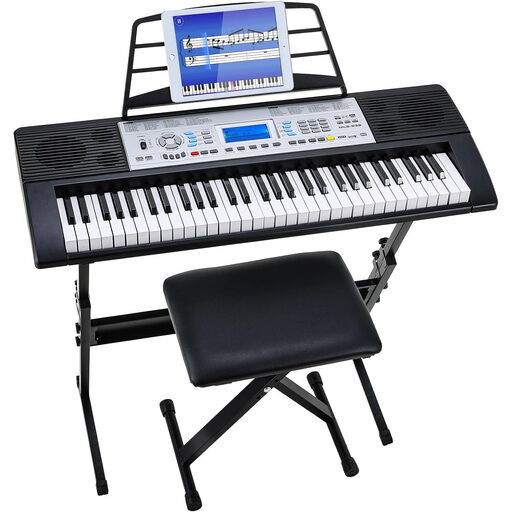 No image available
This set could suit you if you’re looking for a stand and stool as well as a keyboard. Check that the setup will fit in your room.
The product information lists 500 built-in sounds and rhythms, a three-step learning function, dual speakers and an LCD screen.
Not for the built-in accompaniment described by Yamaha for the PSR-E383 and by Roland for the E-X10. Do check that the chord mode suits what you want to learn.
Measure the table and the space you need to play. Korg lists the EK-50’s dimensions as 994 × 392 × 132 mm, excluding the music rest, and specifies a 3.5 mm stereo headphone socket. For a different model, check the dimensions and connector again.
According to the Dutch government, online purchases from a business generally come with a 14-day cooling-off period. Exceptions and the identity of the seller matter. You also have statutory rights if a product isn’t as it should be: ACM ConsuWijzer explains that the seller is responsible for providing an appropriate solution if the product breaks sooner than you could reasonably expect under normal use. In the Netherlands, the statutory guarantee does not have a fixed term of exactly two years.