
Vandaag of morgen in huis

Kwaliteit gegarandeerd

Welkomstaanbiedingen ontgrendelen: GRATIS bezorging | Tot 80% korting | Gratis 30 dagen JoyPlus-proefperiode
Download de app
A kettle may seem like a simple kitchen appliance, but the differences between models are noticeable in everyday use. A small capacity can be inconvenient for a family, while a large model takes up unnecessary space on a small office worktop. Features such as temperature control and keep-warm functions are not essential for everyone either.
When comparing models, focus primarily on verifiable specifications. For example, a high wattage does not automatically mean that every model will boil water equally quickly under the same conditions. The amount of water, its starting temperature and the shape of the heating element also play a part.
A fast kettle with 2,200 or 3,000 watts may sound appealing. However, it is important to consider the power rating together with the capacity. A 1.5-litre kettle with 3,000 watts is designed differently from a model that heats 1.7 litres with 2,100 watts.
It is also inefficient to fill the entire kettle when you only want one cup of tea. A clear water-level indicator or cup markings can help you avoid boiling more water than necessary.
A kettle with temperature control is useful for different types of tea, instant coffee or heating water to a lower temperature. If you only use your kettle for boiling water, a simpler model may be the more sensible choice.
A kettle with a keep-warm function is handy when several people are having tea or coffee one after another. Bear in mind that keeping water warm uses electricity for longer than boiling it once.
Always check that an electric kettle has automatic shut-off and boil-dry protection. These features switch the appliance off when the water boils or when there is too little water in it. They are no substitute for careful use: never fill the kettle above the maximum mark, and keep the steam outlet, lid and body away from children during use.
In areas with hard water, limescale can affect performance. A kettle with a limescale filter and a removable filter make maintenance easier, but they do not prevent limescale completely. Regular descaling is still necessary.
For a household of one or two people, a compact model is often sufficient. A 1.5-litre kettle usually holds enough water for several cups and takes up less space than a larger model. For families or shared use, a 1.7-litre kettle may be more practical.
Also check the minimum fill mark. Some models only heat correctly from a certain volume onwards. For a single cup, a small 0.8- or 1-litre kettle can sometimes be more economical to use.
A stainless-steel kettle generally has a sturdy metal interior or body. The outside can become hot while the water is boiling, unless the appliance has double-wall construction.
A glass kettle makes the water level immediately visible and can have a neutral appearance. However, glass and metal parts become hot and require careful handling. According to the product description, a double-walled model keeps the exterior cooler, but always check the specific safety instructions.
Plastic models are often lightweight and affordable. For each product, check which parts come into contact with water and what material information the manufacturer provides, such as whether components are BPA-free.
Green or white tea may require a lower temperature than boiling water. Models with six or seven temperature settings offer greater control. The exact suitability for a particular drink still depends on personal preference and the instructions on the packaging.
A cordless kettle with a 360° base is easy to pick up and put back down. Cord storage underneath the base helps keep the worktop tidy. For an office or small kitchen, also pay attention to the dimensions.
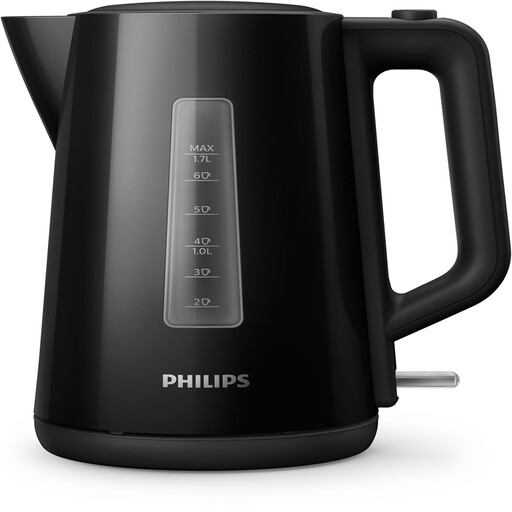
Why it suits this profile: The 1.7-litre capacity is suitable for everyday use by several people, without temperature programmes you may not need.
The water-level indicator with cup markings helps you avoid automatically filling the entire kettle. Automatic shut-off and boil-dry protection are listed as features.
1.7-litre capacity, flat stainless-steel heating element, 360° base, removable limescale filter and a power rating of 1,850–2,020 watts.
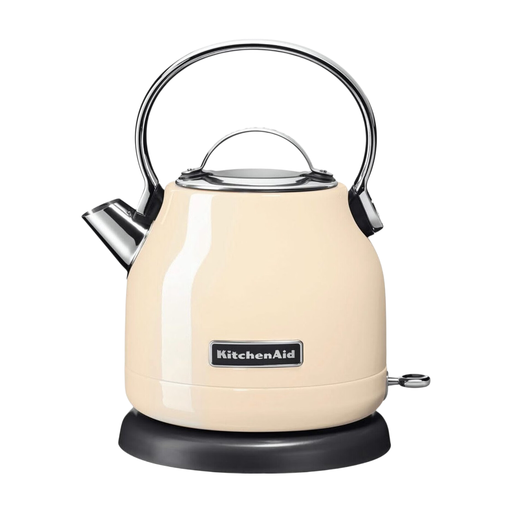
Why it suits this profile: This model is aimed at shoppers who value a metal body, classic design and straightforward controls.
The product specifications list automatic shut-off, boil-dry protection and a removable limescale filter. There is no unnecessary temperature control if you do not use it.
Stainless-steel body, 1.25-litre capacity, 2,000 watts, 360° rotating base and a stated statutory warranty of at least two years in the EU.
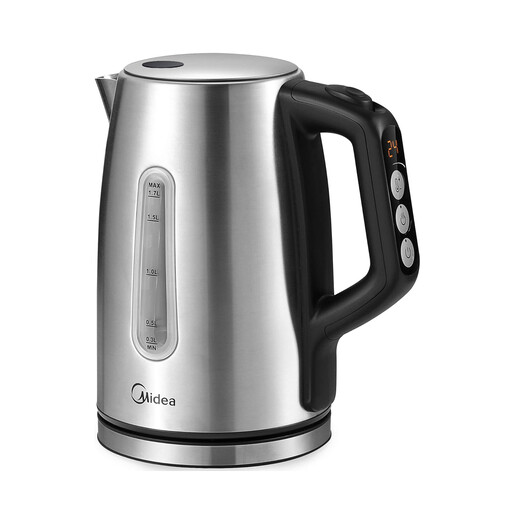
Why it suits this profile: The combination of 1.7 litres, six temperature settings and a keep-warm function suits families, tea drinkers and offices where several cups are prepared one after another.
The temperature can be adjusted from 40 to 100 °C, and according to the product description, the keep-warm function remains active for up to 60 minutes. This means you do not have to boil the water again for different drinks.
2,200 watts, 1.7-litre capacity, six temperature settings, keep-warm function for up to 60 minutes, water-level indicator, limescale filter and boil-dry protection.
A multifunctional kettle with programmes for tea, soup or keeping water warm may be useful for specific purposes. However, check whether the appliance is intended for water only according to the instructions. Not every model may be used to heat milk, juice or other liquids.
We have put together a complete, up-to-date list of products that fully meet these strict selection criteria and the applicable European safety regulations.
For everyday use, models typically range from around 1,850 to 3,000 watts. A higher power rating can reduce the heating time, but the result also depends on the amount of water and the design. Therefore, as well as the wattage, check the stated capacity and any specified boiling speed.
Its lifespan depends on how often it is used, limescale build-up, cleaning and the quality of its components. A limescale filter helps trap particles, but it does not replace descaling. Stop using the kettle if the cord, plug, base or body is damaged, and follow the seller’s warranty and safety information.
Consumption is mainly determined by the amount of water and the boiling time. Only fill the kettle with as much water as you need. A water-level indicator or cup markings makes this easier. A keep-warm function can use extra electricity when it remains active for a longer period.
