
Vandaag of morgen in huis

Kwaliteit gegarandeerd

Welkomstaanbiedingen ontgrendelen: GRATIS bezorging | Tot 80% korting | Gratis 30 dagen JoyPlus-proefperiode
Download de app
A kettle may seem simple, but you’ll notice the differences between models particularly after a few months of use. One that’s too small can be inconvenient for a family, while a powerful model may use more electricity than necessary if you only heat one cup at a time. A temperature function is also not always as precise as the product name might suggest.
As a Joybuy Product Recommendation Officer, I filter the key product specifications and practical considerations. This helps you distinguish marketing claims from features that genuinely make a difference in a Dutch kitchen.
An electric kettle with 2,200 watts sounds fast, but the actual boiling time also depends on the amount of water, its starting temperature and the heating element. A fast kettle is particularly useful when you’re preparing several cups at once. For a single cup, a hot water dispenser may be more efficient, as it only heats the amount you need.
So, as well as the power rating, check:
A temperature-adjustable kettle can be useful for green tea, coffee or warm water for baby food. However, many models only have a few fixed settings. According to the product description, the Midea Stainless Steel Kettle 1.7 litre offers six levels: 40, 60, 70, 80, 90 and 100 °C. This is different from a kettle with temperature control that lets you set every individual degree.
When looking at temperature settings, consider:
For precise preparation, choosing a fixed temperature is often clearer than having a long list of functions you rarely use.
According to the product description, a kettle with boil-dry protection switches off when there is too little or no water in it. This is an important safety feature, but you still need to use the appliance correctly. Never fill it above the maximum mark, place a dry base on the stand and don’t open the lid while the water is boiling.
Also look for:
No feature replaces supervision around hot steam and boiling water.
A 1.7-litre kettle is suitable when you want to prepare several cups of tea, coffee or soup at once. With a cup size of approximately 250 ml, this equates to a maximum of around seven cups, according to the product information for the Midea 1.7-litre kettle. However, only fill it with the amount you need; boiling a full kettle for one cup takes more time and energy.
For one person in an office, a 0.4-litre model may be sufficient. According to its specifications, the Bear Mini Healthy Kettle has a capacity of 400 ml. For a household with several users, models holding between 1.5 and 1.8 litres are more practical. A larger hot water dispenser, such as a model with a 2.5- to 3-litre tank, reduces the number of refills.
A glass kettle lets you see the water level and can offer a calm, transparent appearance. Borosilicate glass is mentioned in several product descriptions as a material suitable for temperature changes, but glass is still more vulnerable to impact.
A stainless steel kettle is generally less transparent, but its body can be well suited to intensive everyday use. With stainless steel, pay attention to the interior: a food-contact-safe inner wall, such as 304 stainless steel on certain models, is listed by the manufacturer as a product specification. Treat this as a material claim from the product information, not as a guarantee of a particular taste or performance.
A kettle with a keep-warm function is useful when several members of the household drink tea one after another. The Midea 1.7-litre kettle states that it can keep water warm for up to 60 minutes. Check whether the function maintains the selected temperature or first heats the water to 100 °C.
A hot water dispenser works differently from a traditional kettle. According to their product descriptions, these appliances dispense a selected amount of water at a chosen temperature straight away. For example, the Nedis KAWD310FBK has seven temperature settings, five volume options, a 2.7-litre tank and a separate 40 °C setting. Only use the 40 °C setting for baby food in accordance with the manufacturer’s instructions, and check the temperature before use.
Descaling remains necessary for both types of appliance. How often this needs to be done depends on the hardness of the water, how frequently the appliance is used and the instructions in the manual. A limescale filter reduces visible limescale particles, but it does not prevent the heating element from needing cleaning over time.

Why it suits this profile: With a clear glass body, a 1.7-litre capacity and 2,200 watts of power, this kettle is suitable for everyday tea and coffee without complicated controls.
The transparent glass body makes it easy to check the water level. According to the product description, automatic switch-off and boil-dry protection are built in.
1.7-litre capacity, 2,200 watts, borosilicate glass and a blue indicator light while boiling.
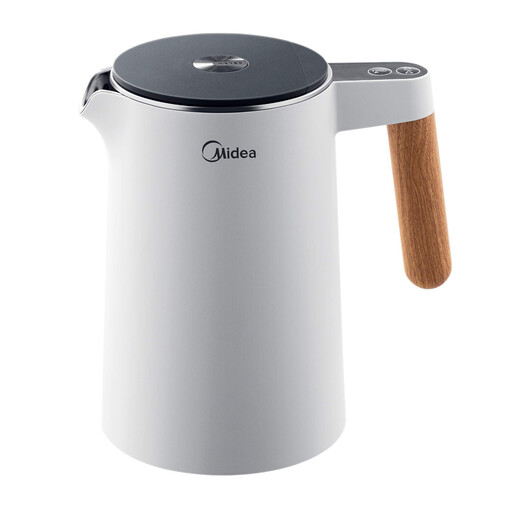
Why it suits this profile: If you prepare tea and coffee at different temperatures, you get seven fixed temperature settings and a display to monitor the selected value.
The product specifications list specific settings from 45 to 100 °C rather than making only a general claim about temperature control. The double-walled body is designed to make the exterior less hot.
Seven temperature settings, keeps warm for up to one hour according to the product description, 1.5-litre capacity and automatic boil-dry protection.
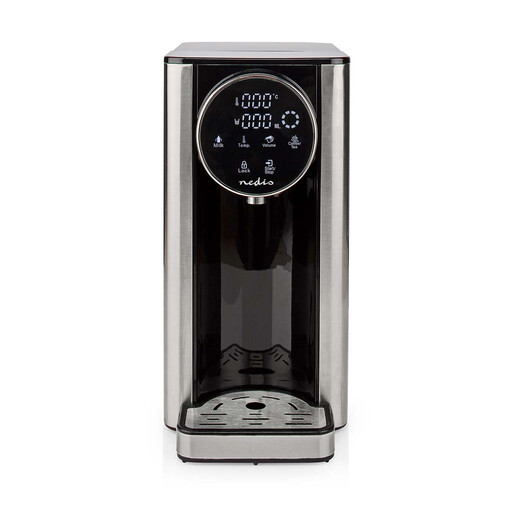
Why it suits this profile: A family, office or household that often needs small quantities can work more efficiently with volume settings and instant dispensing than with a full kettle.
The 2.7-litre tank avoids constant refilling, while five volume settings help prevent heating more water than necessary. According to the specifications, the dispenser has boil-dry, overheating and child protection.
Seven temperature settings, a 40 °C quick selection, five quantities from 100 ml to 2.7 litres and a removable drip tray.
We’ve put together a complete, up-to-date list of products that fully meet these strict selection criteria and the applicable European safety regulations.
A standard kettle heats water in a separate jug and is easy to move. A hot water dispenser sits permanently on the worktop and often dispenses a selected amount straight away. This is practical for several small cups in succession, but you need to allow for a larger footprint and regular tank maintenance.
A boiling water tap is an integrated kitchen solution. It requires installation, suitable connections and checks of the safety features. It is not a direct replacement for every kettle. For rented homes, student rooms or flexible workspaces, a separate kettle is usually simpler.
The lifespan depends on how often it is used, the hardness of the water, the material and maintenance. Descale the appliance according to the instructions, use only clean water and don’t allow the kettle to boil dry unnecessarily. Damage to the cable, plug or body is a reason to stop using the appliance.
Electricity consumption is mainly determined by the wattage and the amount of water you heat. A 2,200-watt kettle only uses that amount of power while heating. So, if you only need one cup, preferably fill it with just one cup’s worth of water. A dispenser can be practical per portion, but standby and tank behaviour varies from model to model.
This depends on the recipe, the type of tea and the manufacturer’s instructions. Choose a model with several fixed settings if you want to work with specific temperatures. For baby food, always follow the instructions on the packaging and check the temperature of the prepared product; a 40 °C button is not, by itself, a guarantee of a suitable preparation temperature.
