
Anyone looking for sourdough for Vlaggetjesdag
You want small rolls to serve with herring, but the shape or an artisan look isn’t proof that they’re sourdough. Compare the product name with the ingredients for the exact roll.


If sourdough is your priority, choose a roll that is explicitly labelled as sourdough: the name ‘kaiser roll’ alone tells you nothing about how it was made. A kaiser roll could work for a herring roll if the shape matters most; a sourdough pistolet or demi-baguette is an alternative if you’re happy to choose a different shape. Check the ingredients and allergens for the exact product, and ask how it was made if fermentation with a sourdough starter is essential to your choice.
You want small rolls to serve with herring, but the shape or an artisan look isn’t proof that they’re sourdough. Compare the product name with the ingredients for the exact roll.
You want to time the baking to suit when you’ll be eating. Check the pack instructions and make sure you have access to the oven or air fryer you’ll need.
You want to choose between white, brown and wholemeal, or you need to check the allergens in the roll and herring in advance. The word ‘sourdough’ doesn’t tell you either of these things.
First decide whether sourdough, the kaiser shape or when you bake the rolls matters most. Then check the nutrition information and allergens for the exact rolls you plan to serve.
Choose this if: you want an individual roll that is explicitly labelled as sourdough; Jumbo, for example, lists Desem Broodjes Wit.
Bear in mind: a sourdough label doesn’t confirm that the roll is wholemeal or has a kaiser shape.
Choose this if: you mainly want the familiar shape and individual rolls to serve with herring.
Bear in mind: the name of the shape doesn’t confirm that it’s sourdough; check the exact product before describing it that way.
Choose this if: sourdough matters more to you than the kaiser shape. Albert Heijn lists a sourdough pistolet, while PLUS lists a sourdough demi-baguette.
Bear in mind: the shape and portion differ from a kaiser roll; the PLUS demi-baguette mentioned is white.
| What to consider | What to check when buying | Who it matters most to |
|---|---|---|
| Sourdough | Read the product name and ingredients; ask how it was made if fermentation with a sourdough starter is essential to your choice. | If I really want sourdough, clear information about how it was made matters more to me than the kaiser shape. For around 36% of consumers, this confirmation would be their top priority. |
| Baking time | Check the baking instructions, the number of rolls and the storage advice on the pack. | When serving herring, I want to be able to plan the baking around serving time. This would be the main concern when buying for around 29% of consumers. |
| Bread type and salt | Look for an explicit label if you want wholemeal or brown bread; check the ingredients to find out whether iodised salt has been used. | I want to be able to assess the bread type and salt used, even if a white sourdough product appeals to me. For around 21% of consumers, this nutritional information would come first. |
| Allergens | Read the label on packaged rolls or ask about allergens in loose rolls before buying; check the toppings too. | When serving rolls with herring, I want to check the allergens in both the bread and the topping in advance. For around 14% of consumers, this clarity would be their top priority. |
Jumbo, among others, lists kaiser rolls and sourdough products separately. A roll’s shape doesn’t tell you how it was made.
Read the product name and ingredients on the exact pack; ask how it was made if that affects your choice.
A roll can contain sourdough and still be white, like the PLUS Desem demi baguette wit. ‘Sourdough’ and ‘wholemeal’ describe different qualities.
Check the bread type separately if you want a wholemeal or brown roll. The Netherlands Nutrition Centre also recommends checking this when choosing sourdough bread.
According to the Netherlands Nutrition Centre, bakers aren’t required to use baker’s salt, and organic bread usually contains non-iodised salt. So a ‘sourdough’ or ‘organic’ label doesn’t give you certainty.
For packaged bread, look for iodised salt or baker’s salt in the ingredients. For loose rolls, ask the seller.
The topping matters too: herring adds fish as an allergen. Sourdough also doesn’t mean a roll is free from cereals containing gluten.
Check the label on packaged products and ask for allergen information about loose rolls before buying.
Albert Heijn lists AH Liefde & Passie Biologisch desem pistolet meerzaden as a roll available in store only.
Jumbo lists Desem Broodjes Wit - 4 Stuks and also has a separate category for kaiser rolls.
Lidl lists kaiser rolls in its oven-fresh range; availability may vary by store.
Aldi lists De Afbakker Kaiserbroodjes wit among its bake-at-home rolls.
PLUS lists a white Korenlanders Desem demi baguette with sourdough and iodised salt in the ingredients.
Dirk lists sourdough in its bread range and also shows bake-at-home kaiser rolls.
This product suits anyone mainly looking for individual kaiser rolls to serve with herring. Check the pack if sourdough preparation, allergens or baking instructions are essential to your choice.
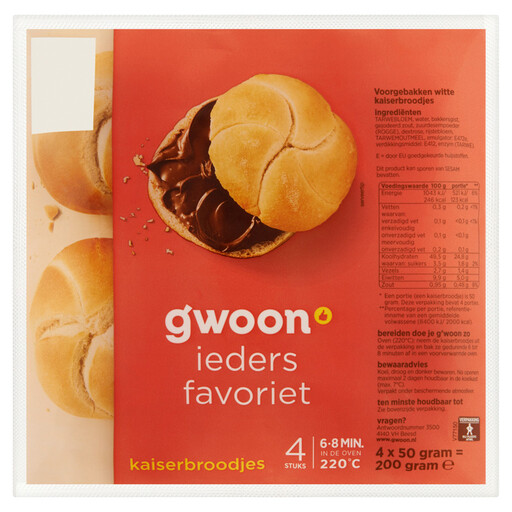 Image unavailable
The pack of four kaiser rolls suits anyone looking for individual rolls to serve with herring.
Looking specifically for a roll fermented with a sourdough starter, or want to bake them just before serving? Check how they’re made and the serving instructions on the pack.
No. ‘Kaiser roll’ describes the shape and doesn’t confirm that it was made with sourdough. Check the product name and ingredients for the exact roll, and ask whether it was fermented with a sourdough starter if that distinction matters to you.
No. Sourdough and wholemeal are separate qualities. The Netherlands Nutrition Centre recommends looking for a wholemeal or brown option when choosing sourdough bread too; check the label on the specific product.
For an unopened pack, follow the date and storage advice on the packaging. For opened bake-at-home rolls, the Netherlands Nutrition Centre recommends keeping them in the fridge for 2 to 4 days or in the freezer for 1 to 3 months; bread may dry out in the freezer, though.
Yes. According to the Netherlands Food and Consumer Product Safety Authority, sellers must provide customers with allergen information for unpackaged foods; if cereals containing gluten are present, the specific cereals must be identified. Ask before buying and check the allergens in the topping too.
No. According to the Netherlands Nutrition Centre, bakers don’t have to use baker’s salt, and organic bread usually contains non-iodised salt. Read the ingredients on packaged bread or ask which salt has been used in a loose roll.