If fibre is your main priority, consider a wholemeal Kaiser roll: the examples from Albert Heijn, Jumbo and PLUS list 6,7–7,1 g of fibre per 100 g, compared with 2,9 g per 100 g in the white rolls from Albert Heijn and Jumbo we looked at. If your fussy eater prefers white bread, try a small amount first rather than assuming that white is just as good as wholemeal. Before packing a roll, check the latest label for allergens and check your school or after-school club’s rules.
Who is this choice relevant to?
Parents looking to introduce wholemeal bread
You want to try a small roll labelled as wholemeal without buying a large pack straight away. The Netherlands Nutrition Centre distinguishes between wholemeal bread, made from wholemeal flour, and brown bread, which blends wholemeal flour with white flour. So colour alone won’t help you choose.
Parents of fussy eaters
You want to find out whether your child will eat the roll after school before you stock up. A white Kaiser roll may suit their preference, but the white rolls from Albert Heijn and Jumbo we looked at list less fibre per 100 g than the wholemeal versions we checked.
Parents who pack rolls for school
You need to check the allergen information before packing a roll and know how to store it. The products we looked at from Jumbo and PLUS, among others, list cereals containing gluten. You should also check your school or after-school club’s rules.
What should you look for when choosing?
First decide whether wholemeal ingredients, your child’s preference, ease of preparation or the rules around packing food matter most to you. Then compare the packaging information that’s relevant to your choice.
| What to consider |
What to check when buying |
Who is this important to? |
| Wholemeal ingredients and fibre |
Look for the wholemeal label and compare the fibre per 100 g in the nutritional information. |
If I want to keep an eye on fibre, I look for a roll that’s genuinely wholemeal, not just dark in colour. Around 33% of consumers prioritise choosing wholemeal. |
| Your child’s preference |
Try a single roll or a small pack before buying more. |
If my child won’t eat a roll, there’s little point buying a large pack. For around 25% of consumers, their child’s preference is the most important factor. |
| Preparation and storage |
Check whether the roll is fresh, part-baked or frozen, along with the preparation and storage instructions. |
After school, I want to know whether I can serve something straight away or need to bake the rolls first. Convenience and having a supply ready are priorities for around 25% of consumers. |
| Allergens and packing |
Read the latest label or ask about allergens when buying unpackaged bread. Also check the school or after-school club’s rules. |
Before I pack a roll, I need to know whether its ingredients and the school’s rules allow it. Around 17% of consumers make this check their top priority. |
Common mistakes
-
Assuming a brown or mixed-flour roll is wholemeal
According to the Netherlands Nutrition Centre, the colour doesn’t tell you whether a roll is made from wholemeal flour. Brown bread may contain a blend of wholemeal and white flour.
Look specifically for the wholemeal label, then compare the fibre per 100 g.
-
Skipping the allergen check because it’s only a bread roll
The Kaiser rolls from Albert Heijn, Jumbo and PLUS we looked at list cereals containing gluten. Depending on the product, other allergens or possible traces may also be listed.
Read the latest packaging. If you’re buying unpackaged rolls, ask about allergen information before you buy and check your school or after-school club’s rules.
-
Buying a multipack before trying one
A pack containing several rolls may not be practical if your child doesn’t like the taste or texture.
Try a single roll or a small pack first, then decide whether to buy a larger pack.
-
Refreezing rolls once they’ve defrosted
The frozen wholemeal rolls from Jumbo we looked at must not be refrozen once defrosted.
Take only the number you need out of the freezer and follow the storage and preparation instructions on the packaging.
Brands compared
Albert Heijn
Albert Heijn offers a single fresh wholemeal Kaiser roll and white Kaiser rolls that you can bake at home.
- The wholemeal roll lists 7,1 g of fibre per 100 g; the white part-baked version we looked at lists 2,9 g per 100 g.
- According to Albert Heijn, the white version takes 8–10 minutes to finish baking. Check the latest packaging for ingredients and allergens when you buy it.
Jumbo
The Jumbo product ranges we looked at include white part-baked Kaiser rolls and frozen wholemeal Kaiser rolls.
- The frozen wholemeal version lists 6,7 g of fibre per 100 g; the white version we looked at lists 2,9 g per 100 g.
- The frozen version needs to be baked at home and must not be refrozen once defrosted.
PLUS
PLUS offers a single wholemeal wheat Kaiser roll if you’d like to try just one first.
- The product information lists 67% wholemeal wheat flour among the ingredients and 6,9 g of fibre per 100 g.
- The roll contains wheat and cereals containing gluten and, according to PLUS, may also contain sesame, among other allergens.
Lidl
Lidl lists a fresh-from-the-oven white Kaiser roll that’s only available in store.
- A freshly baked roll doesn’t need any more baking at home.
- The fresh range may vary from one store to another. Ask in store for allergen information if it’s relevant to your choice.
Dirk
Dirk lists a pack of four part-baked Kaiser rolls from 1 de Beste.
- According to Dirk, these rolls can be baked in the oven or air fryer in 6–8 minutes.
- Check the ingredients and allergens on the packaging before buying them for school.
Kaiser rolls at Joybuy
This pack of four Kaiser rolls may suit you if you’d like to try a small amount for an after-school snack. Check the latest packaging to see whether the rolls match your preference for white or wholemeal.
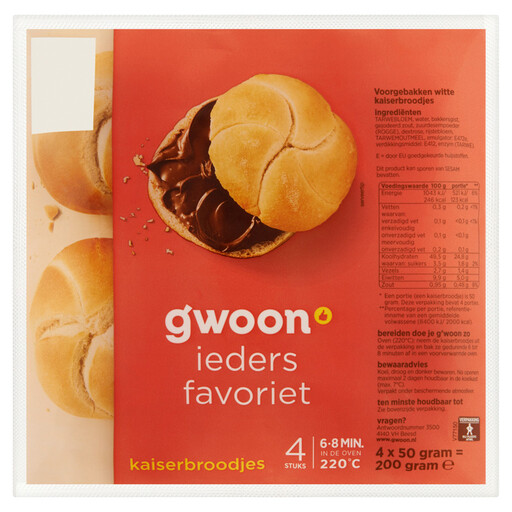 Image unavailable
g'woon Kaiser rolls, 4 pieces, 200 g
The pack of four rolls may suit you if you’d like to try a small amount first.
Pack size: 4 pieces, 200 g in total. Check the latest packaging for the wholemeal label, nutritional information and allergens before packing a roll.
View at Joybuy
Frequently asked questions
Is a brown Kaiser roll the same as a wholemeal roll?
No. According to the Netherlands Nutrition Centre, wholemeal bread is made from wholemeal flour, while brown bread may be a blend of wholemeal and white flour. Look for the wholemeal label rather than going by colour.
Are the Kaiser rolls mentioned suitable for a child who needs to eat gluten-free?
The products from Albert Heijn, Jumbo and PLUS we looked at list cereals containing gluten, so they’re not gluten-free options. For any other packaged roll, read the latest label. If you’re buying unpackaged bread, ask about allergen information before you buy it.
Does every Kaiser roll contain iodine from baker’s salt?
No, you can’t assume that. According to the Netherlands Nutrition Centre, bakers aren’t required to use baker’s salt. Check the ingredients on the packaging if you want to know what kind of salt was used in the roll.
How do I choose between individual and frozen rolls?
An individual roll is a good choice if you first want to see whether your child will eat it. A pack of frozen rolls may suit you if you’re planning several snack occasions and have time to bake them. Follow the storage instructions: the frozen wholemeal rolls from Jumbo we looked at must not be refrozen once defrosted.


