
Families with different bread preferences
If you’re just topping up, you may want to leave room for both white and wholemeal rolls, rather than making everyone choose the same.


If you want to eat the rolls straight away, an individually sold fresh wholemeal kaiser roll is a good choice if wholegrains and fibre are your priorities. If people at home have different preferences, you could combine a small wholemeal option with white bake-at-home rolls, provided you have time to prepare them at home. When picking up a few extra items, pay particular attention to the number of rolls, the description on the label, and the storage and preparation instructions.
If you’re just topping up, you may want to leave room for both white and wholemeal rolls, rather than making everyone choose the same.
You want a roll you can eat without baking it at home, and are comparing the wholemeal description and fibre per 100 g. Albert Heijn’s product pages list 7,1 g of fibre per 100 g for its fresh wholemeal kaiser roll and 2,9 g for the white bake-at-home version.
You’re buying a few rolls for later and can bake them at home. If you choose a frozen version, you’ll also need to consider the freezer space available and the instructions for after defrosting.
First, decide whether the rolls will be eaten straight away or once you get home. Then choose the varieties and pack size that suit the people eating them and when you plan to serve them.
| What to consider | What to check when buying | Who it matters to |
|---|---|---|
| Combining white and wholemeal | See which varieties are available individually or in a small pack. Check that the product you choose is labelled wholemeal. | If not everyone wants the same roll, I like to keep both options open. For around 27% of consumers, this compromise on taste comes first. |
| Wholemeal and fibre | Read the product name and compare fibre figures on the same basis, such as per 100 g. According to the Netherlands Nutrition Centre, wholemeal bread is made from 100% wholemeal flour. | I want to base my choice on the label rather than the colour of the roll. Around 33% of consumers give wholemeal and fibre top priority. |
| Eat straight away or bake at home | Check whether the roll is ready to eat or needs to be prepared, and follow the stated cooking time and equipment instructions. | When I’m out and about or having lunch, a roll that still needs to go in the oven at home is no use to me. Being able to eat it straight away matters most to around 20% of consumers. |
| Portions and storage | Compare the number of rolls with the occasions you plan to eat them, and read the storage and defrosting instructions on the pack. | When I’m just topping up, I don’t want to buy more than I can use or store. For around 20% of consumers, portion size and managing their supplies come first. |
The colour or name doesn’t tell you whether a kaiser roll is made from wholemeal flour. According to the Netherlands Nutrition Centre, wholemeal bread is made from 100% wholemeal flour.
Look for the wholemeal description on the pack, then compare the nutritional information per 100 g.
If you only need a few rolls, the rest may go uneaten. The Netherlands Nutrition Centre lists bread as a product that is often wasted.
Choose a quantity that suits the people eating them and your next few meals. Follow the product instructions for storage or freezing.
Bake-at-home rolls still need time and suitable equipment. Dirk says its four-pack of 1 de Beste Kaiserbroodje takes 6 to 8 minutes to prepare in an oven or air fryer.
Choose a ready-to-eat roll if you can’t bake it, or check the pack’s preparation instructions in advance.
Allergens and whether iodised salt is listed can vary from one product to another. So a general assumption won’t tell you enough about the roll you’re buying.
Check the current label for the exact variety, especially if a particular ingredient or allergen affects your choice.
Albert Heijn lists an individually sold fresh wholemeal kaiser roll and a pack of ten white bake-at-home kaiser rolls.
Jumbo lists frozen wholemeal kaiser rolls, among other products, in a pack of four.
PLUS lists an individually sold fresh wholemeal wheat kaiser roll.
Dirk lists white bake-at-home kaiser rolls, including 1 de Beste Kaiserbroodje in a pack of four.
ALDI lists white kaiser rolls from its own-label brand De Afbakker among its bake-at-home bread rolls.
Lidl describes bake-at-home kaiser rolls on a product page for in-store sales.
This pack of four kaiser rolls could suit a small top-up shop. Check the product packaging before choosing between rolls you can eat straight away and ones you bake at home, or between white and wholemeal.
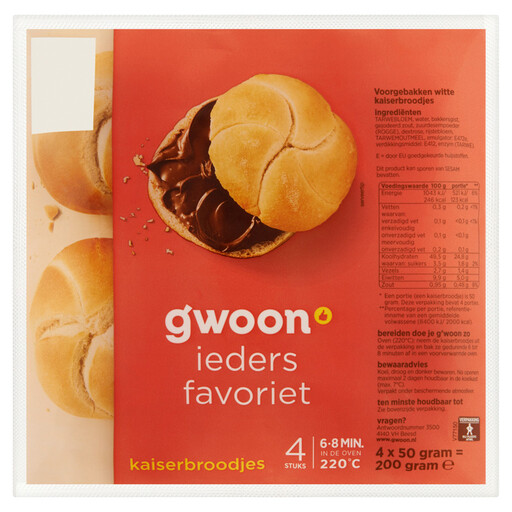 Image unavailable
Four kaiser rolls could be a good choice for a small top-up shop if you have several people to feed or meals planned.
Check the pack to see whether they’re ready to eat or need baking. Also check whether they’re described as white or wholemeal, and read the nutritional information if it matters to your choice.
No. According to the Netherlands Nutrition Centre, wholemeal bread is made from 100% wholemeal flour; brown bread can contain a mixture of wholemeal flour and white flour. So check the product name and ingredients list on the roll’s packaging.
Read the current label on the exact pack, as ingredients and allergens can vary between varieties. The Netherlands Food and Consumer Product Safety Authority says that mandatory labelling covers 14 allergens.
The term alone doesn’t confirm the iodine content of a particular roll. The Netherlands Food and Consumer Product Safety Authority explains that iodine compounds may only be added to bread and bakery products in the form of baker’s salt. Check the ingredients list on the pack of the product you choose.
Always follow the instructions on the pack first. The Netherlands Nutrition Centre’s Storage Guide recommends keeping opened bake-at-home rolls in the fridge for 2 to 4 days, or in the freezer for 1 to 3 months. Jumbo’s frozen kaiser rolls also come with an instruction not to refreeze them after defrosting.