
If wholemeal is your priority
You want a Kaiser roll for a sweet breakfast that is clearly labelled as wholemeal. You can then use the ingredients list and nutritional information to compare fibre and salt per 100 g.


Choose a wholemeal Kaiser roll if the type of bread and nutritional information are your priorities; choose a white roll if that’s more in line with what everyone wants for breakfast. If people around the table have different preferences, you can buy both. Check the ingredients, allergens and preparation instructions for each variety before choosing.
You want a Kaiser roll for a sweet breakfast that is clearly labelled as wholemeal. You can then use the ingredients list and nutritional information to compare fibre and salt per 100 g.
You’re looking for a roll to serve with sweet toppings, but not everyone wants the same type of bread. A white Kaiser roll may suit anyone who prefers white bread. Don’t assume that the product’s colour means it will taste a certain way.
You’re buying rolls in advance and want to know whether they’re sold fresh, ready to bake or frozen. The preparation and storage instructions will help you decide whether they fit into your breakfast plans.
First decide whether the type of bread, your breakfast guests’ preferences or how you’ll prepare the rolls at home is the deciding factor. If people have different preferences, you can choose both white and wholemeal rolls, but check each pack separately.
| What to consider | What to check before buying | Who it matters to |
|---|---|---|
| Wholemeal and nutritional information | Look for an explicit wholemeal description and compare fibre and salt on the same basis, ideally per 100 g. | When serving sweet toppings, I want to know which roll I’m choosing and be able to compare the nutritional information for different varieties. For around 45% of consumers, choosing wholemeal is the priority. |
| Preference for white bread | Check whether the roll is described as white and, if preferences differ, consider buying both types of bread. | If someone at the table prefers a white roll with sweet toppings, I want to take that preference into account. Around 33% of consumers say this is their top priority. |
| Preparation and storage | Check whether the rolls are fresh, ready to bake or frozen, and read the preparation and storage instructions. | When I buy rolls in advance, I want to know what I’ll need to do on the morning of breakfast. For around 22% of consumers, planning is the most important factor. |
The colour or visible grains don’t tell you whether a Kaiser roll is labelled as wholemeal. The Netherlands Nutrition Centre advises replacing white bread with wholemeal or brown bread as often as possible, but these types of bread aren’t the same.
Read the product description and ingredients list, then compare the fibre and salt listed per 100 g.
You’ll need to check whether a specific product contains iodised salt or baker’s salt. The type of bread alone won’t tell you.
Check the current ingredients list, even if you’ve bought a different variety from the same brand before.
A frozen product requires different storage planning from a fresh roll. Jumbo says its frozen wholemeal Kaiser rolls must not be refrozen after defrosting.
Before buying, check how to store and prepare your chosen rolls, and make sure this suits your breakfast time.
Baking them at home takes time and requires an oven or air fryer.
Lidl says its freshly baked range can vary from one shop to another. This is especially relevant if you want to buy both white and wholemeal Kaiser rolls for the same breakfast.
Check what’s available locally if a particular type of bread is important to your choice.
Albert Heijn describes its AH wholemeal Kaiser roll as a wholemeal wheat roll weighing 70 g each.
Jumbo sells a frozen wholemeal Kaiser roll for anyone who wants to bake rolls at home.
PLUS describes its individually sold Kaiser roll as a wholemeal wheat Kaiser roll.
Lidl describes its freshly baked Kaiser roll as a white wheat roll.
ALDI includes a white Kaiser roll in its range of freshly baked rolls.
Dirk lists white Kaiser rolls as well as a packaged ready-to-bake variety.
These Kaiser rolls could be a starting point for a sweet breakfast. Before choosing this variety as either white or wholemeal, check the packaging to see which it is.
 No image available
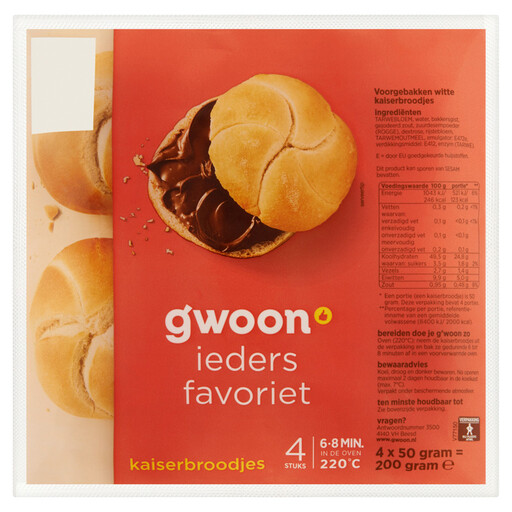
A pack of four Kaiser rolls for breakfast. Check the current packaging to find out whether this variety is white or wholemeal, and what serving size the nutritional values are based on.
The listed allergens are cereals containing gluten, milk, sesame and soya. If you have an allergy, always check the packaging.
Check that the roll is explicitly described as wholemeal and read the ingredients list; colour or visible grains aren’t enough. Albert Heijn calls its variety a wholemeal wheat roll, while PLUS describes its variety as a wholemeal wheat Kaiser roll.
You can’t tell from the type of bread. Check the ingredients for the product you choose: Albert Heijn lists iodised salt in its wholemeal variety mentioned here, while Jumbo and PLUS list baker’s salt in the varieties mentioned here.
Read the current packaging for the specific variety. For its wholemeal Kaiser roll, Albert Heijn lists cereals containing gluten and the possible presence of sesame and oats, among other allergens. For its frozen wholemeal variety, Jumbo lists wheat, rye, barley and soya, among other ingredients.
According to Jumbo, its Frozen Wholemeal Kaiser Rolls must not be refrozen after defrosting. For other products, follow the instructions on the packaging.
Don’t assume that every supermarket or shop stocks the same range. Lidl says its freshly baked range can vary from one shop to another. Check what’s available locally if you want to buy both types of bread for the same breakfast.