
Small households with a few office lunches to plan
You don’t want to open more bread than you’ll use over a few lunches. So compare half a loaf with small packs of rolls, and think ahead about what you can freeze.


Choose half a wholemeal loaf if you want to take sandwiches to work on several days and wholemeal bread matters to you. A small pack of part-baked Kaiser rolls is a better fit if you want individual rolls and have the time and equipment to prepare them. Match the quantity to your lunch plans, freeze any bread you won’t use in time, and check the current packaging for ingredients and allergens.
You don’t want to open more bread than you’ll use over a few lunches. So compare half a loaf with small packs of rolls, and think ahead about what you can freeze.
If sandwiches are often the basis of your work lunch, you could compare half a wholemeal loaf with white part-baked Kaiser rolls. The Netherlands Nutrition Centre points out that wholegrain products contain more fibre than white grain products.
The name ‘Kaiser roll’ doesn’t tell you which allergens a specific product contains. For packaged rolls, read the label; for unwrapped rolls, ask for the allergen information.
A good fit for: sandwiches for several working days in a small household, if you’re choosing wholemeal bread deliberately.
Trade-off: there’s no baking involved, but you won’t get a freshly baked roll; freeze any unused portions in good time.
A good fit for: a short run of lunches when you want to take individual rolls with you.
Trade-off: baking takes time and requires suitable equipment; a white version isn’t wholemeal bread.
| What to consider | What to check before buying | Who it matters to |
|---|---|---|
| Portions and storage | Count your planned lunches and compare the number of rolls or portions. Check how you can store any leftovers. | I don’t want to open more bread than I’ll use over a few working days; for around 36% of consumers, portion size would therefore be the main priority. |
| Wholemeal and fibre | Look for the word ‘wholemeal’ and compare the fibre per 100 g in the nutrition table. | If I often take sandwiches with me, I want to know whether I’m actually buying wholemeal bread; for around 29% of consumers, this would come first. |
| Preparation | Check whether the rolls need baking, and what time and equipment this requires. | I want to be able to prepare my rolls before I leave without disrupting my morning routine; for around 21% of consumers, preparation would be the most important consideration. |
| Allergens | Read the ingredients, allergen information and any warnings on the current packaging. | I need to be able to check whether a specific roll is suitable for my dietary requirements; an estimated 14% of consumers would base their decision on this check. |
A pack of ten Kaiser rolls isn’t automatically right for a small household; packs of four and half loaves are also available.
Work out how many rolls or slices of bread you’ll use over the coming working days, and freeze the rest in good time.
The white part-baked varieties we looked at aren’t a substitute for half a wholemeal loaf if the type of bread is what matters to you. Albert Heijn lists 6.9 g of fibre per 100 g for AH Rond volkoren half.
Look for the word ‘wholemeal’ and compare the nutrition information per 100 g, rather than judging by shape or colour.
The standard Kaiser rolls we looked at contain wheat. A product labelled gluten-free may still contain other allergens.
Read the label for the specific product. For unwrapped rolls, ask about allergen information before buying.
Preparation time and the equipment required vary between part-baked products. This matters if you need to get your roll ready before you leave.
Read the preparation instructions before you buy, or choose bread you can fill straight away if baking doesn’t fit your schedule.
Albert Heijn’s range we looked at includes both part-baked Kaiser rolls and AH Rond volkoren half.
Jumbo offers white Kaiser rolls, among other options, in a pack of four.
Lidl describes a pack of six Kaiser rolls to bake at home.
ALDI lists De Afbakker Kaiserbroodjes wit as six wheat rolls to bake at home.
PLUS offers a pack of four white part-baked Kaiser rolls and also lists individual rolls.
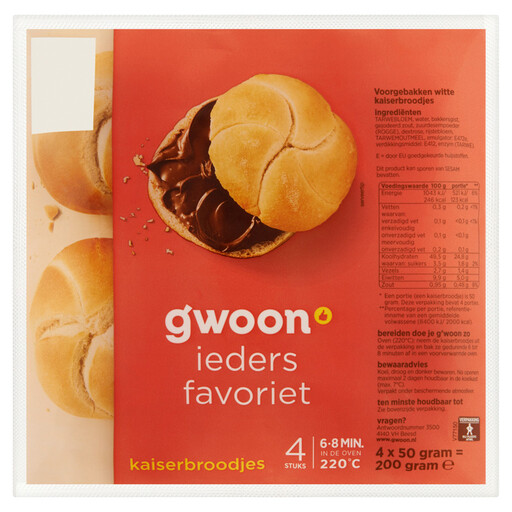
Dirk lists a pack of four part-baked Kaiser rolls under its own brand.
This pack of four is an option if you want to plan individual Kaiser rolls for a short run of office lunches. Check before buying whether they still need to be baked.
 No image available
A pack for lunch plans where you need up to four rolls.
Pack size: 4 rolls, 200 g. Check the packaging for preparation instructions, storage advice and allergen information.
Choose a quantity that matches your planned lunches and freeze the rest in good time. Albert Heijn lists 11 portions of 35 g for AH Rond volkoren half; the small packs of Kaiser rolls we looked at contain four rolls. According to the Netherlands Nutrition Centre, you can freeze soft white rolls, although their quality may deteriorate in storage.
Look specifically for the word ‘wholemeal’ on the bread you buy. The Netherlands Nutrition Centre says that wholegrain products contain more fibre than white grain products; compare the nutrition information per 100 g for specific products.
For packaged Kaiser rolls, read the current ingredients list and allergen information. The standard varieties we looked at contain wheat; the gluten-free Schär product we looked at contains soya and may contain mustard. For unwrapped rolls, ask for allergen information before buying.
Don’t assume that every Kaiser roll contains iodised salt. Check the ingredients list for the specific product; the products from Albert Heijn, Jumbo and PLUS that we looked at list iodised salt.
Keep perishable fillings chilled and use a suitable way to keep them cool while travelling. The Netherlands Nutrition Centre recommends a fridge temperature of 4 °C; keeping food chilled is mainly important for the filling, rather than a plain roll.