
Lunch shoppers who want to identify sourdough
You want to be able to tell from the ingredients what kind of sourdough a roll contains, rather than relying on its name or appearance alone.


Choose a classic Kaiser roll if you’re mainly looking for that distinctive shape; choose a sourdough roll if you specifically want sourdough listed as an ingredient. If wholemeal matters more to you, compare the flour type and fibre per 100 g. Also check the allergens and preparation instructions for the roll you buy, and whether it contains iodised salt if that’s relevant to you.
You want to be able to tell from the ingredients what kind of sourdough a roll contains, rather than relying on its name or appearance alone.
You’d rather compare the flour type and nutritional information than focus only on the white Kaiser shape or a sourdough claim.
You’re looking for a roll that’s already been baked in store, or want to know in advance how much time and what equipment you’ll need to bake one at home.
First decide whether the Kaiser shape, sourdough explicitly listed as an ingredient, or a wholemeal base matters most to you. Then check the label and preparation instructions for the specific roll.
| What to consider | What to check when buying | Who it matters to |
|---|---|---|
| Type of sourdough | Check whether the ingredients list sourdough, rye sourdough powder or inactivated rye sourdough. | If I’m specifically looking for sourdough, I want to know what kind is in my lunch roll. Verifiable sourdough is the first thing around 36% of consumers look for. |
| Wholemeal and fibre | Check the type of flour and compare fibre on a like-for-like basis: per 100 g. | For my lunch, a wholemeal base matters more than the classic white Kaiser shape. That’s why wholemeal and fibre come first for around 29% of consumers. |
| Preparation time | Check whether the roll is already baked or needs an oven or air fryer at home, and look at the recommended cooking time. | If I want lunch straight away, it matters whether I still need to bake the roll. Around 21% of consumers place the most importance on being able to eat it straight away or needing very little preparation. |
| Ingredient information | Read the allergen information and, if necessary, check for iodised salt. For an unpackaged roll, ask the seller for details. | If I need to watch out for certain ingredients, I want to know what’s in a loose or packaged roll before buying it. This check is the top priority for around 14% of consumers. |
The products reviewed list different types of sourdough: Albert Heijn lists rye sourdough powder in its Kaiser rolls, Jumbo lists inactivated rye sourdough in its Kaiser rolls, and sourdough with a starter culture in its white sourdough rolls.
If a specific sourdough ingredient matters to you, check the ingredients for the variant you’re buying.
A sourdough claim doesn’t tell you how much fibre a roll contains. The white rolls reviewed from Albert Heijn and Jumbo list 2.4 to 2.9 g of fibre per 100 g; the wholemeal sourdough rolls reviewed at PLUS list 8.4 g per 100 g.
Check whether the roll is described as wholemeal and compare the nutritional information per 100 g.
Whether a roll contains iodised salt depends on the specific product. A general assumption is no substitute for checking the ingredients list.
Look for iodised salt or baker’s salt on the packaging, or ask about the ingredients if the roll is unpackaged.
Allergen information matters even when there’s no packaging. According to the Netherlands Food and Consumer Product Safety Authority, sellers must provide information about the 14 specified allergens for unpackaged foods.
Before buying, ask which allergens the roll contains and which grain it’s made from if gluten-containing cereals are relevant to you.
These brands offer different ways to get a roll for lunch. Always compare the specific product: a Kaiser roll and a separately sold sourdough roll are not the same thing.
The AH Kaiser rolls reviewed are packaged white wheat rolls that you bake at home.
Jumbo distinguishes classic Kaiser rolls from separately named white sourdough rolls.
The Dutch Bakery Bio wholemeal sourdough rolls reviewed are a bake-at-home option if you’re looking for wholemeal and sourdough in one product.
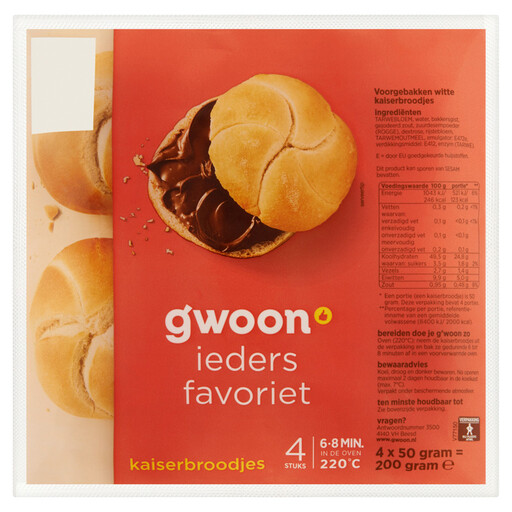
Lidl lists a white wheat Kaiser roll in its range of products baked in store.
Aldi lists a white Kaiser roll in its bakery range.
Dirk lists both a freshly baked Kaiser roll sold individually and packaged Kaiser rolls.
This product selection is for anyone looking for a Kaiser roll for lunch. Check the packaging if the exact type of sourdough, allergens or preparation method will influence your choice.
 No image available
An option if you’re looking for a Kaiser roll for lunch. Check the packaging for the ingredients and preparation instructions if sourdough or quick baking is important to you.
No. The product name ‘Kaiser roll’ doesn’t tell you what kind of sourdough it contains. The Albert Heijn and Jumbo Kaiser rolls reviewed list rye sourdough powder and inactivated rye sourdough respectively; Jumbo’s separately sold Desem Broodjes Wit list sourdough with a starter culture. Check the ingredients for the variant you’re buying.
No. To find out, compare the flour type and fibre per 100 g. The PLUS wholemeal sourdough rolls reviewed list 8.4 g of fibre per 100 g, compared with 2.4 to 2.9 g per 100 g for the white rolls reviewed from Jumbo and Albert Heijn. These figures apply to these specific products.
You can’t tell from the type of bread alone. For a packaged roll, check the ingredients for iodised salt or baker’s salt. If the roll is unpackaged, ask what it contains if this is relevant to your choice.
Ask the seller about the allergens in the specific roll before buying it. According to the Netherlands Food and Consumer Product Safety Authority, sellers must provide information about the 14 specified allergens for unpackaged foods too. If necessary, ask specifically which types of grain it contains.
Cooking times vary by product, so follow the packaging. For the AH Kaiser rolls reviewed, Albert Heijn recommends 6–8 minutes at 220 °C in the oven or 5–6 minutes at 200 °C in a preheated air fryer. For the Dutch Bakery Bio wholemeal sourdough rolls reviewed, PLUS recommends 6–8 minutes at 220 °C in the oven.