
Parents keeping an eye on fibre
You’re looking for a roll that fits with the Netherlands Nutrition Centre’s preference for wholemeal bread for children aged 1 to 3, while also taking account of the texture your toddler is happy to eat.


A wholemeal kaiser roll is an obvious choice if your toddler is comfortable eating its texture: the Netherlands Nutrition Centre recommends wholemeal and brown bread for children aged 1 to 3 because of the fibre. Don’t automatically serve thick pieces or a whole roll as a portion; make the pieces suitable for the way your child chews, and cut them smaller if you’re unsure. Check the current ingredients and allergen information for each variety, especially if the roll is going to school or nursery.
You’re looking for a roll that fits with the Netherlands Nutrition Centre’s preference for wholemeal bread for children aged 1 to 3, while also taking account of the texture your toddler is happy to eat.
You want to divide the roll into pieces that suit your child. If you’re unsure about their ability to chew, the Netherlands Nutrition Centre advises cutting the food into smaller pieces once more.
You check the label for ingredients, allergens and ‘may contain’ statements, and, if necessary, choose a roll that suits your child’s dietary needs and the arrangements at their school or nursery.
First decide whether wholemeal, piece size or a dietary requirement will guide your choice. Then consider which pack size and preparation method suit the way you’ll use them.
| What to consider | What to check when buying | Who is this important for? |
|---|---|---|
| Wholemeal and fibre | Check whether the roll is labelled wholemeal and compare the fibre per 100 g on the label. | If my toddler enjoys wholemeal bread, I want to be able to make the same choice with kaiser rolls; around 30% of consumers prioritise wholemeal and fibre. |
| Piece size and crust | Check the texture of the prepared roll and cut it into smaller pieces if you’re unsure about your child’s ability to chew. | When my toddler is still learning to chew, I don’t want to offer a piece that’s too large. For around 30% of consumers, a suitable piece size is their main concern. |
| Allergens and arrangements | Read the current label and check the arrangements at school or nursery if you’re packing the roll to take with you. | If a dietary requirement or nursery arrangement is a factor, I want to know what my child is taking with them; around 20% of consumers prioritise allergens and making sure everything is suitable. |
| Stock and preparation | Compare the number of rolls, preparation method, and storage and freezing instructions. | If I only use a few rolls at a time, I want to be able to store the rest according to the pack instructions; for around 20% of consumers, convenience comes first. |
A thick slice or large piece isn’t automatically right for a toddler’s chewing ability. The size and texture of the roll after preparation matter more than that description.
Cut the roll into pieces that suit your child. If you’re unsure whether they can chew it properly, the Netherlands Nutrition Centre advises cutting the food into smaller pieces once more.
The standard varieties examined contain wheat or other gluten-containing cereals; additional ingredients and ‘may contain’ statements vary by product.
Check the current ingredients and allergen information every time you buy. If the roll is going to school or nursery, make sure it suits your child’s needs and the arrangements there.
The wholemeal varieties examined from Albert Heijn, Jumbo and PLUS list 6.7 to 7.1 g of fibre per 100 g; the white varieties examined from Jumbo and PLUS list 2.46 to 2.9 g per 100 g. These figures apply to the products listed, not to every kaiser roll.
If you’re choosing based on fibre, compare the wholemeal label and nutritional information per 100 g for the rolls you’re considering.
Preparation and storage instructions vary by pack. Jumbo says its frozen wholemeal kaiser rolls must not be refrozen after defrosting.
Read the instructions for the variety you choose and bake the quantity you want to use.
Defrosted rolls that can no longer be stored according to the pack instructions may go to waste.
Albert Heijn offers, among other options, a fresh wholemeal kaiser roll and bake-at-home varieties.
Jumbo offers, among other options, a white bake-at-home roll and a frozen wholemeal variety to compare.
Lidl stocks kaiser rolls in its oven-fresh range.
ALDI offers both a fresh white kaiser roll and white bake-at-home rolls.
PLUS offers, among other options, a fresh wholemeal kaiser roll and white bake-at-home rolls.
Dirk offers an own-brand bake-at-home variety and a fresh white kaiser roll.
This pack of g'woon kaiser rolls contains four rolls. For a toddler’s breakfast, check the label separately and cut the pieces to suit your child.
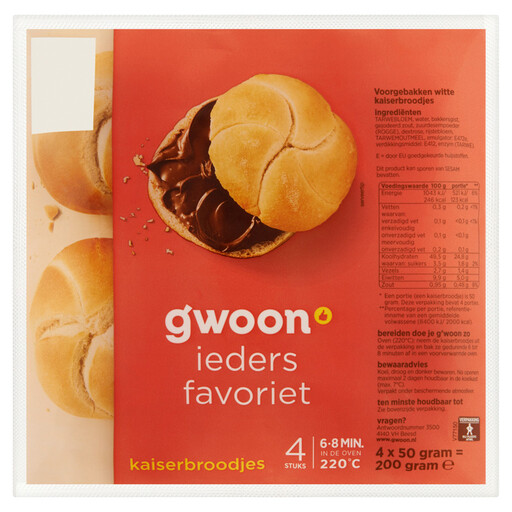 Image unavailable
A multi-roll pack for anyone who wants to choose the portion and piece size for their toddler’s breakfast.
Check the current label for ingredients and allergens. If fibre is a priority, also check whether the variety is labelled wholemeal and how much fibre it lists per 100 g.
Wholemeal is an obvious choice if your toddler eats it comfortably: the Netherlands Nutrition Centre recommends wholemeal and brown bread for children aged 1 to 3 because of the fibre. Fibre values vary between products, so compare the nutritional information per 100 g.
No, thick pieces aren’t automatically suitable for a toddler. Make the pieces appropriate for the way your child chews; if you’re unsure, the Netherlands Nutrition Centre advises cutting the food into smaller pieces once more. Make sure your child eats sitting down and stay nearby.
The standard white and wholemeal kaiser rolls examined contain wheat or other gluten-containing cereals. Check each product for other allergens and any ‘may contain’ statements too. If a gluten-free diet is needed, choose only a product that is clearly labelled gluten-free and suits your child’s needs.
You can’t assume that every roll does. The Netherlands Food and Consumer Product Safety Authority says that iodine compounds may be present in bread and other baked goods as a result of adding baker’s salt. Check the ingredients for the variety you choose, looking for terms such as ‘baker’s salt’ or ‘iodised salt’.
No, a whole kaiser roll isn’t automatically a suitable portion for one breakfast. The Netherlands Nutrition Centre gives bread quantities for children aged 1 to 3 in the context of their daily menu, spread across eating occasions. Decide what to serve with the rest of the meal in mind, and consider the piece size your child can manage.