What should you look for when choosing?
For a child aged 1 to 3, first choose a roll that meets any allergen restrictions. Then compare the type of bread, how easy the portion is to manage and how the rolls are prepared.
| What to consider |
What to look for |
Who it’s most relevant for |
| Type of bread and fibre |
Check whether wholemeal flour is listed in the ingredients and compare the fibre content per 100 g. Don’t judge the type of bread by its colour alone. |
If Kaiser rolls are a regular part of breakfast, I want to know which type of bread I’m choosing. Around 31% of consumers put fibre first. |
| Pieces and portion |
Check the size of the pieces and the crust after baking, if required. Cut or tear the roll into smaller pieces if needed. |
If my child is still chewing cautiously or isn’t very hungry, I want to offer a small portion that’s easy to manage. For around 31% of consumers, this is the main consideration. |
| Allergens |
Check the current packaging for both ‘contains’ and ‘may contain’ information. For unpackaged bread, ask for the allergen information and, if necessary, check the school or childcare rules. |
If wheat or other allergens are a concern, I need to know what’s in the roll before serving it. For around 23% of consumers, this check comes first. |
| Storage and preparation |
Compare the number of rolls and the baking, storage and defrosting instructions on the packaging. |
I want to be able to store rolls without preparing more than I need. For around 15% of consumers, stocking up and preparation matter most. |
Brands to compare
These brands stock relevant Kaiser rolls. Always compare the specific version, as the type of bread, allergens and preparation method vary from product to product.
Albert Heijn
Albert Heijn lists regular AH Kaiser rolls and an AH wholemeal Kaiser roll.
- You can compare the names of a regular and a wholemeal version side by side.
- Albert Heijn warns that ingredients, nutritional values and allergen information may change. Check the packaging of the roll you buy.
Jumbo
Jumbo lists white and wholemeal frozen Kaiser rolls, as well as white Kaiser rolls.
- The product information for the versions we looked at helps you compare ingredients, allergens, storage and preparation instructions.
- The white products we looked at contain wheat and gluten. For the frozen version, also check the other allergen information and defrosting instructions.
PLUS
PLUS lists white bake-at-home Kaiser rolls and a wholemeal Kaiser roll.
- The wholemeal version we looked at lists 67% wholemeal wheat flour and 6,9 g of fibre per 100 g, so you can compare this specific version with the white PLUS product.
- Both versions we looked at contain wheat and gluten. Check the other allergen information for the product you choose too.
ALDI
ALDI lists white Kaiser rolls and white bake-at-home rolls from De Afbakker.
- The De Afbakker pack we looked at contains six wheat rolls and gives a baking time of 5–7 minutes.
- Check the packaging for full ingredients and allergen information before serving this version.
Dirk
Dirk lists 1 de Beste Kaiserbroodje, pack of 4, and white Kaiser rolls from Bakker van der Akker.
- For the 1 de Beste bake-at-home version we looked at, Dirk gives a cooking time of 6–8 minutes in an oven or air fryer.
- When you buy, check the nutritional information and allergens on the packaging of the version you choose.
Lidl
Lidl includes Kaiser rolls in its oven-fresh bread range.
- Kaiser rolls are one of the types of bread Lidl lists in this range.
- Lidl says its range may vary between stores. Ask for information about the ingredients, allergens and nutritional values of the rolls at your local store.
Kaiser rolls at Joybuy
This Joybuy selection includes Kaiser rolls that you can portion yourself. Before buying, check that they’re cut the way you want.
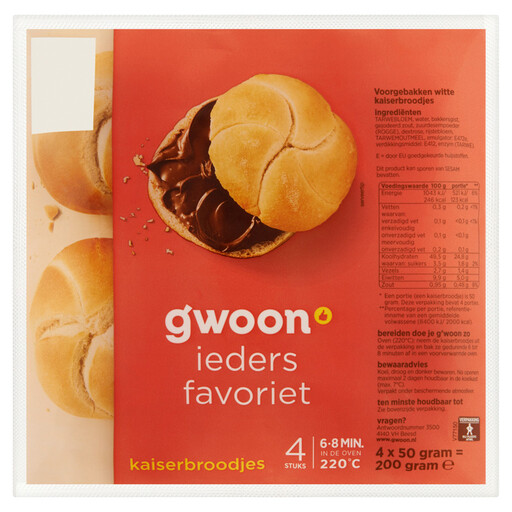 Image unavailable
g'woon Kaiser Rolls, 4 rolls (200 g)
For a toddler’s breakfast, you can offer part of a roll and cut or tear the pieces smaller if needed.
The pack contains 4 rolls and states a weight of 200 g. Check the current ingredients and allergen information, and consider whether the crust and pieces are suitable for your child’s chewing ability.
View at Joybuy
Frequently asked questions
How much bread should you give a toddler at breakfast?
A whole Kaiser roll doesn’t have to be the breakfast portion. The Netherlands Nutrition Centre suggests around 2 to 3 slices of bread a day for children aged 1 to 3, usually split between breakfast and lunch. Consider what your child eats throughout the day and offer a small piece first if needed.
Should you cut a sliced Kaiser roll into smaller pieces for a toddler?
Cut or tear it into smaller pieces if you’re unsure whether your child can chew them properly. The Netherlands Nutrition Centre advises cutting food into extra-small pieces if you’re in doubt. Check the crust after baking too, and stay with your child while they eat.
Are regular white and wholemeal Kaiser rolls gluten-free?
The regular white and wholemeal versions we looked at from brands including Jumbo and PLUS contain wheat or gluten-containing grains. For other products, don’t rely on the type of bread alone: check the current allergen information and, if you need a gluten-free option, choose only a product that is explicitly labelled gluten-free.
Does every Kaiser roll made with baker’s salt contain iodine?
Baker’s salt contains iodine, but not every baker uses it. According to the Netherlands Nutrition Centre, bakers aren’t required to do so. For packaged rolls, check the ingredients list. For unpackaged bread, ask which salt has been used; don’t assume every Kaiser roll contains iodine without checking.


