
Parents who regularly buy rolls
You want to keep the cost of your toddler’s breakfast under control. So you compare not only the price per roll, but also whether you can use up a pack or store it according to the instructions.


For an affordable toddler breakfast, compare white kaiser rolls by price per roll and by how many you’ll actually use. If you’d like to serve wholemeal bread more often, check the ingredients and fibre content too. If your child follows a gluten-free diet or you have an arrangement with their childcare provider, the allergen information for the specific roll is key.
You want to keep the cost of your toddler’s breakfast under control. So you compare not only the price per roll, but also whether you can use up a pack or store it according to the instructions.
As well as the cost, you consider the ingredients and fibre content, because white and wholemeal kaiser rolls don’t have the same nutritional profile.
If your child follows a specific diet or takes food to childcare or school, check the allergens in the exact product and ask about any relevant arrangements there.
First, work out whether allergens limit your choice. Then compare the type of bread, pack size and preparation with what’s practical at home in the morning.
| What to consider | What to check before buying | Who it matters to |
|---|---|---|
| Price and pack size | Compare the price per roll for similar products and check how many you’ll use before the end of the storage period. | If I only need a few rolls, I don’t want to buy a larger pack that I won’t use up. Around 36% of consumers put keeping everyday costs manageable first. |
| Type of bread and fibre | Check whether wholemeal flour is listed in the ingredients and compare the stated fibre content per 100 g. | For everyday breakfast, I want to know whether I’m serving white or wholemeal bread. For around 29% of consumers, this choice of bread matters most. |
| Preparation and storage | Check whether the rolls need to be baked and follow the storage and defrosting instructions on the packaging. | On a busy morning, preparation needs to fit the time and equipment I have available; around 21% of consumers prioritise this. |
| Allergens and arrangements | Read the full allergen information for the product you’ve chosen and, if necessary, ask about the childcare provider or school’s food-packing policy. | If there’s a dietary arrangement in place, I want to know whether this particular roll is allowed before packing it. This check is a priority for around 14% of consumers. |
A pack of four rolls and a pack of ten don’t give you the same amount of stock. A larger pack only makes sense if you use up the rolls or can store them according to the instructions.
Compare the price per roll for the same type of bread and preparation method, then choose a quantity you can use.
Rolls that aren’t eaten or stored properly can still go to waste.
The ingredients and nutritional value can differ. The PLUS wholemeal kaiser roll included in this comparison lists wholemeal wheat flour and 6,9 g of fibre per 100 g.
If wholemeal bread is important to you, check the product name, ingredients and fibre content; don’t judge by colour alone.
The Schär Kaiserbrötchen listed by Albert Heijn and PLUS is gluten-free, but it also lists soya and may contain mustard.
Check the full allergen information on the exact pack and, if you’re packing food for childcare or school, ask about their policy.
Albert Heijn lists a pack of ten white AH kaiser rolls, as well as a separate Schär alternative.
Jumbo offers kaiser rolls in different pack sizes, including a white frozen variety.
Lidl lists a kaiser roll in its fresh-from-the-oven range.
ALDI lists individual white kaiser rolls and white De Afbakker kaiser rolls that need baking.
PLUS lists white kaiser rolls that need baking, an individual wholemeal kaiser roll and a separate gluten-free Schär product.
Dirk lists 1 de Beste Kaiserbroodjes in a pack of four.
This pack of four kaiser rolls may suit you if you’re considering a smaller quantity for breakfast. Before buying, compare the current price per roll and check the preparation, storage instructions and allergens.
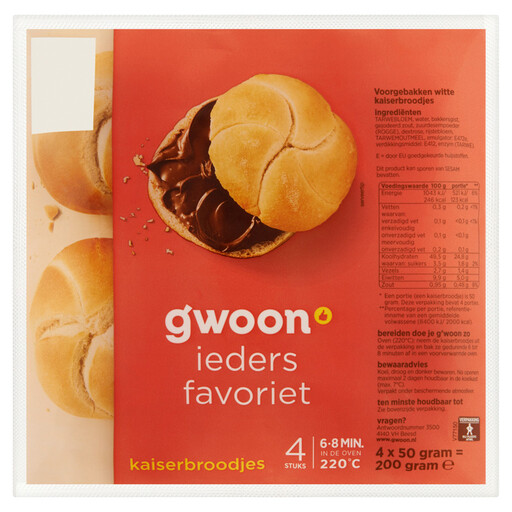 Image unavailable
A pack of four may suit you if you’d rather not buy a large pack for breakfast.
Before buying, check whether the rolls need to be baked and read the latest storage and allergen information.
The Netherlands Nutrition Centre recommends around 2 to 3 slices of bread a day, usually split between breakfast and lunch. Adjust the amount you offer to what your child feels like eating at the time.
A white kaiser roll can be part of breakfast, but if you’d like to serve wholemeal bread more often, check the type of bread rather than judging by its shape. For young children, the Netherlands Nutrition Centre recommends wholemeal and brown bread because of their fibre content.
If your child has an allergy or follows a specific diet, read the allergen information on the exact pack and ask the childcare provider or school about its food-packing policy. According to the Netherlands Food and Consumer Product Safety Authority, allergen information for prepacked products must appear on the label.
No, gluten-free doesn’t mean free from all allergens. The Schär Kaiserbrötchen listed by Albert Heijn and PLUS contains soya and may contain mustard, so read the full information on the pack you buy.
That depends on the product and the instructions on the packaging. Albert Heijn says its pack of ten rolls included in this comparison can be frozen at home on the day of purchase; for its frozen variety included in this comparison, Jumbo advises not to refreeze it after defrosting.