
Organisers catering for fussy eaters
You want to give guests a choice of white or wholemeal, without automatically labelling a darker roll as wholemeal. Separate baskets and clear labels help you keep the two types apart when serving them.


A mix of white and wholemeal Kaiser rolls gives guests at a street festival a familiar choice when preferences differ. Buy the two types separately, check the product description and nutritional information on each pack, and display them separately. Follow the baking and storage instructions for the products you choose. If you’re serving perishable fillings, you’ll also need to handle and serve them safely.
You want to give guests a choice of white or wholemeal, without automatically labelling a darker roll as wholemeal. Separate baskets and clear labels help you keep the two types apart when serving them.
You’re looking for a familiar wholemeal option and want to compare the fibre content per 100 g of the products you’re actually buying. The product description, ingredients list and nutritional information are more important than the colour of the roll.
You want to plan serving around the oven and storage space available. Before buying, check the cooking and storage instructions on each pack, especially if you’re combining bake-at-home and frozen products.
For a mixed festival crowd, choosing between white and wholemeal is different from choosing between fresh, long-life and frozen. First decide which types of rolls you want to offer, then consider which cooking and storage methods will work on site.
| What to consider | What to check when buying | Who it matters to |
|---|---|---|
| Choosing between white and wholemeal | Check the product description for both types and make sure you can display them separately when serving. | If you want to offer guests both options, they need to be able to see which roll they’re picking. Around 42% of consumers say this choice is their top priority. |
| Wholemeal and fibre | Look for the wholemeal description on the pack and compare the fibre content per 100 g of the exact products. | If you’re deliberately buying a wholemeal option, don’t rely on the brown colour of a roll. For around 33% of consumers, this nutritional choice comes first. |
| Cooking and storage | Check the oven instructions and storage conditions. If you’re serving perishable fillings, also check that you have the facilities to serve them safely. | If you’re baking on site, you’ll want to store the stock as directed on the pack and prepare the rolls in time. This is the main concern for around 25% of consumers. |
Nutritional values vary from product to product. Albert Heijn lists 7.1 g of fibre per 100 g for its wholemeal Kaiser roll and 2.9 g per 100 g for its white bake-at-home Kaiser rolls. For the Jumbo varieties mentioned, the figures are 6.7 g per 100 g for the wholemeal frozen rolls and 2.9 g per 100 g for the white long-life bake-at-home rolls. Don’t apply these values to another variety without checking the label.
The colour or a multigrain description doesn’t confirm that a Kaiser roll is wholemeal. As a result, the information you give when serving it may not match the product guests receive.
Check the product description and ingredients list for the roll you choose. Only compare the fibre content per 100 g using the nutritional information for the exact varieties.
According to the Netherlands Nutrition Centre, using baker’s salt when baking bread isn’t compulsory. So don’t assume that all Kaiser rolls contain the same ingredient.
If you want to know whether a particular roll contains iodised salt or baker’s salt, check the ingredients on the pack before sharing this information.
When preparing and selling filled rolls at an event, you also need to work hygienically and store perishable ingredients correctly. The Netherlands Food and Consumer Product Safety Authority provides separate guidance on these points.
Choose fillings that suit the facilities you have for preparation, storage and serving. Keep the allergen information for the products you use readily available.
Lidl says its fresh bread range can vary from one branch to another. Product information, including ingredients and allergens, can also change, according to Albert Heijn.
Check the range at your chosen branch shortly before buying, and read the packaging of the products you pick up.
These examples show the types of products you can compare. Cooking instructions and nutritional information always relate to the specific variety mentioned.
Stocks separate white bake-at-home Kaiser rolls and a wholemeal Kaiser roll.
Stocks white and wholemeal Kaiser rolls in different pack formats, with different storage requirements.
Describes a freshly baked white wheat Kaiser roll for in-store purchase.
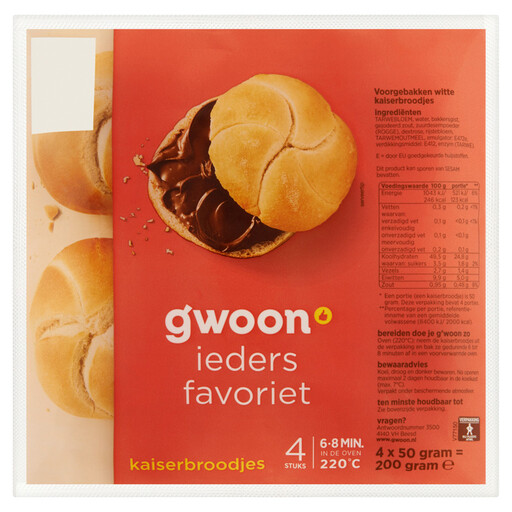
This product is a pack of Kaiser rolls to consider when choosing what to offer at your festival. Check the product description before including it as a white or wholemeal option, and look at the cooking instructions if you plan to bake the rolls on site.
 No image available
A pack of four Kaiser rolls for anyone looking to work out the quantities needed for each type.
The pack contains 200 g in total. Before buying, check that the product description and cooking instructions suit your plans for serving the rolls.
Keep the types separate and label them as white or wholemeal based on the packaging of the products you’ve bought. Keep the ingredients and allergen information for both products so you can answer questions about the rolls you’re serving.
No. According to the Netherlands Nutrition Centre, using baker’s salt when baking bread isn’t compulsory. Check the ingredients list for the specific Kaiser roll if you want to know which salt it contains.
Prepare, store and sell filled rolls hygienically, and take the ingredients in the fillings into account. For perishable foods, the Netherlands Food and Consumer Product Safety Authority recommends a storage temperature of no more than 7 °C; hot-held foods should be kept above 60 °C. Make sure allergen information for unpackaged products is also available.
Not if the packaging says not to refreeze them after defrosting. This warning appears on the Jumbo white and wholemeal frozen Kaiser rolls mentioned here. For another product, follow the instructions on its own packaging.