
A small group wanting to buy just enough
If you only need a few rolls for the parade, you could buy them individually or choose a small pack rather than buying a large pack you may not finish.


For a small group at the Sinterklaas parade, it’s best to buy the number of Kaiser rolls you expect to eat. Buying them individually avoids having a pack left over, while a small frozen pack lets you bake a few rolls at a time. Then choose between white and wholemeal, and if you have specific dietary requirements, check the ingredients, allergens and storage instructions for your chosen variety.
If you only need a few rolls for the parade, you could buy them individually or choose a small pack rather than buying a large pack you may not finish.
Part-baked or frozen rolls make it easier to plan ahead. Just check that you have enough storage and oven space, and follow the product’s cooking instructions.
If you’re looking for wholemeal or need to choose gluten-free, check the full product name and current label rather than relying on the shape of the roll alone. Check for other allergens too.
First, work out how many rolls you’ll need and whether you’ll buy them on the day or store them in advance. Then compare the type of roll, preparation method and labels of the varieties that suit your plans.
| What to consider | What to check when buying | Who is this important for? |
|---|---|---|
| Portion size | Compare the number of rolls in each pack and check whether you can store any unused rolls according to the packaging. | For a small group, I don’t want to buy more rolls than we’ll eat. Getting the quantity just right is the top priority for around 36% of consumers. |
| Wholemeal or white | If you want wholemeal, look for the word ‘wholemeal’ and compare the fibre content per 100 g. | If I want to serve wholemeal rolls, I don’t choose based on colour or shape alone. Around 29% of consumers prioritise this choice of grain and fibre. |
| Planning and preparation | Check whether the rolls are fresh, part-baked or frozen, and follow the preparation and storage instructions. | I want to shop in advance and serve the rolls when I’m ready; for around 21% of consumers, this planning is their main concern. |
| Ingredients and allergens | Check the current label for ingredients and allergens, and, if relevant to your choice, baker’s salt or iodised salt. | If I need to take a specific dietary requirement into account, I check the exact variety. Checking the label is the top priority for around 14% of consumers. |
A pack of ten won’t necessarily suit a small group. Nor can you assume that every part-baked roll can be frozen at home: Albert Heijn says its Kaiser rolls are not suitable for this.
Count how many rolls you expect to serve. If needed, buy them individually or choose a small frozen pack, and follow the packaging instructions for any leftovers.
The colour and the word ‘multigrain’ don’t mean the same as ‘wholemeal’. According to the Netherlands Nutrition Centre, bread labelled ‘wholemeal’ is made with wholemeal flour.
Look for the word ‘wholemeal’ on your chosen variety and, if you like, compare the stated fibre content per 100 g.
According to the Netherlands Nutrition Centre, bread does not have to be made with baker’s salt. So the ingredients in one variety don’t tell you for certain what’s in another.
Check the label on the rolls you’re buying to see whether baker’s salt or iodised salt is listed.
Gluten-free doesn’t mean free from all allergens. The product information for Schär Kaiser brötchen lists soya and warns that it may contain mustard.
Before buying, read the full allergen information on the current packaging for that exact variety.
Jumbo provides product information for white Kaiser rolls in packs of ten, and white and wholemeal frozen rolls in packs of four.
Albert Heijn lists an individual wholemeal Kaiser roll, as well as part-baked Kaiser rolls.
Schär has a Kaiser brötchen variety labelled gluten-free.
Lidl Netherlands describes its bake-off range and provides fibre information for packaged breads.
If you’re considering a pack of four Kaiser rolls, this is one option to compare with the portions you need and the instructions on the packaging.
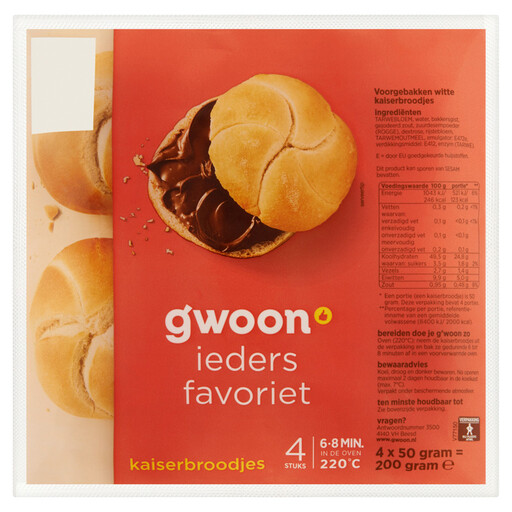 Image unavailable
This pack could suit a group that needs four rolls. Before serving, check the preparation instructions on the packaging, and if you have an allergy, read the current allergen information.
No. Choose Kaiser rolls based on how many individual rolls you need, not on the basis of half a loaf. For a small group, you can weigh up buying a roll individually or choosing a pack of four, depending on how many people you’re serving.
No. The Netherlands Nutrition Centre says that bread does not have to be made with baker’s salt. If you want to know whether baker’s salt or iodised salt has been used, read the ingredients for your chosen variety.
It depends on the product and its storage instructions. Albert Heijn says its Kaiser rolls are not suitable for freezing at home, so follow the packaging instructions for the variety you buy. According to the Netherlands Nutrition Centre, bread can dry out if stored in the freezer for a long time.
No. A gluten-free label doesn’t tell you anything about other allergens. The product information for Schär Kaiser brötchen lists soya and says it may contain mustard; always check the current allergen statement on the packaging.