For a regular school lunch, you can compare standard own-brand Kaiser rolls by pack size and number of rolls, but remember to allow time to bake part-baked bread at home. If bread is often on the lunch menu, the Netherlands Nutrition Centre recommends choosing brown or wholemeal bread more often. If you need a gluten-free option, choose a roll that is explicitly labelled gluten-free. Check for other allergens too, and avoid contact with bread containing gluten when preparing it.
Who this choice matters to
Parents planning school lunches in advance
If you pack rolls regularly, it helps to know how many come in a pack and whether the pack size suits your planned lunches. The packaging from Jumbo, Dirk and Albert Heijn shows that both the number of rolls and their weight matter.
Families looking to choose brown or wholemeal more often
White Kaiser rolls don’t have to be your go-to choice. The Netherlands Nutrition Centre recommends replacing white bread with brown or wholemeal bread as often as possible, and suggests these types of bread for school lunches too.
Carers catering for a gluten-free diet
If a child needs to eat gluten-free or the school has specific arrangements, the label is key. As well as checking that the product is labelled gluten-free, look for other allergens and avoid contact with bread containing gluten during preparation.
What should you look for?
Start with anything that’s non-negotiable for this school lunch, such as a gluten-free requirement. Then compare the type of bread, pack size and time needed to prepare it.
| What to consider |
What to check when buying |
Who it matters to |
| Pack size |
Check the number of rolls and the net weight; packs with the same number of rolls can vary in weight. |
If I’m packing lunches for several school days, I want to know how many rolls I’ll get from one pack. For around 36% of consumers, planning their regular bread needs comes first. |
| Type of bread |
Check whether an alternative is actually brown or wholemeal; the shape of a roll doesn’t tell you that. |
If lunch often includes bread, I don’t want to automatically choose white. Around 29% of consumers prioritise the type of bread above all else; the Netherlands Nutrition Centre recommends replacing white bread with brown or wholemeal bread as often as possible. |
| Preparation |
Check whether the rolls need baking at home, and follow the preparation and storage instructions on the pack. |
On a busy school morning, I want to know whether baking the rolls at home fits into my plans. For around 21% of consumers, practical preparation is the biggest consideration. |
| Gluten and allergens |
Read the current label and check the school’s arrangements. If you need a gluten-free option, check for other allergens and possible contact during preparation too. |
If gluten-free food is required, I need to be able to choose a suitably labelled product and prepare it separately. For around 14% of consumers, this is the first thing they consider when choosing. |
Common mistakes
-
Assuming a regular Kaiser roll is gluten-free
Albert Heijn and PLUS state that their regular Kaiser rolls contain cereals containing gluten. Even products labelled gluten-free may contain other relevant allergens.
If you need a gluten-free option, choose a roll that is clearly labelled gluten-free and read the full label. When preparing it, don’t use a shared chopping board or knife with traces of bread containing gluten.
-
Assuming white Kaiser rolls are the obvious choice for regular lunches
The familiar shape of a roll tells you nothing about the type of bread. The Netherlands Nutrition Centre recommends replacing white bread with brown or wholemeal bread as often as possible.
For regular school lunches, consider a brown or wholemeal alternative too, and check the type of bread on the pack.
-
Leaving it until the morning of school to check whether the rolls need baking
Part-baked bread needs to be prepared at home. A roll from an in-store bakery is a more convenient alternative, but Lidl says its range may vary by store.
Read the preparation instructions before planning your lunches, and check that your chosen store stocks the rolls.
Baking at home takes time and requires an oven or air fryer.
Brands to consider
These examples show different pack sizes and preparation methods. The details below apply to the products mentioned, not to a brand’s entire range.
Albert Heijn
AH Kaiser rolls are white wheat rolls sold in a pack of four, weighing 220 g in total.
- Albert Heijn provides ingredient, allergen and preparation information for this product.
- The regular rolls contain cereals containing gluten. Albert Heijn warns that product information may change, so check the current label.
Jumbo
Jumbo’s own-brand Kaiser rolls come in a pack of four with a net weight of 200 g.
- The pack shows how many rolls it contains and their total weight.
- Larger packs and frozen options should be assessed separately for pack size and preparation.
Dirk
Dirk’s 1 de Beste Kaiser rolls are part-baked and sold in a pack of four, weighing 200 g in total.
- The pack shows both the number of rolls and the net weight.
- Dirk says these part-baked rolls need a further 6–8 minutes to bake.
ALDI
ALDI’s De Afbakker Kaiser rolls wit are a 300 g pack for baking at home. It also sells a fresh white Kaiser roll.
- You can choose between baking rolls at home and buying one in store.
- Consider these two products separately: the weight of a pack and that of a single roll don’t tell you the same thing about how much you’re getting.
PLUS
PLUS Kaiser rolls wit come four to a bag and, according to PLUS, can be prepared in an oven or air fryer.
- PLUS provides preparation, ingredient and allergen information for this product.
- The rolls contain wheat, rye and cereals containing gluten, and may also contain milk and sesame.
Lidl
Lidl describes a white wheat Kaiser roll from its in-store bakery, available in store only.
- This is an option if you don’t want to bake a roll at home.
- Lidl says its range may vary by store.
Kaiser rolls on Joybuy
This Kaiser roll is an option for a regular school lunch where there’s no gluten-free requirement. Before packing it, check the current allergen information and make sure the preparation time fits into your morning routine.
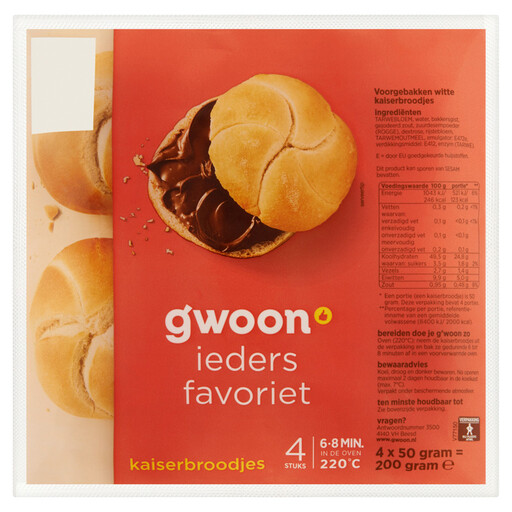 Image unavailable
g'woon Kaiser Rolls, 4 rolls, 200 g
Four Kaiser rolls in one pack could be a good fit for a school lunch planned in advance. The product information lists cereals containing gluten, milk, sesame and soya; check the current label and the school’s arrangements. Check the preparation instructions too before planning when to serve the rolls.
View on Joybuy
Frequently asked questions
Are white Kaiser rolls suitable for regular school lunches?
A white Kaiser roll can be part of a school lunch, but the Netherlands Nutrition Centre recommends replacing white bread with brown or wholemeal bread as often as possible. If you pack bread for lunch regularly, consider the type of bread as well as the shape of the roll.
How do I check whether a Kaiser roll is suitable for a gluten-free diet?
Choose a roll that is explicitly labelled gluten-free, and check for other allergens too. Regular Kaiser rolls from Albert Heijn and PLUS are listed as containing cereals containing gluten. Schär Kaiser brötchen, listed by Albert Heijn, is labelled gluten-free, but also lists soya and may contain traces of mustard. Avoid contact with bread containing gluten when preparing it, too.
Does every Kaiser roll contain iodised salt?
Don’t assume that it does. Albert Heijn and PLUS list iodised salt in the Kaiser rolls mentioned here. If this matters to you, check the ingredients for the specific product you’re considering.
When should I prepare part-baked Kaiser rolls for school?
Follow the preparation instructions on the pack you choose, and allow time for the rolls to cool before putting them in a lunchbox. Instructions vary by product and appliance: PLUS recommends four minutes in a preheated air fryer, while Albert Heijn recommends five to six minutes for the product mentioned here.


